


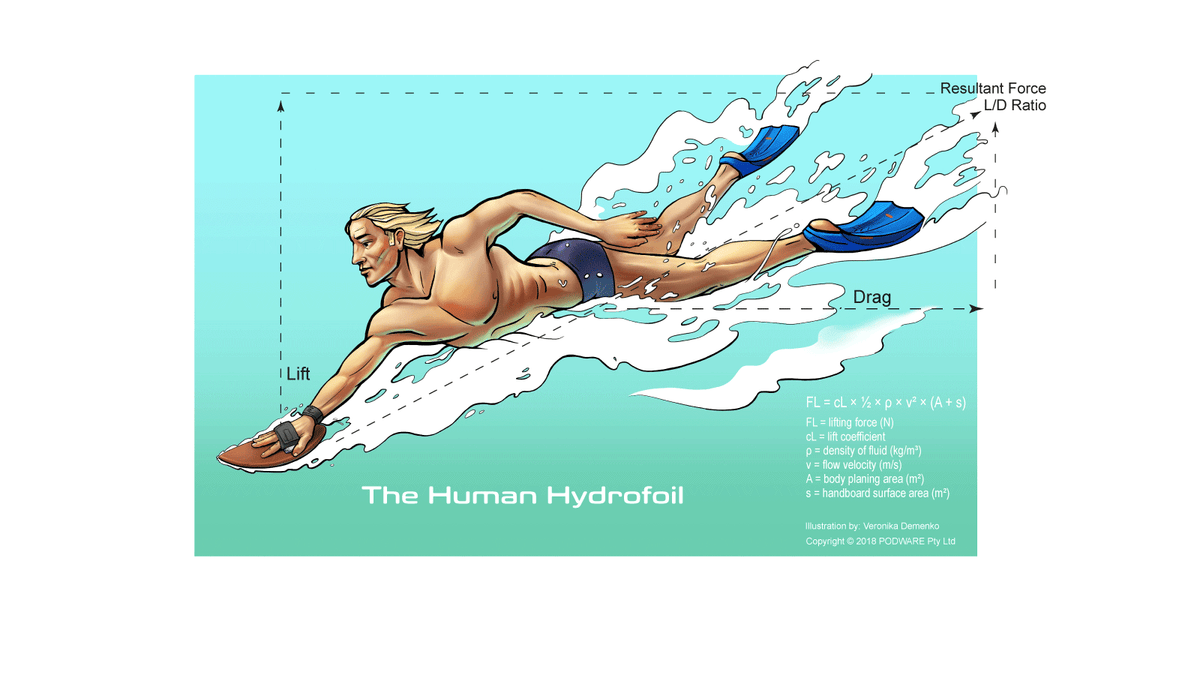
The illustration above shows the physics of the human hydrofoil, the bodysurfer, in motion. Lift force, drag, and the lift-to-drag ratio all directly affect how a handboard performs. Understanding these forces separates a well-chosen handboard from one that works against you.
Choosing the right bodysurfing handboard starts with understanding size, shape, and how they interact with your body and the waves you surf. This guide covers each factor clearly so you can make an informed decision before you buy.
Bodyboarders and Surfers Know What's Best
Bodyboarders and surfers select a board's length, width, and volume based on their height and weight. They understand how length, width, rails, thickness, and materials affect performance in real surf conditions. The same principle applies directly to bodysurfers choosing a handboard.
It's No Different for a Bodysurfer
Since the late 1980s, we've tested the relationship between a rider's body area and handboard surface area extensively in real surf conditions.
No two hands are the same length or width, so start with your own. Measure your hand from the wrist crease to your fingertips with your fingers closed, then measure across it with your fingers spread. The right handboard should be just over the size of your hand, up to about two and a half times that closed length and about one and a half times that open width.
For example, at 170cm and 70kg, and observing bodysurfing friends at 180cm and between 80 and 90kg, handboards twice the length and width of the hand consistently provide the best combination of lifting force, speed, and control.
Size also depends on the day. When the surf is big, Shane reaches for the FLO 15" or something close, even though it's harder to swim with. On medium days, a middle size like the WOO 12" is enough, and on small days he leaves the board on the sand. For most people starting out, the WOW 13" is the board we'd suggest first.
If you want a board on each hand, keep them small. Bigger boards tend to hit each other, which is why the Duo pairs two EGO 9" boards.
A friend who was both a pilot and an engineer first sketched the physics behind all of this after a body surf. That is the drawing below: The Human Hydrofoil.

The Best Shape for a Bodysurfing Handboard
With the wide range of handboard shapes now available, understanding which shapes work is essential before deciding.
The best shapes are elliptical or oval (surfboard outline shapes) and rounded rectangles (snowboard or skateboard shapes). These shapes maximise usable surface area for the fastest body lift out of the water, reducing drag and improving planing efficiency.
Handboards with cut-out tail shapes, such as crescent tails, fishtails and similar designs, lose surface area and volume through those tail cuts. Less surface area means less lift. These tail shapes also direct fluid to splay outward, spraying water up your arm and towards your face. The result is reduced forward vision, less directional control, reduced lift, and lower speed. A board with a cut-out tail would need a larger overall footprint to compensate for that lost surface area, which defeats the design's purpose.

The board above shows two things to look for. The tail cut removes planing surface from behind the hand, where the board carries your weight. The strap crosses the centre of the deck, a position our testing found reduces control. Every POD handboard keeps a full rounded tail, and the concave runs right through to it.
Surface Area and Water Contact
A larger planing surface can provide more hydrodynamic lift, but additional surface area does not automatically reduce resistance.
The amount of the board in contact with the water changes with speed, running angle, and the load applied through the hand. More wetted area can increase frictional resistance, while raising the board's running angle too far can also increase resistance.
The goal is to choose enough usable planing area to support body positioning without adding unnecessary drag or making the board difficult to swim with.
This is why handboard size must be considered alongside shape, balance and rider control.
Proven Hand and Strap Position
Hand position on a handboard directly affects performance and control. This has been researched and tested since the late 1980s through shaping and water testing across a wide range of conditions.
Testing showed that placing your hand in the middle of the board tends to reduce control. Boards with the hand placed further forward tend to nose-dive, with the front of the board digging in, or, for a better description, driving and altering the board's running angle into the water surface rather than planing across it.
The best hand position is off-centre toward the rear of the board. This is consistent with the hydrodynamics of planing hull surfaces and the centre of pressure on a planing surface. The illustrations below show this positioning clearly.
Why the Centre of Pressure Matters
A handboard is supported by pressure from water moving against its underside. The combined force acts through what is known as the centre of pressure, which changes with the board's running angle, wetted surface and speed.
Research into planing surfaces by naval architect Allan B. Murray established the relationship between centre of pressure, trim angle and resistance.
POD's testing identified the importance of positioning the hand above the keel fin, where the rider can control the board's running angle through small changes in hand pressure. Tilting the board rearward increases resistance and can slow or stall its forward movement. A slight forward adjustment reduces that resistance and allows the rider to maintain or increase speed on the wave.
Hand over the pivot point. Level, the board planes across the face. When your hand tilts it back, the nose lifts and the tail dips into the water. The board slows and stalls. The diagram under Hydrodynamics of a Planing Hull shows the same pivot point in section.
This is why hand and strap positioning matter. They give the rider direct control over the board's running angle, helping maintain lift, balance and efficient planing.
Why Strap Width Matters

Position puts your hand over the pivot, and the strap has to keep it there. A narrow strap like the one above concentrates the load from every wave on a thin strip of skin. Over a session it rubs, and the hand starts to shift.
Our strap runs on 50mm webbing inside 65mm double-padded neoprene, more than twice as wide as a common 25mm strap. The padding overhangs the webbing on each side, so no hard edge meets your skin, and the load spreads over the whole back of the hand. The board stays put without you having to grip it.
Hydrodynamics of a Planing Hull - Centre of Pressure

Reference: Allan B. Murray, The Hydrodynamics of Planing Hulls, presented to the New England Section of the Society of Naval Architects and Marine Engineers, February 1950. See Figures 7, 10 and 11.
To watch the pivot point at work, see the animation under Why the Centre of Pressure Matters.
For a deeper understanding of how these forces interact with your body position on the wave, read Bodysurfing Speed - The Missing Link Most Riders Miss.
Convex Deck and Concave Bottom
Before selecting a handboard size, the deck and bottom configuration matter as much as the dimensions.
- Convex deck: Provides palm comfort. A flat deck surface strains the hand and arm muscles throughout a session. The convex shape fills your palm and keeps it comfortable. Riders on the Original Classic asked for more support under the palm, and the raised palm support on the WOW and the cedar and walnut boards grew from that request. It goes further than the convex deck alone, holding the hand in place and stopping the cramping that used to force riders to slip their hand out between waves.
- Concave bottom: Generates optimum lift, speed, and directional control in the surf. The concave channel creates a high-velocity Venturi Effect, mixing water and air through the channel to form an aerated cushion that reduces skin-friction drag and generates dynamic lift. Little to no spray on the face is a direct result of this shape working correctly.

A flat deck like this one works against your hand's natural shape. A relaxed hand curves, with a hollow in the centre of the palm. Strap it onto a flat surface, and the strap presses it flat, a position no hand can hold comfortably, with nothing under the hollow to take the load. Your hand strains to hold its shape, and the forearm tyres long before the session ends.
A convex deck meets that hollow, so the strap holds your hand against a matching surface. On the WOW and our cedar and walnut boards, the raised palm support builds on that convex shape. Fitted to a flat deck, it wouldn't do the same job.
For the full physics explanation of how the concave and keel work together to generate lift, read The Invisible Cushion.
POD Handboards - Flow Velocity Built for Bodysurfing
The POD handboard signature shape combines a concave bottom and keel fin surface area with air-water interaction to generate instant lift, speed, and control. This isn't a marketing position; it's the result of decades of testing the same physics principles in real surf conditions.

The diagram above shows the flow in three views. This clip animates the rear view. Air and water mix in the concave on each side of the keel fin. That mixture forms an aerated cushion under the board, which reduces skin-friction drag and generates dynamic lift.
POD's testing found that the concave and keel fins work together, rather than independently. Removing the keel fins while retaining the concave noticeably reduced lift and directional control, increased resistance, and made water displacement less effective. Refining the keel and concave geometry together helped maintain the board's planing response, with their proportions adjusted to suit each board's length and width.
Buoyancy, Size and Thickness - Why They Work Together
A handboard that floats at neutral, or just above it in seawater, swims naturally when it's the right size and thin enough to cut through the surface. Judge buoyancy and size together, because one changes how the other feels.
The oversized board is the problem. The bigger and thicker it gets, the harder it pushes back against every stroke. It adds load to the hand, wrist, arm, and shoulder, and twists your body to one side with each stroke. That's not bodysurfing; it's fighting your own equipment.
Buoyancy, volume, and surface area work together:
- A smaller handboard provides less lift.
- A larger board with more volume and surface area can provide greater lift, but the effect on drag depends on its shape, running angle and wetted surface.
- If it's too large, you can't swim efficiently to the break or catch waves cleanly.
The handboard size needs to match your height and weight to balance lift and swimability. If it's too small, you won't get the lift and speed needed for real performance. If it's too large, the board becomes an obstacle rather than a tool.
Boards larger than three times the rider's hand length and width, and over 40 mm thick right across, are closer in size to a swim kickboard or training board. Some are as large as a small bodyboard. Boards manufactured with the same materials as bodyboards are over-buoyant and not suited to bodysurfing. Even for an experienced swimmer, paddling with a board that size and with that buoyancy is physically difficult and quickly discouraging.
A board that forces you to kick your legs like a training board rather than swim naturally is not a bodysurfing handboard. There are also real safety risks. An oversized, over-buoyant board can sprain a wrist, strain a shoulder or be driven back into your face, and it can hit others nearby.
Every POD board stays well under 20 mm thick across its wings, which is why the WOW can float a little higher than the timber boards and still swim easily.
Before You Buy a Bodysurfing Handboard
Take the time to research the full range of bodysurfing brands and individual shapers available before deciding. The market has expanded significantly, and not all handboards are designed around the physics that actually govern performance in the surf.
Find the size that suits your height and weight. The right board lets you swim to the break without strain and gives your hand the planing surface and lift it can't make on its own.
Your six priorities when selecting a handboard:
- Surface area: matched to your body size
- Volume: enough for lift without over-buoyancy
- Convex deck: palm comfort and hand position stability
- Concave bottom: dynamic lift, speed, and directional control
- Buoyancy and thickness: neutral or just above, on a board thin enough to swim with
- Hand strap: wide and padded, so it holds the board without rubbing
These six factors together determine whether a handboard delivers comfort, lift, speed, and control or works against you from the moment you paddle out.
For the pros and cons of riding with and without a board, read Bodysurfing With or Without a Handboard - The Pros and Cons. For technique once you have one, read How to Bodysurf with a POD Handboard.
For guidance on choosing the right swim fins to complement your handboard, read How to Choose the Right Swim Fin and Why.
The POD Range
These principles are built into every board in the range. The EGO is 9", the WOO is 12", and the FLO is 15", all cedar and walnut. The WOW is the 13" polyurethane model, 18% to 28% lighter than timber at the same volume. See the full POD Handboard range to match size and material to your height, weight, and conditions.
The palm support and strap retainers keep the same size on every board, so only the board scales.
The Right Board Disappears Under Your Hand
Get the size, shape and buoyancy right, and you stop noticing the board. You notice the wave instead. That is the whole point of choosing well.


Share:
How to Body Surf Like a Pro - Freestyle Technique From Take-Off to Exit
Which Is More Eco-Friendly: Polyurethane or Other Plastics?