


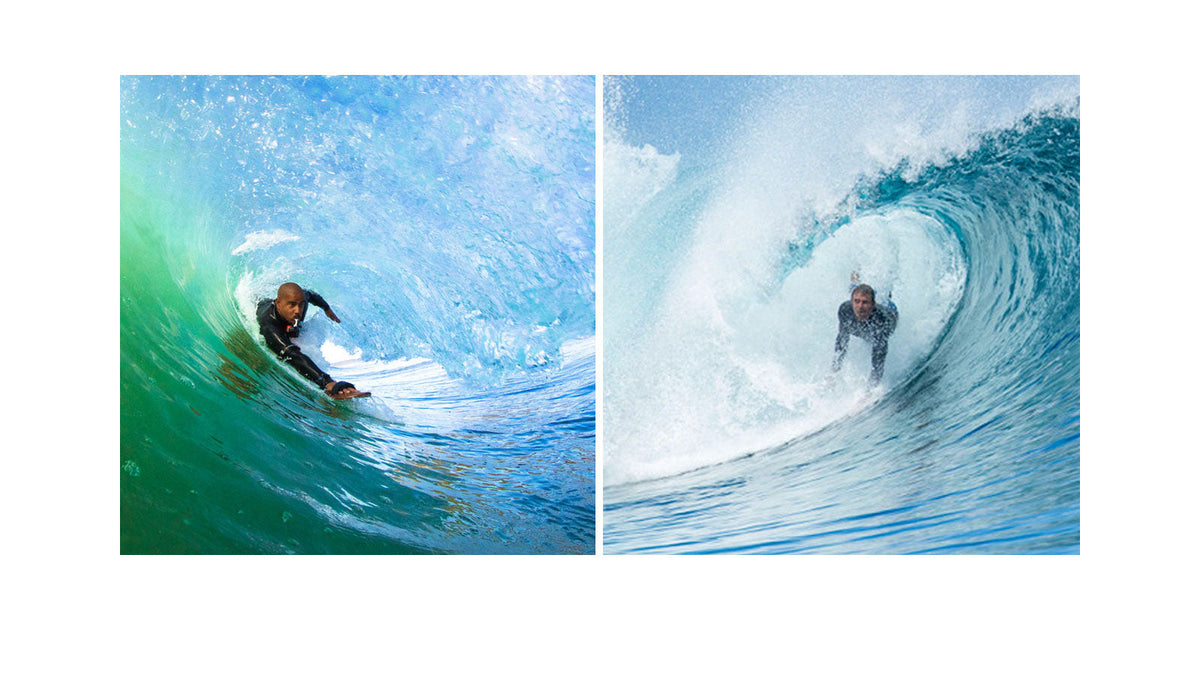
Body surfing comes in two forms, and both have grown in their own right. Freestyle bodysurfing means swim fins and nothing in your hands, while handboarding puts a small planing board on your leading hand. Both are bodysurfing, and each gives you something the other can't. Which one to take out depends far more on the waves in front of you than on how good you are.
Below, you'll find what each way of riding gives you, what it costs, and how to decide on the day.
Questions About Bodysurfing
What is bodysurfing?
Bodysurfing is riding a breaking wave with your body as the board. You swim onto the wave as it starts to break, then hold your body straight and streamlined across the face while the wave carries you. Most bodysurfers wear swim fins to match the wave's speed at take-off, and some add a handboard to put a planing surface under their leading hand. Either way, your body does the riding.
Can you body surf without a board or fins?
Yes. All you need is a wave and enough swimming strength to catch it. Without fins, your legs alone have to match the wave's speed, so you need to get into position earlier and swim harder, which keeps you on waves breaking close enough to stand. Swim fins add surface to your feet, so the same kick moves more water. A handboard does the same for your hand on the face. Neither changes the technique underneath.
Is bodysurfing dangerous?
Yes, it can be, mostly in shallow water and rips. A dumping shore break can drive you headfirst into the sand and injure your neck, so keep your leading arm out in front of your head and avoid waves breaking in very shallow water. Swim between the red and yellow flags on patrolled beaches, and check local signage, because handboards and other hard boards usually aren't allowed between the flags. If a rip takes you, stay calm and float, raise an arm to signal a lifeguard, and swim parallel to the beach towards the breaking waves once you can. Like every water sport, you enter the water at your own risk, so know your limits and the conditions before you paddle out.
Is bodysurfing hard?
It's simple to start and takes years to master. If you're a confident swimmer, you can catch a small broken wave in your first session: swim with it, kick as it lifts you, and put your head down. The hard part is reading the wave. Timing your take-off, finding the steep part of the face and holding a line across it all come from time in the water, and you need them whether you ride freestyle or with a handboard.
For a step-by-step guide to catching and riding a wave, read How to Body Surf Like a Pro. For how bodysurfing compares with swimming and bodyboarding, read Swimming vs Bodysurfing vs Bodyboarding.
Handboard, Hand Plane, Hand Board or Body Surf Board
You'll hear the same piece of gear called a handboard, a hand board, a hand plane, a body surf board or a hand surfer. In a woodworking shop, a hand plane is a tool for shaving timber, but put "body surfing" in front of it, and nobody is confused. We use handboard most of the time. Whatever name you search for, it's the same idea: a small board in your hand that planes on the face of the wave.
Freestyle Bodysurfing - Fins and Nothing Else

Shane has always said he learnt more from freestyle than from anything else. With no board in your hand, your arm, shoulder and chest are the planing surface, and they tell you straight away whether you're in the right spot on the wave. Get it wrong, and you sink or get left behind. Get it right, and you feel the wave take your weight. That feedback is what builds positioning and timing, and it carries over to every wave you ride afterwards, with a board or without.
What freestyle gives you
- A natural swim stroke: Nothing on your hand changes how you swim, so you can stroke and porpoise into a steep take-off the way you would in the pool.
- Wave reading you can't skip: Without extra planing surface, you have to be in the steepest part of the face to stay on the wave. You learn exactly where that is.
- Freedom to move your body: Your lead arm and shoulder adjust as the wave changes shape, and rolling, spinning or pulling out is easier with nothing strapped to you.
- Less to carry: Fins and a pair of togs are all you need, and you can ride between the flags without breaking the rules on hard boards.
What freestyle costs you
- Less lift: Your hand and forearm make a small planing surface, so you ride lower in the water with more drag, and the ride ends sooner on a slow or fat wave.
- More work for your body: Your shoulder and chest carry the load, and in bigger surf you'll feel it by the end of a session.
- A narrower range of waves: Freestyle shines on steep, punchy waves. On a soft, rolling face, there is often not enough push to keep your body on top of the water.
Bodysurfing With a Handboard

Strap on a handboard, and your leading hand suddenly has a real planing surface to ride on. The concave underneath traps air and water, lifting the board and your chest out of the water with it. That's where the extra speed, lift, and control come from. You still choose the wave, take off, set your line and hold it. The board puts more surface under the hand, doing that work.
What a handboard gives you
- Lift: Your upper body rides higher on the face, so less of you drags through the water, and you stay on the wave longer.
- Drive across the face: With the board planing under your hand, you can trim along a wave that would leave a freestyle bodysurfer behind, especially a slower or fatter one.
- Control: The rails and keel fin give your hand an edge to hold a high line and change direction.
- A more comfortable arm: A convex deck and palm support take the strain off your hand and wrist, so a long session doesn't end in a cramp.
What a handboard costs you
- It changes your swim stroke: With a board on your hand, it is harder to swim and porpoise into a steep wave. The bigger the board, the more you notice it.
- The wrong board fights you: An over-buoyant board is hard to cut into the surface while you swim. It loads up your hand, wrist, arm and shoulder, and it can twist your body to one side.
- Load on your shoulder: A board planing under your hand puts real force through your arm when a heavy wave grabs it. The bodysurfer in the freestyle photo above loves riding but leaves the board behind, because he doesn't want to risk his shoulder. That's a fair call, and it's his to make.
- A hard object in the water: A handboard can hit you. Shane is the first to admit it has happened to him on the swim back out. The whitewash hit the board's surface with so much force that it pulled his whole arm back and drove the board, still strapped to his hand, into his face. If a board comes off your hand while you're being tumbled, it can hit you anywhere, and it can hit the people around you. That's why beach patrols don't want handboards between the flags, and why every POD handboard comes with a wrist leash. Any surfboard can hit you too, and any surfboard fin can cut you. That's the reality of taking anything hard into the surf.
- It can cover up gaps in your technique: The extra lift can hold you on a wave you were never quite in position for. Without freestyle time, you can miss learning where the right spot is.
Nearly every one of those costs comes back to size, buoyancy and where the strap sits. A board that floats close to neutral and suits your height and weight lets you swim almost as you would without it. Strap position decides whether the board rides or dives. Our testing showed that a strap set too far forward pushes the nose down and the board nosedives, so POD sets the strap toward the tail. Your hand sits over the keel fin and the pivot point, and the nose stays up. Our guide How to Choose a Bodysurfing Handboard, covers size, shape and buoyancy in detail.
Swimming with a handboard
Don't slap the water with the flat of the board. It throws spray straight back into your face and fights you on every stroke. Turn your hand sideways so the little finger side, and the rail of the board with it, cuts into the water first. The same works without a board. Pull the stroke in towards the centre of your body, which stops the board twisting you to one side, then move it out to the side as it passes your body and finish the rotation.
With a smaller board, you can enter nose first instead, the way your fingertips would enter on a normal freestyle stroke. The pull stays the same: in toward your body, then out to the side.
Learn Freestyle First, Then Add a Board
Start with fins and nothing in your hands. Catching waves without a board teaches you timing and positioning faster than anything, because the wave gives you nowhere to hide. Once you can catch a wave cleanly and hold a line across it, add a handboard and you'll immediately feel what it adds. It's basically like treading water or swimming without fins.
Begin in small waves between the flags on a patrolled beach, where freestyle is allowed, and hard boards usually aren't.
Match the Gear to the Day
A surfer doesn't paddle out on a 10 ft day on a 6 ft board. They take something longer, because a big wave needs more board under them to stay stable. Bodyboarders do the same with board size, and bodysurfers should follow these same principles.
Shane picks his fins this way. On ordinary days, he rides the PF2, a fin that handles most conditions well. On the big days, he takes out the PF3. Handboards follow the same logic:
- Big days: A board the size of the FLO 15". It's a little harder to swim with, but in heavy surf the extra planing surface and stability are worth it.
- Medium days: A middle size board such as the WOO 12", which is easier to swim with and still gives you plenty of lift.
- Small days: Leave the board under your towel on the sand. Nothing beats a freestyle surf, sometimes without fins at all.
So the question isn't whether a handboard is better than freestyle. It's which one suits the waves at that time.
Staying Safe With or Without a Board
- Read the water first: Watch a few sets before you go in. Look for where the waves break consistently and avoid spots where they dump onto shallow sand.
- Know a rip when you see one: Rips often show as darker water or a gap where waves aren't breaking. If one takes you, stay calm and float, raise an arm for help, and once you can, swim parallel to the beach towards the breaking waves.
- Watch for hazards: Submerged rocks, reefs, undertow and marine stingers all turn up on our coast. Ask a lifeguard or local surfer if you're unsure.
- Warm up while you watch: Loosen your shoulders, arms, hamstrings and calves on the sand. You get your body ready and read the surf in the same few minutes.
-
Duck dive your handboard with both hands: Do what a surfer does with a surfboard. When whitewash comes at you on the swim out, keep your hand in the strap, put your other hand on top of the board and push it down and under the wave with you. A board left flat on the surface catches the full force of the whitewash, and that force goes straight back into your arm.

- Use a leash: A wrist leash keeps your handboard with you in a wipeout, and fin savers keep your fins on your ankles if a wave pulls them off.
Read the Day, Then Choose
Bodysurfers argue about boards the way surfers argue about longboards and shortboards, and both sides are riding the same waves. The handboard adds surface. Freestyle teaches you how to use it. Look at the waves before you choose what to take out, then swim out and Chase It®.
Share:
Keeping Your Bodyboard Protected with a Stretch Cover
POD Swim Fins - How Natural Rubber Extends Your Propulsion