


Built for the Water, Used Everywhere
If you have ever opened a soaked bag after a sudden downpour and found a laptop, camera, phone, or paperwork ruined, you already know that water-resistant and airtight are not the same thing. Are Waterproof Backpacks Really Waterproof? How to Tell shows you how to check a bag's seams, closure and zips. This guide covers where airtight construction came from and where it earns its place.
POD waterproof dry packs provide dependable protection across a wide range of environments and users, from ocean sport and outdoor adventure to daily commuting, cycling, and professional use. The construction that makes them reliable in the water is the same as the one that makes them reliable everywhere else.
- Commuters and inner city cyclists: protection from sudden rain, road spray, and daily exposure
- Motorbike riders: reliable defence against wind-driven rain and harsh road conditions
- Document couriers and mobile professionals: secure storage for paperwork, devices, and essential gear
Part 1. Why Airtight Construction Matters
Why Construction Matters in the Field
Daily commuters deal with rain, road spray, vibration, and constant exposure to the elements. Those same stresses multiply in water sports and outdoor travel. River crossings, capsizes, sand, mud, saltwater, and prolonged exposure quickly reveal the limits of conventional waterproof gear.
Stitched seams, taped joins, and standard fabrics may withstand light rain, but under real-world conditions, they are often the first to fail. Flexing, abrasion, and immersion eventually force water through needle holes and joins. Once water gets in, protection is compromised.
True submersible storage removes failure points rather than coating over them. Gear built for immersion must keep water out, maintain its structure, and protect contents every time it is used.
Industry History: Welded Seams and Why They Matter
Early waterproof backpacks relied on stitched seams sealed with tape or adhesive. While serviceable in controlled conditions, these constructions regularly failed under repeated flexing, pressure, and prolonged exposure to water.
As the marine, rescue, and expedition sectors demanded equipment that could withstand immersion and rough handling without compromise, manufacturers entirely rethought seam construction. The answer was welded PVC seam technology, bonding materials without needle holes or adhesives that break down over time.
This shift established a new standard for waterproof gear:
- Airtight, fully waterproof structures
- Built-in buoyancy when sealed correctly
- Long-term durability in harsh environments
Welded seams became the professional standard for waterproof gear and remain the foundation of modern submersible backpacks.
The Professional Standard: 1970s to 1990s
The marine, military, rescue, and commercial diving sectors were early adopters of welded construction. In these environments, seam failure was not just inconvenient; it was a liability. Equipment had to stay dry and reliable under repeated immersion, harsh handling, and heavy loads. Traditional stitching could not keep up.
By the 1980s and 1990s, heat welding and RF welding had become the professional standard for dry bags and inflatable rafts, survival and rescue equipment, and expedition storage systems. By fusing materials into a single continuous structure, welded seams eliminated needle holes and weak joins. The result was greater durability, airtight integrity, and dependable waterproofing where it mattered most.
From Specialist Sectors to Everyday Use
As manufacturing became more precise and scalable, welded-seam construction moved from specialist sectors into serious consumer watersports and outdoor gear. What was once reserved for marine, military, and expedition use is now available to people who expect the same level of reliability in daily life and recreation.
Why Welded Seams Still Matter Today
Even now, the difference between a standard waterproof backpack and a truly airtight pack comes down to construction. Welded seams do not rely on tape, glue, or stitched joins that weaken over time. Instead, they deliver long-term waterproofing in demanding conditions, structural strength under heavy loads and repeated use, and buoyancy that adds a margin of safety in water environments.
Where the Industry Stands Today
Welded-seam construction remains the standard for waterproof and airtight backpacks. Materials, coatings, and finishes continue to evolve, but the core principle remains the same: a backpack is only as reliable as its seams. No fabric innovation compensates for weak construction at the joins.
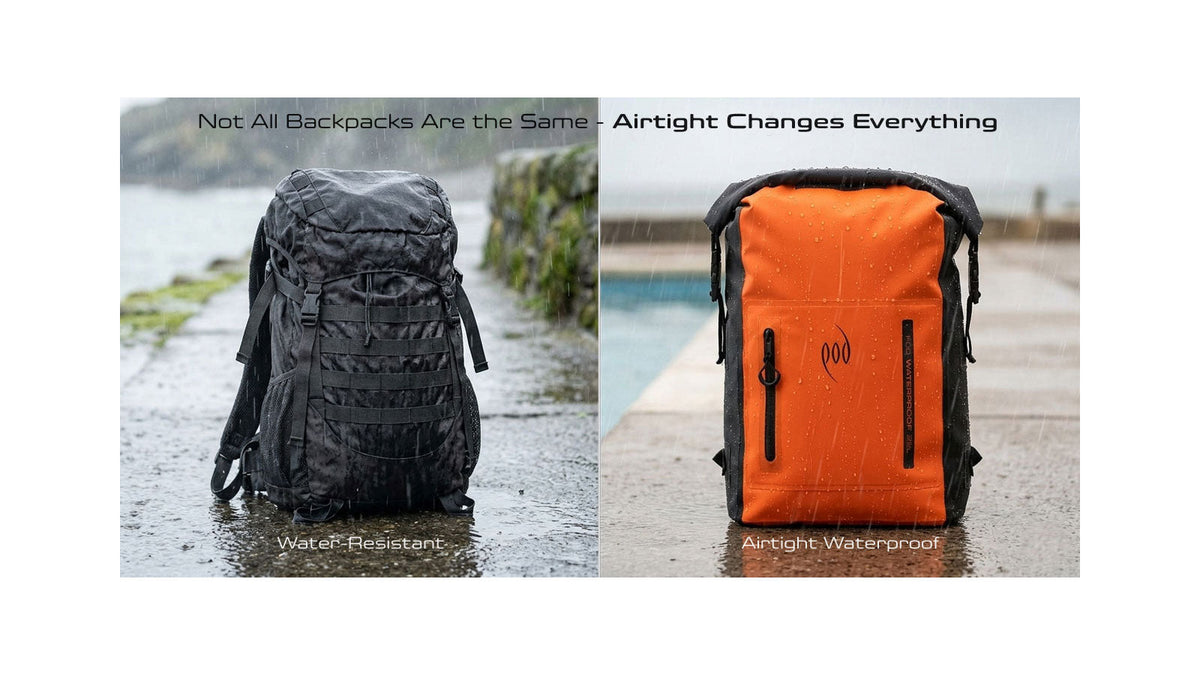
Today, the market has split into two clear paths: lightweight stitched bags marketed as water-resistant or showerproof, suited to mild conditions and occasional use, and fully welded, airtight backpacks built for repeated exposure to water, pressure, vibration, and long-term wear.
Modern welded backpacks now benefit from improved PVC and TPU formulations for flexibility and durability, precision heat and RF welding for consistent seam integrity, ergonomic load distribution for extended use, and IP-rated hardware that works with the overall waterproof system.
POD waterproof airtight backpacks are built on this foundation. Welded PVC tarpaulin construction, electronically heat-welded seams, and IP-rated zipper pockets work as a sealed system, keeping water out and contents dry across every environment covered in this article.
Part 2. Where This Matters in Real Life
Versatility Across Every Environment
POD backpacks suit any environment where weather, spray, grit, or mud threaten gear. Built with the same welded construction used in marine and rescue equipment, they handle daily downpours in the city and withstand rougher conditions on the road, in water sports, and outdoors.
Urban and Road: Daily Protection for Fast Movement
City use is not about deepwater immersion, but it still punishes weak gear. Sudden showers, road spray, oily grit, vibration, and constant exposure quickly reveal the limits of ordinary backpacks.
- Commuters and couriers: laptops, documents, electronics, and clothing stay dry through heavy rain and road spray
- Motorbike riders: airtight construction resists wind driven moisture more reliably than standard water resistant zippers and fabrics
- Urban travellers: ferry decks, wet luggage racks, tropical storms, dust, and sand become less of a risk when the bag is a sealed system
Water and Marine: Built for Spray, Splash, and Submersion Risk
Once you move from the road to the water, the demands change immediately. The issue is no longer rain. It is constant exposure, immersion risk, salt, sand, and impact.
- Jet skiing: stable, compact carry and dependable buoyancy if dropped overboard
- Kayaking and SUP: protection from spray, splashes, and capsize risk with easy post-session cleanup
- Canoeing: dry storage for first-aid kits, food, clothing, and emergency gear in unpredictable conditions
- Beach and watersports: secure storage for valuables, clothing, towels, and wet session gear on shifting shorelines
- Diving and snorkelling: keeps topside essentials organised and dry on wet decks and crowded boats
- Sailing and fishing: saltwater-resistant exterior, dependable flotation, and waterproof storage for gear and valuables
Expedition and Wilderness: Beyond the Water's Edge
Adventure does not stop when the boat reaches shore. Mud, grit, abrasion, melting snow, and unpredictable weather create their own demands. A waterproof airtight backpack continues to matter well beyond the marine environment.
- Hiking and trekking: protection from rain, snow, humidity, and rough terrain
- Camping and basecamp use: keeps spare clothes, electronics, and food dry and contained
- Caving and technical exploration: smooth PVC surfaces resist mud and moisture while withstanding abrasion
- Wildlife and outdoor photography: optics and electronics stay protected from sudden weather changes and ground moisture
- Cold and alpine conditions: snow becomes water quickly, and a sealed bag keeps spare layers and valuables dry when it matters most
For valuables that need to stay within reach, such as your phone, keys, wallet and cards, the POD 2L Waterproof Cross Body Bag pairs with the 25L or 40L as a compact companion for the same session.
Part 3. How to Choose the Right Capacity and Features
Choosing the Right Capacity and Structure
Selecting a waterproof airtight backpack comes down to how much you carry, how you move with it, and how demanding the conditions are.
1. Capacity: Choosing the Right Volume for Your Use
Volume should follow what you carry and how much you move with it. A compact pack suits commuting, cycling, jet skiing and short sessions, where balance and low bulk matter most. A larger pack suits travel, longer days and full ocean load-outs. Once you move into true multiday trekking with tents, sleeping systems and bulk supplies, 50L to 70L packs become a different category built around maximum volume.
For what fits in each POD bag, see the 2L, 25L and 40L comparison in Are Waterproof Backpacks Really Waterproof? How to Tell.
2. Features vs Simplicity
Every extra zipper, pocket, flap, or attachment adds complexity. In waterproof gear, complexity often means more weight and more potential failure points.
- POD approach: clean, functional construction with a large sealed main compartment and practical quick access storage where it makes sense
- The tradeoff: fewer openings and fewer seams mean more reliable waterproofing, greater structural integrity, and easier long-term use
3. Comfort and Carry
A backpack is only as useful as it is comfortable to carry. Capacity matters little if the pack becomes unstable, awkward, or fatiguing under load.
- Ergonomics: padded shoulder straps, chest support, and a stable back profile all matter more as loads increase
- Load balance: compact 25L packs suit high-movement environments, while 40L packs carry larger loads and need to stay close to the body under that weight
- Attachment points: external D-rings carry overflow items while keeping the sealed interior protected
4. Material Choice and Durability
The reliability of a waterproof backpack starts with its material. Not all fabrics perform equally, and the difference matters when gear must stay dry under pressure.
- Heavy-duty PVC tarpaulin: resists tears, punctures, abrasion, and repeated harsh use
- Welded seam integrity: removes needle holes and weak points that fail first in stitched bags
- Longevity over trend: durable materials outlast lightweight, short life alternatives when conditions get serious
- Easy maintenance: smooth surfaces resist mud, salt, and sand and wipe clean quickly
5. Seal and Zipper Systems
A backpack is only as waterproof as its weakest point, and that is usually the opening. Closures and access points must work with the overall construction.
- Roll-top sealing systems: create a dependable barrier that performs well beyond stitched flap closures
- IP-rated zippers: useful for quick-access pockets where spray protection and convenience must work together
- Reinforced stress points: repeated opening and closing should not undermine long-term structural integrity
- Systems thinking: seams, materials, closures, and hardware must work as one waterproof structure
Match the Pack to Where You Take It
Choosing the right waterproof backpack comes down to what you carry and where you take it. For compact, stable, and highly mobile use, commuting, day sessions, or fast-moving environments, the 25L is the right fit. For load-outs that include wetsuits, fins, towels, clothing, and larger gear, the 40L provides capacity without stepping into oversized expedition territory.
Both share the same welded PVC tarpaulin construction, electronically heat-welded seams, and IP-rated zipper pocket system. The difference is capacity and carry volume, not construction quality.
Compare the POD Waterproof Backpack 25L and 40L to find the right capacity for your needs.

Share:
How Body Position Controls Speed and Direction in Bodyboarding