

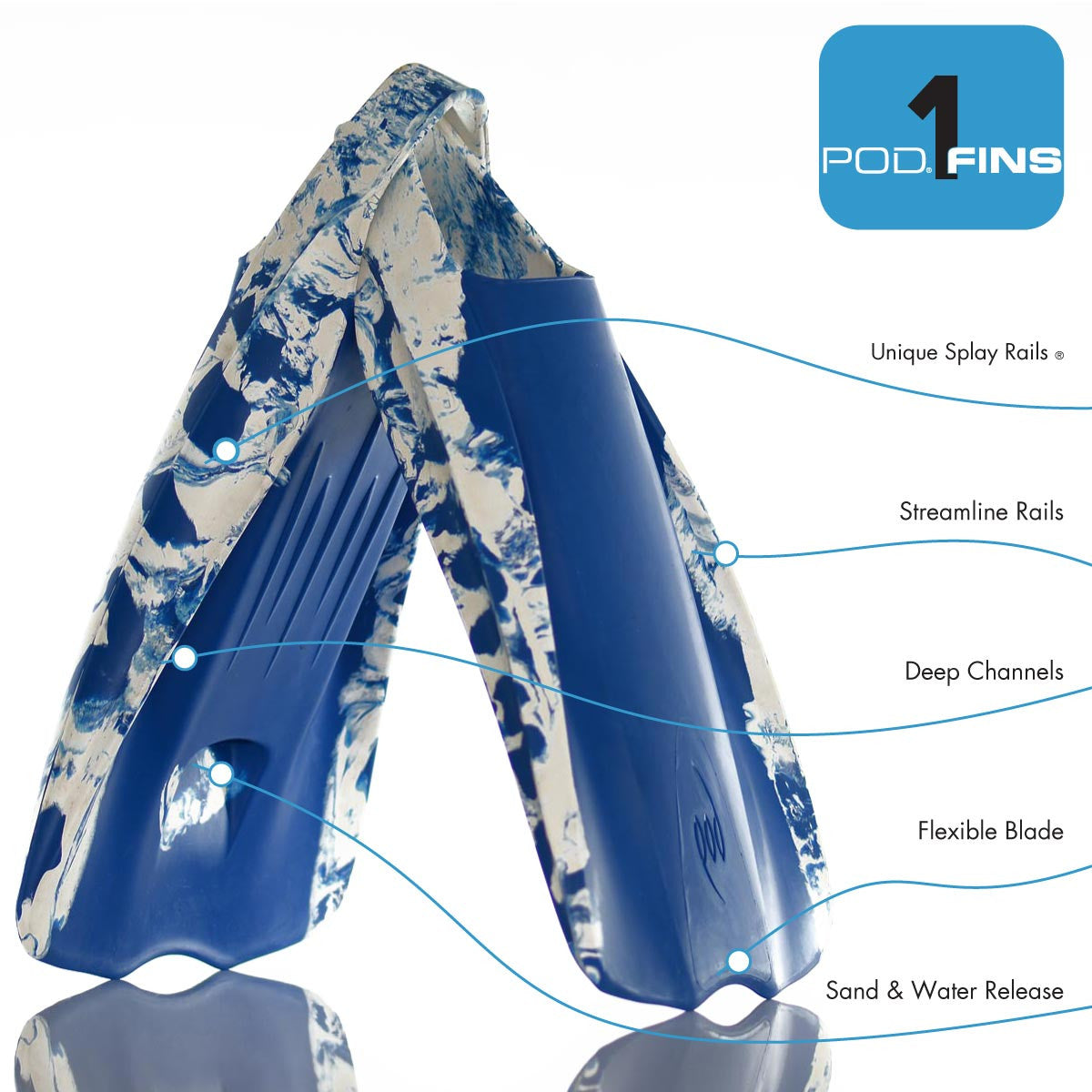


Freestyle body surfing means riding without a board, in swim fins with your hands free. It's the oldest way to ride a wave and the one Shane says taught him the most, because there's nothing between you and the wave to cover a mistake. Get the take-off, trim, and timing right without a board, and everything you ride afterwards gets easier.
This guide covers reading the break, sharing the lineup, catching the wave, holding a line across it, and getting out of it safely. When you're ready to add a board, How to Bodysurf with a POD Handboard picks up from here. If you're still deciding between the two, read Bodysurfing With or Without a Handboard - The Pros and Cons.
Before You Paddle Out
All you need for freestyle is a pair of swim fins. They put a larger surface on each foot, so every kick moves more water, and you can match the speed of waves that would otherwise roll straight under you.
Spend five minutes on the sand first. Loosen your shoulders, hips and ankles, which take most of the load when you're kicking in fins, and watch the water while you do it. Pick the sandbank you want, count how often the sets arrive and find any rips before you go in.
Reading the Break

Look for a wave that peels left or right along a sandbank. That gives you a wall to ride across. A wave that closes out along its whole length gives you nowhere to go but straight down.
The bottom shape tells you how hard the wave will hit. A gently sloping bank lets you swim out without fighting a heavy shore break. A steep bank throws faster, more powerful waves that need stronger swimming and more experience.
- Starting out: Stay in waves of one to three feet, inside the flagged area of a patrolled beach. Freestyle is allowed there, where hard boards like handboards are usually banned.
- Building up: Move to waves that pitch with more energy, on a sandbank that breaks consistently left or right rather than closing out.
- Experienced: Beach breaks and reefs open up as your swimming and wave reading improve. The principles don't change with wave size; only the consequences do.
Sharing the Lineup
Body surfers follow the same rules as every other wave rider. The rider closest to the peak, or the one already up and riding, has the wave. If a surfer takes off first and you go on the same wave in front of them, you've dropped in. It doesn't matter that you're on your belly and they're on a board.
- Don't drop in: Look along the wave before you go. If someone is already on it, let it pass.
- Don't snake: Swimming around someone to get inside them at the peak is the same as dropping in, just slower.
- Swim out through the channel: Go around the breaking waves rather than through the line a rider is using.
- If you get it wrong: Pull out straight away and apologise. Nearly everyone accepts an honest mistake.
Catching the Wave
Start swimming towards the beach just before the wave reaches you, so you're already moving when it lifts you. Take two or three hard strokes, help kick through the lift, then put your head down and arch your back as the wave picks you up. In chest-deep water, you can push off the bottom as the wave arrives.
Shane waits, facing the wave, and decides left or right at the last moment, once he can see how it's peaking. The later and cleaner that decision, the less time you spend going the wrong way.
Where take-offs go wrong
- Too late, with no speed: Sitting in the impact zone without swimming leaves the wave to break on top of you. Experienced riders take off right where the wave forms most, but they get there with their timing already set.
- Half committing: A take-off you aren't sure about usually ends in the whitewash. Once you go, go.
- Losing sight of the wave: Keep checking it over your shoulder as you swim, so you know when it's about to lift you.
If the wave keeps passing under you, you're starting too late. If it keeps breaking on you, sit a little further out.
The dolphin take-off
It's one of the hardest entries in bodysurfing and one of the best when you time it. As the wave is about to break, dive to the sandbank, drive off the bottom with both fins and go up through the wall of the wave as it pitches. Timed right, you come out of the face already on the open wall, carrying the speed from the push off the bottom. Only try it where you know the depth, never in shallow water.
Body Surfing Position - Trimming Across the Face

Once the wave has you, ride across the wall, not straight at the beach. Moving along the face is where bodysurfing shifts from a push toward shore to real wave riding.
- Lead with your preferred hand: Most riders lead with the same hand on every wave. Shane is right-handed and leads with his right hand whether the wave breaks left or right. Others switch to the hand that matches the wave. Both work, so use the one that feels natural.
- Hold a straight line: Keep your body firm from shoulder to fins, chest pressing lightly into the water and head up enough to see where you're going. The straighter the line, the less drag, and the longer you hold the speed the wave gives you.
- One-arm or two-arm push-up: You can lift your chest out of the water with your leading arm alone or with both hands pressing down. Both are real techniques; use whichever gets you up fastest in that moment. The quicker your body clears the water, the less drag holds you back, and the more speed you keep.
- Balance with your trailing arm: Your back arm is ballast. It balances your leading hand and helps your body hold its line, a little like a steering wheel. Where it sits depends on the wave. It can sit down beside you, back behind you, or pointing up the face on a steep wall to keep you from sliding down. Feel what the wave is doing and move the arm to match.
- Turn toward the open face: Angle your body slightly toward the unbroken wall so the wave carries you along it rather than over the falls.
As your wave reading improves, the progression runs to hollow waves and the barrel, where you ride inside the breaking section as the lip pitches over you. For the mechanics behind trim and speed, read Why Body Position Changes Speed in Bodysurfing and How Movement Creates Speed in the Water.
Is Body Surfing Dangerous? Wipeouts and Shore Break
Body surfing is as safe as the waves you choose. Most serious injuries happen to the head and neck, and most of them in shallow water. A few habits protect you on every wave.
- Keep an arm out in front: Your leading arm is your guard. If the wave drives you down, your arm hits the sand before your head does.
- Land flat: When a wipeout is coming, spread out flat with your hands in front. Don't tuck into a dive.
- Fall back off the wave: At the end of a ride, roll back over the top rather than diving forward off the front.
- Never turn your back on the waves: Walk in and out facing the surf, so a wave can't knock you over from behind.
- Stay out of shore break: A wave that breaks straight onto the sand throws you forward onto a bottom that feels like concrete. Older riders called it body bashing, and some now call it getting womped. Ride the waves breaking further out over the bank instead.
Getting Out of the Wave
A clean exit saves your energy and keeps you out of the impact zone for the next wave.
- Pull back through the wall: Aim your leading hand at the face and punch back through it into the deep water behind.
- Go over the top: At the end of a ride, use the last of your speed to lift up and over the lip as the wave closes. Experienced riders turn it into a full 360 on their stomach as the wave fades, the same finish a bodyboarder uses.
Freestyle Is Where Every Ride Begins
A board can add surface to your hand, but it can't teach you where to sit, when to go or how to hold a line. Freestyle does, a little more with every wave you take. Find a bank, watch a few sets, then swim out and Chase It®.



Share:
Swim Fin Fit and Comfort - Keeping Your Fins On and Lasting
Bodysurfing Handboard Guide - Size, Shape, and How to Choose