

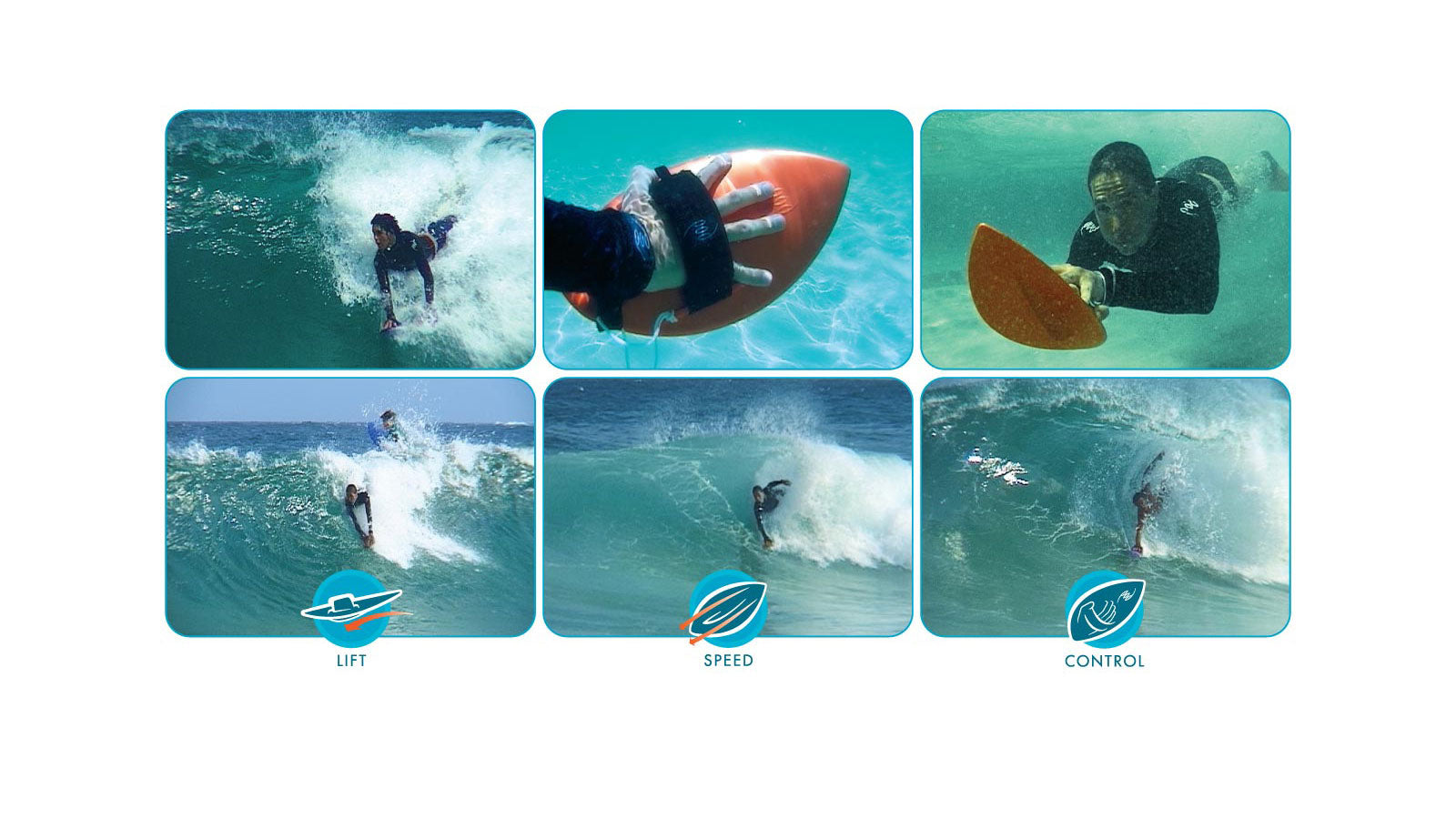
A POD handboard is a precision bodysurfing tool built from UV-stabilised polypropylene - a material chosen for its buoyancy, impact resistance, and ability to hold its shape and performance across years of regular ocean use. The concave bottom channels water across the hull surface as the board accelerates across the wave face, generating upward lift that raises the rider's body out of the water. The keel fin holds directional line, preventing the board from sliding sideways under lateral wave force.
This is not a decorative feature. It is a hydrodynamic consequence of the shape. The lift generated by the board reduces drag by raising the rider higher in the water. The keel fin converts that lift into directional hold. Those two functions, working together, are what allow a bodysurfer to hold a line across the face of a wave without constant muscular correction.
What a Handboard Actually Does
The hand generates lift naturally when angled correctly in moving water. A handboard extends the surface area of the hand and locks the angle of attack. The result is increased lift from the same arm movement. The board does not replace technique. It amplifies what the hand is already doing and removes the variables that come from maintaining hand angle manually.
The width of the board determines how much lateral surface is in contact with the water. The concave depth determines the pressure gradient across the hull. The keel fin depth determines directional authority. These are the three variables that determine how a handboard performs across different wave types and conditions.
For a detailed breakdown of the physics, read The Invisible Cushion: Why Handboards Fail vs Physics-First.
How to Use a POD Handboard
Strap the board securely to your dominant hand. The strap should sit across the back of the hand with the board centred over the palm. The board extends forward from the fingertips when the hand is flat.
Enter the water and bodysurf normally. When a wave approaches, position your body at an angle to the wave face with your handboard hand extended forward. As the wave lifts you, angle the board downward slightly to generate lift. Your body should rise in the water as the board begins to plane across the wave face.
The keel fin will hold your line once you are planing. Adjust your body angle to control speed and direction. Lean into the wave face to accelerate. Flatten your body position to slow down.
Adjusting Hand Position
The natural swimming hand position for bodysurfing places the hand slightly forward of the shoulder with the palm facing down. The handboard should rest in this position with the hull parallel to the water surface when the hand is relaxed.
Do not force the board flat against the water at entry. Allow it to find its angle as the wave picks you up. Forcing the angle causes the board to dive rather than plane.
Which Hand to Use
The handboard straps are ambidextrous. Use your dominant hand for your first sessions. Once you are comfortable with the feel of the board planing across the wave, experiment with your non-dominant hand. Different hand positions change how your body angles across the wave face and affect your natural trim line.
Choosing the Right Handboard
The right handboard depends on the conditions you ride most often, your body size, and your bodysurfing experience. Read How to Choose a Bodysurfing Handboard for a full breakdown of the sizing and material options across the POD range.
The full handboard range is available at POD Bodysurfing Handboards.
After Your Session
Rinse the board with fresh water after each session. Check the strap and hardware for salt buildup or wear. Timber boards should be stored in a cool, dry place away from direct sun. Do not leave any handboard in a hot car.
For ongoing care and maintenance specific to each model, refer to the product page for your board.
Share:
How to Choose Water Sports Rubber Swim Fins