

Beyond Buoyancy: Why "Floating" is the Enemy of Performance
Lift comes from shape, not float.
This is for the bodysurfer who is tired of "sliding sideways."
The Geometry of Performance: 30 Years of Convex, Concave, and Keel
1. The Lifting Engine (The Concave)
The Formula: FL = cL x (1/2)rho x v² x (A + s)
- FL = Total Lifting Force
- cL = Lifting Coefficient (Optimised by the POD Concave)
- rho = Water/Air Density
- v² = Velocity Squared
- A = Body Surface Area
- s = Handboard Surface Area

2. The Stabiliser (The Keel Fin)
3. The Ergonomic Convex (The Top Surface)
Ergonomic Design: World-First Convex Palm Support and Hold
The "Let Them" Theory of Bodysurfing:
The Data: Efficiency through (l)
- Resultant Pressure Calculation: By calculating the p/l ratio, the POD® design ensures the Pivot Pressure Point is precisely aligned with your hand.
- Wetted Length/Beam Ratio: Defined as Ratio (L/b) = l / b. A higher ratio indicates a more efficient planing surface, allowing the board to stay on top of the water even at lower velocities.
- Dynamic Lift Efficiency: As speed increases, the Mean Wetted Length (l) effectively changes, altering the Trim Angle (tau). The POD® signature shape maintains a stable lift-to-drag ratio across these shifting variables.
Chapter 1: The Physics of the "Human Hydrofoil"
The "Air-Water Mixture" Analogy
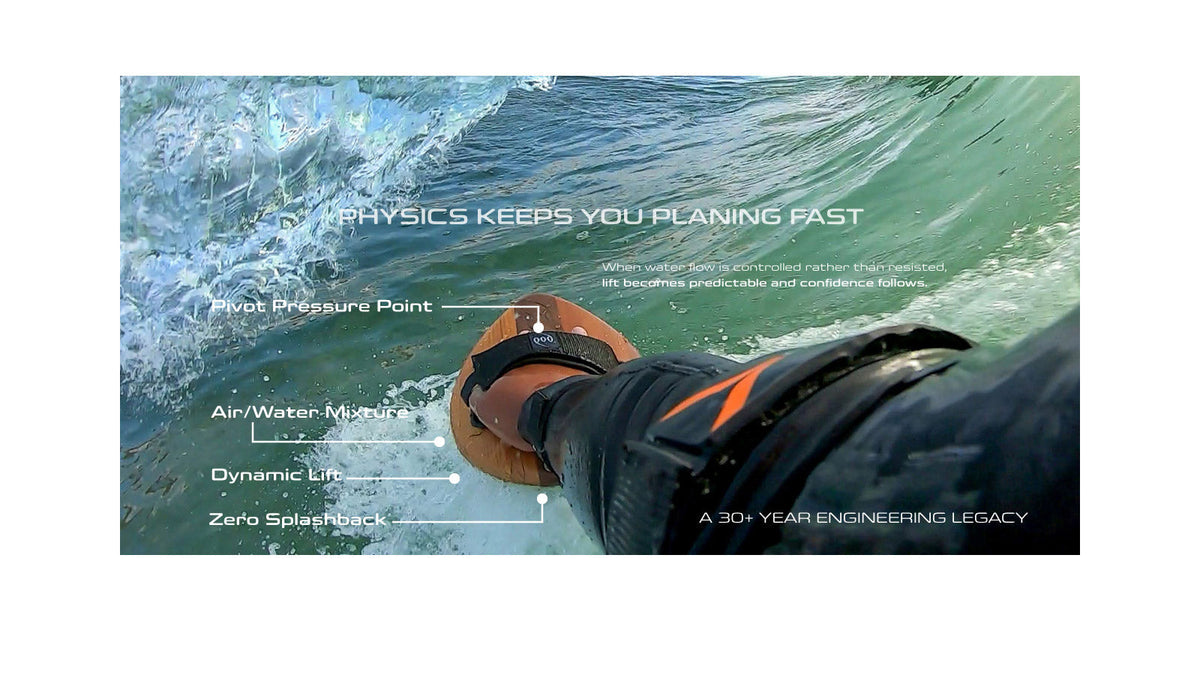
- Aerated Lubrication: Circular vortexes under the board suggest air is trapped and mixed with water. This mixture is less dense than solid water, effectively "greasing" the surface to reduce skin-friction drag.
- The Vortex Lift: As water enters the deep 16mm–20mm concave and is split by the keel fin, it creates high-velocity spiral flows. According to Bernoulli's principle, the increased velocity decreases pressure on the bottom surface relative to the top, generating a powerful "Lifting Force" (FL) that pushes the board upward.
- Pivot Pressure Point: By positioning the hand directly over the keel fin and the resultant pressure point (p), riders manipulate this lift with micro-movements, ensuring the board "flies" on a cushion of turbulent, high-energy air and water rather than just planing.
Chapter 2: The "POD Lift" Formula - A Three-Pillar Thesis
To translate 30 years of engineering for the athlete, we define the relationship between shape, material, and performance through three critical pillars:
Shape and Configuration: The Pursuit of Directional Stability
- The Feature: Deep 16mm–20mm Concave + Integrated Keel Fin.
- The Result: This configuration provides the "bite" required to hold a high line in the barrel. It eliminates the "skipping stone" effect of flat boards, ensuring you track exactly where you point your hand without sliding out.
Surface Area (Ratio L/b): The Secret to Maximum Planing
- The Feature: High Wetted Length/Beam Ratio (Ratio (L/b) = l / b).
- The Result: By optimising the relationship between the board's length and width, we maximise the Lifting Force (FL). Ensures the board stays on top of the water even at lower speeds, allowing you to catch waves earlier and glide through "flat" sections where other boards would sink.
WDR (Weight, Density, Rigidity): The Direct Feedback Loop
- The Feature: Solid Cedar/Walnut or High-Density WDR Polyurethane.
- The Result: Rigidity is the conductor of energy. Unlike soft materials that soak up the wave's power, a POD® board holds its shape under load and passes the Lifting Force to your arm, creating the "Direct Drive" feel that lets you read the wave through your palm. Where a POD® board flexes, as the WOW does, the flex is controlled and returns to shape.
Chapter 3: Dynamic Lift vs. Static Buoyancy
The Assessment Summary: Controlled Energy
- Aerated Cushion: The board generates Dynamic Lift by accelerating an air/water mixture under the hull.
- Active Lift vs. Passive Float: Unlike flat-bottomed boards that rely on displacement, the POD® hull actively pushes back against the wave.
- Stability at Speed: This is the "Point of Difference" that prevents the dramatic failures, such as nose-diving or sliding sideways, that occur when a flat board loses its grip on the water's surface tension.
Chapter 4: The Physics of WDR - Weight, Density, and Rigidity
4.1 The Role of Rigidity in Energy Transfer
- The Failure of Uncontrolled Flex: Soft foams and thin plastics bend under the pressure the concave creates and don't spring back cleanly. Some of the Lifting Force goes into bending the board and is lost as heat. Controlled flex is different. The board gives under load, smoothing the hits through your wrist and arm, then rebounds and returns most of that energy as lift. Too soft, and flex dampens lift. Too stiff, and every bump goes straight into your arm.
- The Failure of Contaminated Plastics: Beware of "hard" boards made from contaminated ocean plastics or dissimilar materials. These often lack a true chemical bond, creating internal fault lines. Under the extreme torque of a heavy wave, these boards don't just flex; they can crack or shatter because the dissimilar materials were never unified at the molecular level by heat.
- The POD® Advantage: By utilising Solid Timber (Cedar or a combination of Cedar/Walnut) or WDR Polyurethane (PU), the POD® handboard maintains absolute structural integrity under load.
- Direct Feedback: This rigidity ensures that every micro-vortex and pressure change (p) is transferred instantly to the rider's palm, called "Direct Drive", the ability to feel the texture and power of the wave through the board, allowing for split-second adjustments in the barrel.
4.2 Density and the Hydrodynamic Bounce
- Weight and Response: Weight changes how a board behaves, not whether it works. A lighter board is easier to paddle and responds faster. A heavier, denser board carries more momentum and damps vibration on a fast, choppy face. Change the volume of the same shape, and the weight changes with it, in timber or polyurethane. The right choice depends on the rider and the day's conditions.
- Neutral Buoyancy vs. Dynamic Lift: The board is engineered to sit in the water just enough to engage the rails and keel fin. It does not rely on "floating" (static buoyancy) to stay up; it relies on its velocity (v2) to generate the Dynamic Lift that brings it to the surface.
4.3 Material Comparison: Timber vs. WDR Poly
Solid Cedar/Walnut: The Artisan Drive
- The Science: A natural cellular structure with a high strength-to-weight ratio.
- The Experience: Offers unique natural vibration dampening. This "muffles" the water's chatter, making high-speed rides feel smoother and more organic. It is the choice for the purist who values the tactile feedback of natural wood.
WDR Poly: The Technical Edge
- The Science: An engineered polymer with extreme impact resistance and precision moulding capabilities.
- The Experience: This material enables exact, micro-millimetre replication of the 16mm–20mm concave. It is designed for consistent "Venturi" performance and extreme durability in heavy shore break conditions.
4.4 The Problem of "Greenwashing" Materials
- The "Spongy" Density and Splashback: Lower-grade recycled plastics often have an inconsistent, "spongy" density. Instead of the water flowing cleanly through a rigid concave, these boards vibrate and deform, causing splashback, where water energy is pushed upward into the rider's face rather than downward to create Dynamic Lift.
- The Overweight and Brittle Failure: Many "recycled" boards use dissimilar plastic resins that don't chemically bond. To compensate for poor strength, brands often make these boards excessively thick and heavy. This results in a board that is "dead weight" in the water and, more dangerously, brittle. Without a unified molecular bond, these boards develop "fault lines" and can shatter upon impact with the sand or under the torque of a heavy lip.
- True Sustainability vs. Planned Obsolescence: True sustainability, as defined by the "Protect Our Destiny" philosophy, is about building tools that last. A board that maintains its rigidity and structural integrity for 30+ years is far more environmentally responsible than a "recyclable" board that fails, cracks, and ends up in a landfill after only a few seasons.
The POD® Standard: We don't build for a marketing cycle; we build for a lifetime of "Direct Drive" performance.
Chapter 5: Ergonomics and the Kinetic Chain - The Science of the "Human Interface"
5.1 The Convex Deck: Ending "Palm Fatigue"
- Anatomical Alignment: The POD® signature Convex Deck is a world-class design, specifically engineered to mirror the natural "arch" of a relaxed human palm.
- Less Grip Effort: A flat surface forces the hand into an unnatural position. Testing in the 80s and 90s showed that flat-top boards caused significant palm discomfort and cramping, requiring riders to constantly remove their hands to "reset" the muscles during a session.
- The Glove-Fit Effect: By supporting the palm's medial arch, the convex surface allows for a secure grip with minimal muscular effort, enabling longer sessions and more precise control over the board's pitch.
5.2 The Kinetic Chain: Hand Position as the "Rudder"
- The "Nose-Dive" Error: Boards with centre-leaning or forward-leaning hand positions frequently fail by digging the nose into the water at high speeds. This immediately loses planing and often sends the rider tumbling.
- Pivot Pressure Point (p): The POD® design places the hand position directly over the Keel Fin and aligns the rider's downward force with the board's Resultant Water Pressure Point (p).
- Direct Drive Control: Because the hand synchronises with the keel, the rider can use wrist micro-tilts to bank, turn, or "lock in" to a high line, transforming the board from a passive planing surface into an active steering tool. You aren't just holding on for the ride; you are driving the board through the "Kinetic Chain" of your arm.
5.3 Surface Area and the "Lifting Force"
- Maximum Planing: A high ratio ensures the board generates enough "lift" to stay on top of the water even at lower speeds and prevents the "drag" that occurs when a board sinks too deep into the wave face.
- Lifting Force Translation: Because the POD® construction holds its shape and any flex rebounds, very little of the lifting force generated by the concave is lost; it is transferred directly through the convex deck into the rider's arm, and this is the force that propels the bodysurfer forward with minimal resistance, creating the sensation of "flight" across the water.
5.4 The POD® Mandate: Intent and Identity
- Who is the intended athlete? The serious bodysurfer who understands that comfort and performance are inseparable. It is for the person who knows that a cramped hand or a vibrating board is a barrier to the barrel.
- What is the functional purpose? To eliminate the "human failure" points: cramping, sliding, and nose-diving that occur when a board ignores human biology. We use Substance (the alignment of physics and anatomy) to ensure that when you are in the water, your equipment is the last thing on your mind. We don't use "green" labels to hide poor shapes.
Chapter 6: The "Direct Drive" Competitive Edge - Engineering vs. Marketing
6.1 Exposing the "Flat Bottom" Fallacy
- The Problem: Splashback and Lateral Instability. Flat surfaces create high "splashback" directly into the bodysurfer's face. Without a channel or keel, there is no lateral hold. This causes the board to "skate" uncontrollably across the wave face rather than carve into it.
- The POD® Logic: Controlled Energy. By utilising a deep 16mm–20mm Concave precisely calibrated to the board’s length and beam (width), water is channelled and compressed under the hull to generate maximum Dynamic Lift (FL).
- Flat Boards: Simply push water away, reducing planing speed and creating a "side-sliding" effect.
- POD® Boards: Use a high-velocity Venturi Effect to compress and accelerate the air/water mixture under the hull. This controlled energy pushes the board upward and forward, locking you into the wave's power and turning that energy into usable thrust.
6.2 The "Wheel" of Bodysurfing
- Water must be channelled (The Concave).
- Pressure must be stabilised (The Keel).
-
The Body Surfer's hand must be supported (The Convex).
6.3 The "Pivot Pressure Point" Advantage
- The Mechanics of Failure: A centre-weighted or forward-leaning hand position forces the nose into the water, increasing drag and causing the board to "plough" rather than plane. This centre-of-mass error prevents the leading edge from being lifted out of the water at high speeds.
- The POD® Solution: The hand position is synchronised specifically toward the rear of the board, directly over the Keel Fin and the Resultant Pressure Point (p).
- Direct Drive: This rear-biased configuration allows the rider to act as a Human Hydrofoil. By applying pressure behind the centre line, the rider can easily control the Angle of Trim (tau), keeping the nose elevated and the board locked into a high-speed plane.

6.4 The "Let Them" Theory: Applied to the Competitive Edge
- "Let them" have generic marketing labels, "greenwashed" buzzwords, and non-functional aesthetic shapes.
- The POD® Point of Difference is simple: we design every shape and configuration for your life and survival in the water. We don’t build for a shelf; we build for the impact zone.
- Who is it for? The ocean athlete who demands facts, logic, and functional performance. It is for the rider who values the evolution of a shape that has worked since 1988.
- What is it for? To transform the bodysurfer from a floating object into a precision-steered aquatic vehicle.
Chapter 7: The Bodysurfing Manifesto - Why Substance Outlasts the Hype
7.1 The "Stands Out" Philosophy: One Grain of Sand
- Substance Over Hype: We don't rely on generic "marketing labels" or hollow greenwashing promises. Instead, we provide Substance: a product so deeply integrated with the laws of fluid dynamics that it becomes a functional extension of your own body.
- The Power of Association: When you use a POD® handboard, you don't just see a piece of equipment; you see your own potential in the design. Because the Convex Deck mirrors your hand and the Rear-Biased Pivot Point (p) mirrors your movement, the board is perfectly applicable to the way you move, drive, and survive in heavy surf.
- The Result of Work Since 1988: While other brands disappear when the "hype" fades, POD® remains. We "Stand Out" because we solve the physical problems of the ocean chatter, drag, and nose-diving with engineering solutions that never go out of style.
7.2 Engineering as a Moral Obligation: Protect Our Destiny
- Sustainable by Durability: While others market "recyclability," POD® stands for longevity. We build boards from solid Cedar/Walnut, or high-grade WDR Poly, that last for decades, not seasons. Reducing waste by eliminating planned obsolescence is the highest form of sustainability.
- Functional Integrity: The "Destiny" we protect is the rider’s performance and safety in the ocean. By perfecting the Convex Deck, Deep Concave, and Keel Fin, we ensure the rider’s experience is defined by "Lift" and "Control" rather than "Failure" and "Fatigue".
7.3 The "Let Them" Theory of Market Leadership
- Let them make false claims that lack logic, physics, or functionality.
- Let them use inferior materials that result in "splashback" and "nose-dives."
- Let them focus on the "cart" while we focus on the "wheel."
- We will focus on the Facts: The Bernoulli Principle, the Venturi Effect, and the Kinetic Chain. We lead by providing the hardware that proves these laws in the heaviest surf on earth.
Design Clarification - Lift, Flow, and Control
Lift is inherent to the shape and configuration. It is not a separate feature, but the result of how the planing surface, deep concave, Splay Rails®, and integrated keel work together to manage pressure and flow.
Venturi governs speed, Coandă keeps the flow attached, and the integrated keel organises that flow at entry. When the water splits and is guided through the concave and rails, lift becomes stable and controlled, producing forward drive and clean tracking rather than stall or wander.
7.4 Conclusion: The Human Hydrofoil
Refine Your Approach
To get the most out of your handboard, understanding technique and choosing the right equipment is key. Explore body surfing techniques or learn how to choose the right handboard to match your style and conditions.
Signing off,

Shane Vassallo
Innovator and Lead Designer
Next in this series, read Truth About "Eco-Friendly" Bodysurfing Handboards - Handplanes.
Share:
Why Your Swim Goggles Keep Fogging Up - What Actually Stops It
Why Swim Goggles Leak (and How to Fix It)