


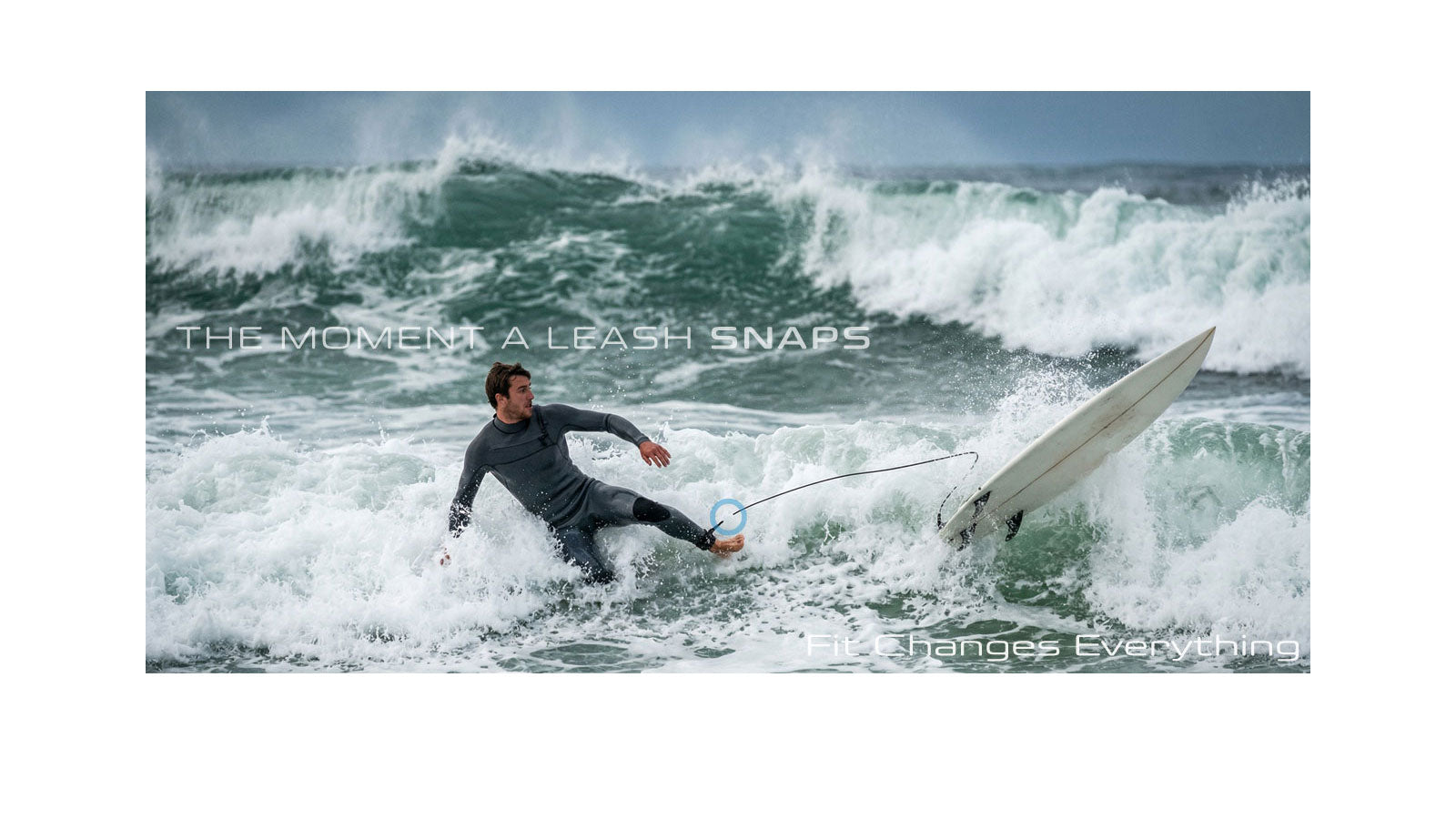
When a surfboard leash fails, it rarely happens gradually. It happens in a single moment under load, often when you need it most. One second, you are connected to your board; the next, you are watching it pulled away by the wave's energy.
In heavier conditions, this is more than an inconvenience. A snapped leash can leave you separated from your board, exposed in the impact zone, or forced into a long swim through moving water and other surfers. Even in smaller surf, the loss of control can create unnecessary risk for both you and those around you.
Most surfers accept this as part of the sport. Leashes break. It happens. But in reality, leash failure is rarely random. It follows a pattern, and more often than not, the cause was already there before the moment it snapped.
Why Strength Is Not the Real Issue
Most surfers already have an explanation when a leash snaps. It was a cheap leash. It had been used too long. The wave was too powerful. Or simply, it was bad luck.
These assumptions are easy to accept because they require no deeper understanding. Replace the leash, paddle back out, and move on. But these explanations rarely address what actually happened in that moment.
The idea that a leash fails purely because of strength is one of the most common misconceptions in surfing. In reality, most modern leashes are made from high-quality urethane designed to handle significant load and tension. Strength alone is rarely the problem.
What is often overlooked is how that load is transferred through the leash system, and how the materials behave under stress. When a leash fails, it is not usually because it was not strong enough. It is because something in the system was already compromised, or the load was not managed correctly.
Leash Failure Is Not Random
It follows a pattern and almost always occurs under load, when the forces on the leash exceed the system's capacity at that moment.
When a wave pulls against the board, the leash is suddenly placed under extreme tension. This load is not steady or predictable. It spikes, releases, and shifts direction depending on the movement of the water, the position of the surfer, and the energy of the wave itself. In these moments, the leash is no longer just a cord - it becomes a load-bearing system transferring energy between the board and the surfer.
The critical factor is not simply how strong the leash is, but how that force is distributed and absorbed throughout the entire system. If the load is concentrated at a single point, or if one part of the leash cannot move in unison with the rest, stress builds rapidly. This is where failure begins.
In many cases, the leash does not fail because of a single event. It fails because the conditions for failure were already present. Whether it is a mismatch in how materials behave under tension, a design that interrupts the natural stretch of the cord, or damage that has already weakened the surface, the final snap is often just the visible result of a problem that started earlier.
Strength Alone Is Not the Problem
Modern surfboard leashes are built from polyurethane, a material widely recognised for its high tensile strength, elasticity, and resistance to tearing. In isolation, urethane is exceptionally durable and well-suited to handling the demands of surfing, where equipment is repeatedly placed under tension and exposed to harsh conditions.
However, not all urethanes behave the same way. The cord itself is typically made from extruded urethane, a process that maintains the integrity of the polymer structure and allows it to stretch and recover efficiently under load. This is what gives the leash its flexibility and capacity to absorb force.
At the connection points, the material changes. Connectors and structural components are usually made from injection-moulded urethane, which is formed under heat and pressure. This process results in a material that is inherently more rigid and less stretch-responsive than the extruded cord.
Environmental conditions also influence how urethane behaves under load. At higher air and water temperatures, the cord maintains its natural flexibility and stretch characteristics. In colder conditions, the material becomes slightly more rigid, reducing its ability to extend and absorb force. While this change is subtle, it affects how load is transferred through the system, particularly during sudden tension spikes.
This difference in material behaviour creates a critical transition within the leash system. When placed under load, the cord stretches freely, while the connector resists that movement. The result is a concentration of stress at the point where these two materials meet.
A surfboard leash does not fail because urethane is weak. It fails when different materials within the system are forced to behave identically under load, even though they cannot. This is where the failure begins.
Where Most Leash Designs Fail
The transition between the cord and the connector is where most leash designs fail. While the material difference creates the condition for failure, it is the shape and configuration of the connector that determine whether that load is managed correctly or concentrated at a single point.
Many traditional connector designs rely on sharp edges, grooves, or angular transitions. These features interrupt the natural stretch of the cord, creating what are known as stress concentration points. Under load, instead of allowing the leash to extend smoothly, these areas force the material to bend, twist, or resist movement.
A related manufacturing defect exacerbates this problem in lower-quality components. When the two halves of an injection mould do not seal correctly during production, a thin ridge of excess material - known as flashing - forms along the parting line of the connector or stand-off. This ridge is often razor-thin and easily overlooked during inspection. Under load, the leash material bends along this seam line rather than stretching uniformly. The flashing acts as a pre-existing stress riser, initiating fatigue cracking at the parting line before the component has been subjected to any significant use. A single-piece moulded connector without a parting line eliminates this specific failure point entirely. The finish quality of a moulded component is not cosmetic - it directly affects where the first crack forms under load.
In some designs, transverse cuts or angled slots are introduced into the connector. While these may appear to add flexibility, they often work against the cord's natural stretch. As the leash is placed under tension, these features act as stress risers, increasing the likelihood of failure at the connector end.
The result is that the cord and the connector are no longer working together. The cord stretches, but the connector does not respond in the same way. This mismatch forces the load into a small, concentrated area, accelerating material fatigue and increasing the risk of a sudden snap.
For a leash to perform under load, the connector must be designed to stretch in unison with the cord. This requires a geometry that allows for a smooth, progressive transfer of force, rather than abrupt changes in direction or stiffness. When this balance is achieved, the load is distributed evenly across the system, reducing stress at any single point.
The Damage You Don't See Is What Causes the Failure
Not all leash failures start at the connector or in the system's design. In many cases, the cause is external and often goes unnoticed until the moment the leash snaps under load.
One of the most common sources of hidden damage is contact with surfboard fins. When the leash cord wraps around a fin, especially under tension, the fin's edge can cut or abrade the urethane surface. Whether the fin is sharp or not, the load applied in that moment is enough to damage the cord.
This damage may not cause an immediate failure. The leash can continue to function, and the issue often goes undetected. However, once the urethane surface is compromised, it creates a weak point. Under the next significant load event, that damaged area becomes the starting point for a tear.
The physics behind this is known as the notch effect. When an intact cord stretches under load, stress is evenly distributed across the entire cross-sectional area of the urethane. The moment a nick, fin scratch, or surface abrasion introduces a notch into the smooth cylinder of the cord, that even distribution is broken. Stress lines cannot smoothly route around the notch. Instead, force concentrates heavily at the apex of the cut - the deepest point of the damage. Under load, the stress concentration at that single point can instantly exceed the material's tensile limit, even when the overall load on the cord is well within its capacity. A scratch that appears superficial becomes a catastrophic failure point, not because of its size but because of where all the force goes the moment the cord is placed under tension.
Polyurethane is highly resistant to tearing, but it does not recover from surface damage. Once a cut or gash has formed, the material is no longer intact. When tension is reapplied, the tear can propagate rapidly, leading to sudden failure.
This same principle applies to contact with reefs, rocks, or any abrasive surface. A small, unseen defect can develop into a critical failure point without warning.
For this reason, inspect the leash cord regularly. What appears to be a minor surface mark can, under load, become the point at which the entire system fails.
The Damage You Cannot See: Chemical Degradation
Not all leash failure begins with physical damage. Polyurethane degrades chemically over time through two processes that leave no visible trace on the cord's surface.
The first is hydrolysis - the breakdown of the polymer chains through sustained reaction with water. Salt water accelerates this process. Over months of regular use, the molecular bonds within the extruded cord weaken progressively. The cord loses its elastic memory and its tensile capacity without any visible indication that this has occurred. A leash that looks intact, free of cuts or surface marks, can snap under a load it would have handled easily when new.
The second is UV photolysis - the breakdown of the polymer structure through exposure to solar radiation. A leash left in direct sunlight on a car dashboard, stored on a board rack exposed to the sun, or repeatedly dried in full sun rather than shade undergoes accelerated molecular degradation. The urethane becomes brittle, losing the flexibility and stretch recovery that allows it to absorb force. Again, this damage is invisible. The cord does not discolour or crack until the degradation is already advanced.
Both processes mean that a leash has a functional lifespan determined by cumulative exposure rather than just by physical condition. A leash used regularly in salt water and sun for twelve months may be structurally compromised regardless of how it looks. Regular replacement on a time and use basis - not only when visible damage appears - is the more reliable approach to managing this risk.
Other Weak Points Surfers May Overlook
Beyond external damage, other areas within the leash system can become failure points if not properly designed or configured.
One of these is the rail saver. When properly constructed, a rail saver protects the surfboard from damage and helps distribute the load. However, if the webbing is too thin, poorly stitched, or incorrectly positioned, it can fail under tension. In some cases, if no rail saver is used and the cord is tied directly near the plug, the urethane cord can cut into the rail itself under load, damaging both the board and the leash system.
At the cuff end, another component is the stand-off, which connects the leash cord to the ankle cuff. This part is typically made from injection-moulded urethane and is subject to the same material limitations as the connector.
If the stand-off is too rigid, it cannot absorb or redirect load, forcing stress into a fixed point. If it is too thin, it may flex excessively and fatigue over time. In both cases, repeated load cycles can lead to failure.
For the leash to perform reliably, these components must allow controlled movement. The system must be able to flex not only in a straight line, but also accommodate side-to-side and rotational forces. Without this, the load is not evenly distributed, and secondary failure points begin to form.
The swivel is another component that surfers rarely inspect but that directly affects how load moves through the system. Leashes include swivels at both the ankle cuff and the connector end to allow the board to rotate independently of the cord during a wipeout. When a swivel functions correctly, rotational forces from a tumbling board are absorbed by the swivel mechanism rather than transferred into the cord. When a swivel seizes through salt corrosion, sand ingress, or simple mechanical wear, that rotational load has nowhere to go. The board's rotation is transferred directly into the urethane cord as a twisting force. Polyurethane handles linear tensile load - the straight-line stretch it is designed for - but it is not structured to resist high-torque twisting under tension. When a seized swivel forces the cord to twist tightly while simultaneously under load, the material fails rapidly at the joint. Rinsing the leash after every session and checking that both swivels rotate freely is the most direct way to prevent this specific failure mode.
Leash Failure Is a System Problem, Not a Strength Problem
Surfboard leashes do not fail because they lack strength. They fail because of how that strength is managed under load, how materials behave at critical transition points, and whether the system has already been compromised before failure.
From the cord-and-connector interaction to the design's shape and configuration, to external damage from fins, reefs, or abrasion, to invisible chemical degradation from salt water and sun - every part of the leash contributes to how it performs under tension. When any one of these elements is out of balance, the system is placed under stress it cannot distribute effectively.
What appears to be a sudden snap is often the final stage of a process that started earlier. A small cut, a poor transition, a seized swivel, a factory mould defect, or a design that interrupts natural movement may go unnoticed until the leash is placed under significant load.
Understanding how and why leashes fail is not just about preventing breakage. It is about improving safety, maintaining control, and staying connected to your board when it matters most.
To understand how stretch behaviour and energy management affect the leash system before failure occurs, read How Surfboard Leash Stretch Affects Control and Safety. For a closer look at how connection design affects load transfer and twist behaviour at the joint, read POD Connection - Why Organic Fusion Stops Leash-Twist Tangle. To match your leash correctly to your board and conditions, read the Surfboard Leash Size Guide - How to Choose and What to Avoid.
Share:
How Different Wave Types Affect Bodysurfing Speed
How to Read a Wave for Speed in Bodysurfing