


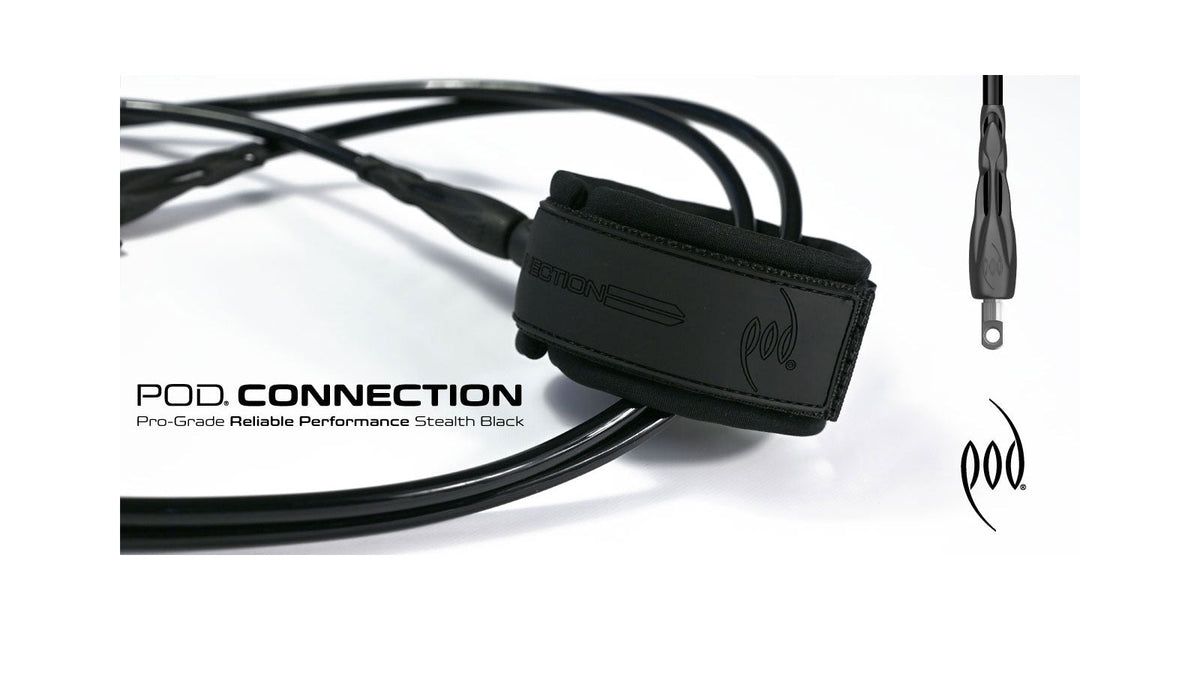
Beyond the Connection: Engineering a Seamless Interface for High-Performance Surfing
Most surfers treat their leash as an afterthought, a $40 to $50 insurance policy they grab off the rack without a second look. But when you're staring down a clean-up set at a heavy reef break, or trying to avoid a collision in a crowded Saturday lineup, that "leg rope" is the only thing standing between a great session and a dangerous disaster.
At PODWARE, we believe a leash shouldn't just be a cord; it should be a precision-engineered component of your surfing. Here, we answer the most common questions surfers ask and expose the industry secrets most brands won't tell you.
Level 1: The Problem Aware Surfer
"Why does my leash always seem to get in the way?" If you’ve ever felt the sting of a "neoprene rash" or had your leash wrap around your fins during a bottom turn, you are Problem Aware. You know something is wrong with your gear, but you might not know the solution exists.
1. The Ankle Rash and Slippage Nightmare
The Problem: Traditional ankle cuffs rely on basic, embossed neoprene technology that hasn't changed much since the early 90s. Once saturated, this material becomes heavy, stretches out, loses its shape, and begins to rotate. This constant shifting is what causes painful skin chafing (the dreaded "leash rash") and leaves your cord tangled under your feet during a critical take-off.
The POD Solution: Octo-Grip Technology. Moving beyond the limitations of outdated materials, our new non-slip ankle cuff is a masterclass in biomimicry. Inspired by the natural suction power of an octopus's tentacles, the specialised silicone print features a strategic array of circles of varying sizes and thicknesses.

- The Octo-Grip Ankle Cuff: Low-Profile Traction Interface
The Benefit: This creates a Low-Profile Interface between the cuff and your skin or wetsuit. Rather than relying on a "tight" strap that cuts off circulation, Octo-Grip provides unyielding stability through traction. It stays in place without requiring excessive pressure. Whether you're surfing in a 4/3mm steamer or boardshorts, the cuff remains snug and secure exactly where you put it, providing a comfortable, stable connection that respects your skin.
2. The Temperature Factor: Why Your Leash Feels "Stiff."
A common frustration is a leash that feels like a coiled spring in winter.
The Science: The primary component of a surfboard leash is urethane. It is a polymer, and like all polymers, its molecular flexibility is influenced by ambient temperature. In colder winter conditions, urethane molecules move more slowly, making the cord firmer.
Pro Tip: This is why "straightening" your leash in the sun before a winter session helps. However, at PODWARE, we use a premium 7mm extruded urethane specifically balanced to maintain a consistent "memory" and eliminate "kink memory" across a wider temperature range than cheap, generic leashes.
Level 2: The Solution Aware Surfer
"I know I need a better leash, but what makes one 'premium'?" You’ve moved past the basic leashes. You’re looking for features. This is where the POD Connection engineering sets us apart from the mass-market brands.
3. The "Snap" Point: Why Connectors Fail
Most surfboard leashes break at the joint, the point where the urethane cord meets the injection-grade connector.
The Industry Flaw (The "Power Plug" Fallacy): Most brands design connectors like electrical extension leads, using transverse slots or perpendicular grooves. Because these cuts run opposite to the longitudinal stretch, they act like perforations. When the leash stretches, these grooves create "stress risers" that force the connector to snap, or at least cause the cord to snap at the connector end point. Furthermore, if these slots are angled, the connector is forced into a rotational twist under load, over-spinning the swivels and causing constant tangles.
The POD Difference: Organic Fusion. Our connectors are organically shaped and over-moulded directly onto the cord. By utilising a "straight-through" organic configuration, we eliminate the angled slots that cause twisting and the transverse cuts that cause snaps.

- The Iconic POD Connector: Pro-Grade Reliable Performance

- The Linear Path in Action: As shown above, our organic over-moulded geometry ensures that even under maximum load, the assembly expands on a true axial path. By eliminating the angled slots found in traditional leashes, we neutralise rotational twist and prevent the cord from ever entering a spiral motion.
Watch the POD Connection Tensile Test
The Science of Strength: As you see in the video, our Organic Fusion is built to handle extreme loads without failure. Note how the connector maintains a true linear path as it stretches; there is no induced rotation or "spiral motion," even as the force reaches a Pro-Standard 105kg tensile load. This reliability lets you take on the elements with total confidence.
The Anatomy of the POD Fusion: Shape and Configuration
- Tapered Organic Geometry: The connector features a distinctive, fluid-like curvature that mimics natural structural transitions. Unlike the blocky or "stepped" designs of competitors, this organic taper evenly distributes stress across the entire surface rather than at a single "snap point".
- The Over-Moulded Interface: By injection-moulding the connector directly over the 7mm extruded urethane cord, the two parts are fused, allowing them to move as a single unit. This eliminates the internal friction and "play" that causes generic leashes to heat up and fail under load.
- Progressive Strain Release: The "hero" of the design is how the configuration manages the transition between the flexible cord and the rigid swivel housing. The organic shape acts as a progressive shock absorber, allowing the more rigid, injection-moulded urethane to stretch in unison with the highly flexible extruded cord.
- Straight-Through Alignment: The internal configuration is engineered for zero-twist integrity. Because the cord runs straight into the heart of the over-mould, it maintains a true linear path, preventing the induced rotation and tangling that occurs in connectors with angled slots or grooves.
The Result (Unison Stretch): Injection-moulded urethane (the connector) naturally has different physical properties than extruded urethane (the cord). The POD Connection geometry manages this material transition perfectly, allowing both components to expand in unison. The connector stretches 100% without twisting and moves with the cord as one unit. The full leash extends up to six times its original length, mainly in the urethane cord. This dramatically absorbs wipeout impact, protecting your ankle and your board with proven tensile strength of 105 kg.
4. Marine-Grade Hardware: No More Seized Swivels
If you’ve ever had a leash that "tangles" constantly, your swivels are likely seized. Saltwater is incredibly corrosive.
- Stainless Steel Swivel Shaft: A high-tensile core providing a permanent, unbreakable anchor.
- Greasy Plastic (PP) Barrel Casing: A self-lubricating housing that creates a low-friction environment, ensuring 360-degree rotation that will never seize due to salt crystallisation.
- Zero-Twist Architecture: Because the cord runs straight into the heart of the over-mould, it prevents the "spiral motion" and binding common in generic designs.

- Marine-Grade Hardware: Self-Lubricating Swivels for Salt-Resistant Rotation
PODWARE Engineering: We use marine-grade stainless steel swivels encased in a PP self-lubricating barrel housing. Like a crankshaft, this internal casing creates a naturally low-friction environment, ensuring 360-degree, salt-resistant rotation that will never seize. Combined with our zero-twist organic connectors, it keeps the cord out of your way so you can focus on the wave, not your gear.
Level 3: The Most Aware Surfer
"How does PODWARE compare to the big global brands?"
5. The "Length Lie": Are You Getting What You Paid For?
This is one of the surf industry's best-kept secrets. Many brands advertise a "6ft Leash," but that 6ft measurement includes the cuff, the swivels, and the rail saver.
The Reality: In those brands, the actual stretching urethane cord might only be 5ft 4".
The POD Standard: At PODWARE, when we say 6ft, we mean 6ft of urethane cord alone.
- Our 5ft leash has a total length of 5ft 9".
- Our 6ft leash has a total length of 6ft 9".
- Our 7ft leash has a total length of 7ft 9".
Why this matters for Safety: A leash acts like a high-tension spring. A shorter cord reaches maximum tension abruptly, resulting in a violent "recoil." By providing a full-length cord plus hardware, POD Connection leashes offer a more controlled, progressive stretch. This prevents the board from "slingshotting" back toward you at dangerous speeds.
6. The 7mm "Sweet Spot."
Thinner (Comp) Leashes: Great for reducing drag, but they have a high "perma-stretch" rate and snap easily. Thicker (Big Wave) Leashes: Incredibly strong, but they create massive drag, slowing your paddling and speed.
The POD Sweet Spot: We’ve standardised our premium range at 7mm. This delivers the ultimate balance: minimal drag for high-performance surfing with enough structural integrity to handle powerful, heavy swell in the impact zone.
Essential Bonus Q&A: Deep Dive into Maintenance & Safety
- How Long Should a Good Leash Last? A well-made leash should last a season or longer with care. Always rinse with Fresh Water to remove salt crystals that act like sandpaper on swivels and Velcro.
- Avoid the Sun: UV rays break down urethane over time. Store your gear in a bag or indoors.
- The "Hanging" Rule: Never store your leash wrapped tightly around your board's tail. This creates "kink memory." Always hang it straight or keep it loose.
- The Sustainability of Quality: The most sustainable thing you can do is buy a leash that doesn't break. Every time a cheap leash snaps, it ends up in a landfill. By investing in PODWARE’s Organic Fusion, stainless steel, and premium urethane, you are choosing gear that outlasts the competition.
Stay Connected, Surf Harder
The ocean is unpredictable, but your equipment shouldn't be. If your leg rope is old or sun-damaged, replace it before it fails in the water. The POD Connection range comes in 5 ft, 6 ft, 7 ft, and 8 ft, all with the same Organic Fusion connectors.
Thank you for reading.
To show our appreciation for those who value the details, we have a Special Offer: Buy any two POD Connection Surfboard Leashes and get 5% OFF.
Earlier in this series, read Surfboard Leash Size Guide - How to Choose and What to Avoid.
Next in this series, read How Surfboard Leash Stretch Affects Control and Safety.
Choose POD®. Stay Connected. Chase It®.
Share:
Coastal Living: Where the Ocean Breaks - Atlantic and Pacific
Ear Health for Surfers and Swimmers - The Complete Guide