

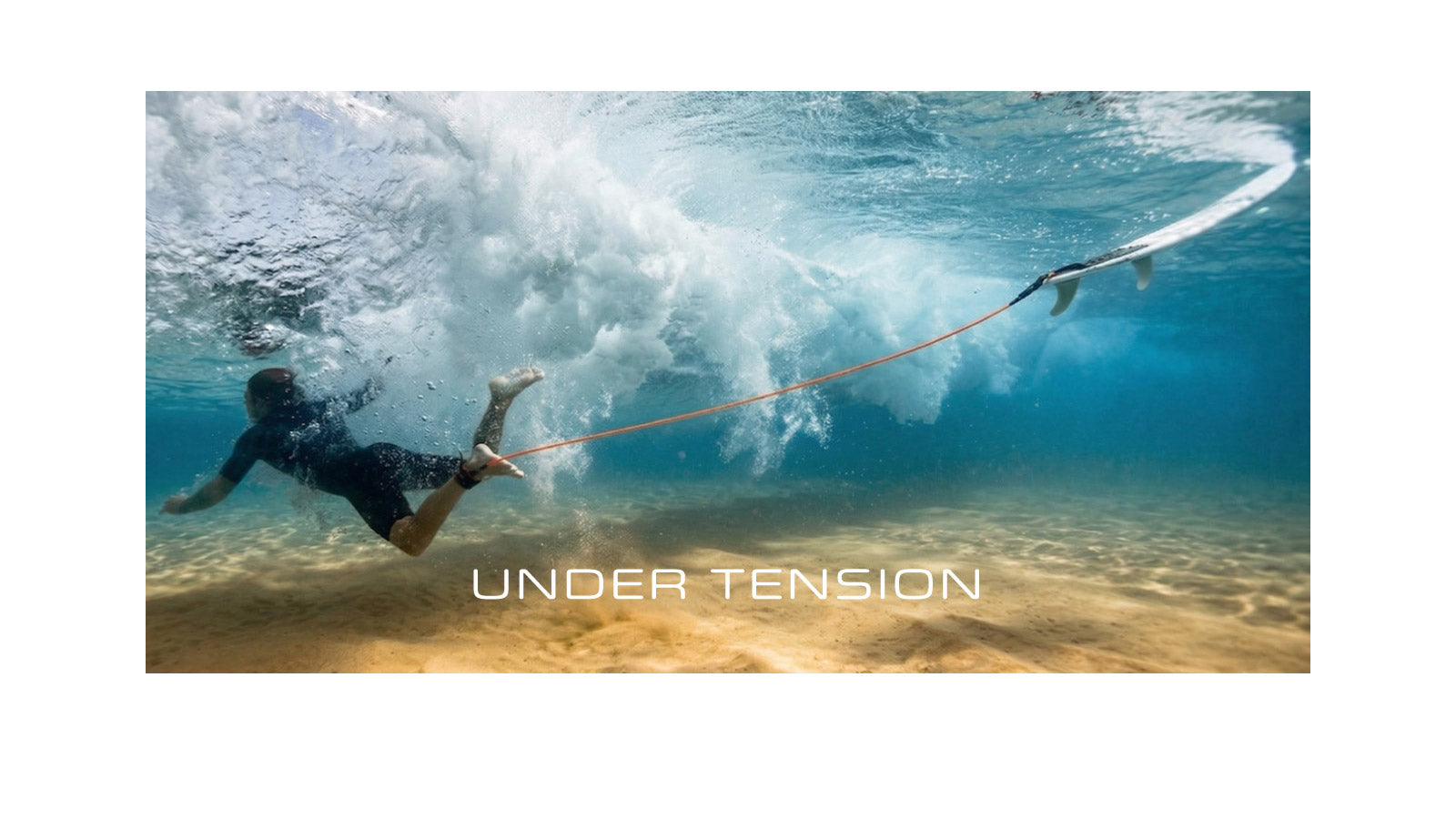
A surfboard leash does more than keep you connected to your board. Under load, it stretches, stores energy, and releases it back into the system. When this happens smoothly, it absorbs force and helps maintain control. When it does not, that stored energy can return suddenly, pulling the board unpredictably and affecting your balance, positioning, and safety in the water.
When the Leash Pulls Back
Every surfer has felt it. The wave breaks, the board is pulled away, and the leash stretches to its limit. For a moment, everything goes quiet as the tension builds.
Then it releases.
The board snaps back toward you, often faster than expected. In some cases, it skips across the surface. In others, it is pulled directly back through the whitewater, tracking the same line you were just in. The movement is not always smooth or predictable.
This is not just the leash working. It is stored energy being released back through the cord and into the board. How that energy is absorbed, redirected, or returned determines whether you regain control quickly or end up reacting to the board's movement.
What Most Surfers Think About Stretch
When it comes to leash performance, stretch is often misunderstood. A common belief is that more stretch automatically means more safety, as it allows the leash to absorb greater force. Others assume that a shorter leash or a thicker cord provides better control and reduces the chance of failure.
These ideas seem logical, but they do not tell the full story. Stretch is not simply about how far the cord can extend. It is about how energy is absorbed, stored, and returned under load.
Too much uncontrolled stretch can delay the board's return, creating moments of slack followed by sudden tension. Too little stretch can result in sharp load spikes, increasing the force transferred back through the cord and into the board.
In both cases, the issue is not the presence of stretch, but how that stretch behaves under real conditions.
Leash length is also often overlooked when considering stretch. A leash that is too short for the board reduces the distance over which energy can be absorbed. When the cord reaches its limit, the stored energy is returned more aggressively, increasing the rebound effect and the speed at which the board is pulled back. Matching leash length to board length directly affects how stretch behaves under load and how safely that energy is managed.
Board length is only part of the equation. Board weight and volume determine how much kinetic energy the leash stores when a wave drags the board away. A high-performance shortboard weighing 2.5kg creates a very different load profile from a high-volume mid-length or hybrid board weighing 5kg on the same length leash. The heavier, higher-volume board carries significantly more mass through the water, stretching the cord much closer to its structural limit and producing a more forceful recoil when that energy is released. When evaluating stretch risk, board weight and volume matter as much as board length. A leash correctly matched to board length may still be underspecified for the load created by a heavy, high-volume board in powerful surf.
Stretch Controls How Energy Moves
Leash stretch is not just about extension. It is about how energy is absorbed, stored, and returned under load.
When a wave pulls on the board, energy is transferred into the leash. As the cord stretches, it absorbs part of that force, reducing the immediate load placed on both the surfer and the board. The way this stretch occurs determines how smoothly that energy is managed.
Cord diameter is one of the most overlooked variables in how stretch behaves under load. The most common diameter is 7mm - a balance between stretch characteristics, durability, and weight in the water. Cords thicker than 7mm add weight and increase drag, which affects how the leash moves through the water and how quickly it recovers after a load cycle. Thinner cords at 6mm reduce weight and drag but are more prone to failure under repeated heavy loads. A 6mm cord may handle light to moderate conditions across a limited number of sessions. Still, its reduced material volume means it reaches its structural limit sooner than a 7mm cord under the same load. Diameter is not just a matter of personal preference. It is a direct factor in how the cord manages energy and how long it continues to do so reliably.
Cord drag has a second function that is less commonly understood. When a stretched leash releases and the board begins its return, the water surrounding the cord acts as a natural dampening fluid. The resistance created by the cord moving through water slows the velocity of the returning board, reducing the force of recoil before it reaches the surfer. Without this hydrodynamic resistance, the cord would release stored energy at the full speed of an unimpeded elastic band. The drag that slows the leash in the water is not only a weight and recovery consideration - it is a built-in safety function. A cord with no drag would recoil with significantly more violence than one moving through water resistance. Understanding this reframes cord drag from a performance penalty into a mechanical advantage during the most dangerous phase of the wipeout cycle.
If the stretch is progressive and controlled, the load is absorbed gradually, and the return of energy is more predictable. This helps reduce sudden recoil, maintain positioning, and improve overall control in the water.
If the stretch is inconsistent, limited, or delayed, the energy is not absorbed evenly. Instead, it builds quickly and is released more abruptly. This creates sharper tension spikes and more aggressive rebound, increasing the risk of losing control or being pulled out of position.
Stretch, when understood correctly, is not just a feature of the leash. It is the mechanism that determines how force moves through the cord and back into the board.
When Stretch Becomes a Risk
Not all stretch improves control. When stretch is poorly managed, it can introduce new risks rather than reduce them.
If the cord reaches its limit too quickly or if the stretch is inconsistent, energy is returned more abruptly. This creates a stronger rebound effect, where the board is pulled back faster and with less predictability. In these moments, the leash is no longer absorbing force - it is transferring it directly back toward you.
This is where loss of control becomes a safety concern. A fast-returning board can track directly toward the surfer, particularly in turbulent water where movement is harder to anticipate. The combination of tension, release, and direction can increase the risk of impact, especially during repeated wipeouts.
Over time, repeated heavy load cycles can also change how the leash behaves. As the cord stretches beyond its range, it may lose some of its ability to recover quickly. This can create inconsistent tension, where the leash alternates between slack and sudden load, further reducing control.
In severe cases, the cord does not recover at all. Polyurethane, the standard material used in surfboard leash construction, has an elastic limit. When a heavy load cycle pushes the cord past that limit, the material undergoes permanent molecular-level deformation. The cord does not spring back to its original length. A 6-foot leash can permanently become a 7-foot leash after a single extreme wipeout. That extra length is not functional stretch - it is structural failure. The cord has lost its memory of rebound entirely. What remains is a leash with trailing slack that wraps around the feet during a pop-up, fails to absorb energy under the next load, and can no longer be trusted to behave predictably under load. A permanently elongated leash is compromised and should be replaced.
Environmental conditions add another layer. In colder water, the cord becomes slightly more rigid, reducing its ability to absorb force smoothly. In warmer conditions, increased flexibility can lead to greater extension, potentially delaying the board's return. In both cases, changes in material behaviour affect how energy is managed under load.
When stretch is no longer controlled, it affects not just how the leash performs, but also how safely it can manage the forces generated by the wave.
Where Force Concentrates: The Joint Problem
When a leash stretches to its maximum, the energy does not distribute evenly along its full length. It concentrates on the points where the flexible polyurethane cord meets the rigid hardware - the swivel assemblies at the ankle cuff and the rail saver connection at the board.
At these termination points, the stretch stops abruptly. The cord cannot extend further, and the load transfers entirely to the joint. If the leash construction does not include a progressive, tapered neck at these connection points, the force has nowhere to go gradually. It loads the joint suddenly and completely. This concentration of force at a rigid pivot point causes the board to whip or spin on recoil rather than tracking back on a predictable linear path. The more abrupt the transition between flexible cord and rigid hardware, the more erratic the board's movement on release.
A well-constructed leash manages this transition gradually. The neck - the section of cord between the main body and the swivel - should taper or flex in a way that distributes load progressively rather than terminating it abruptly at a hard joint. When the connection between cord and hardware is smooth and organic rather than rigid and angled, the energy transfer at the joint is more controlled, and the board's recoil path is more predictable. To understand how connection design affects load transfer and twist behaviour at the joint, read POD Connection - Why Organic Fusion Stops Leash-Twist Tangle.
How Controlled Stretch Improves Control and Safety
When stretch is controlled, the leash becomes a stabilising part of the surfer's connection to the board rather than a source of unpredictable movement.
Under load, the cord extends progressively, absorbing energy over a greater distance rather than all at once. This reduces sharp tension spikes and allows force to be managed more evenly between the board and the surfer.
As the load is released, the return of energy is more gradual and predictable. Instead of snapping back, the board is guided back at a slower speed with more control. This makes it easier to regain positioning and maintain awareness of where the board is moving in relation to your body.
Consistency is the key. A leash that stretches and recovers in a controlled, repeatable way allows the surfer to anticipate how it will behave under load. This reduces the need to react suddenly and helps maintain rhythm in the water, even during heavier conditions.
Understanding the Full System
Leash stretch is not just a feature. It is the mechanism that determines how energy is managed between the surfer and the board.
When stretch is controlled, energy is absorbed and returned in a way that supports balance, positioning, and recovery. When it is not, that same energy becomes unpredictable, increasing the risk of loss of control and impact.
From leash length and cord diameter to material behaviour, repeated load cycles, and environmental conditions, every factor influences how stretch performs under load. Understanding these interactions is what separates a reliable connection from one that works against you.
To see how leash length and sizing decisions affect stretch behaviour in practice, read the Surfboard Leash Size Guide - How to Choose and What to Avoid. To understand how the connection point between cord and board affects load transfer and twist, read POD Connection - Why Organic Fusion Stops Leash-Twist Tangle.
Share:
Hands vs Handboards - What Changes and What Doesn’t
How Different Wave Types Affect Bodysurfing Speed