


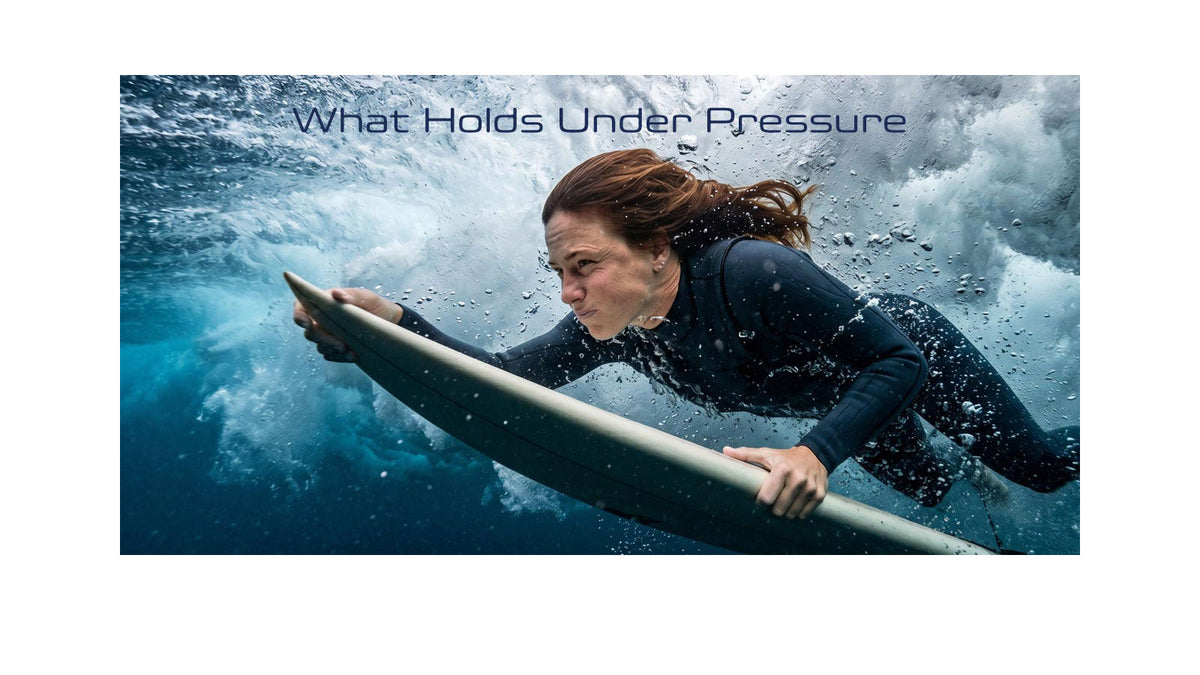
You put them in, toggle or twist them into place, and they feel sealed. Paddle out, duck dive, take a hit, and a few moments later water is already in your ear. Not because you forgot them. Not because you fitted them carelessly. Because what feels secure in still water can fail quickly in surf, open water, and turbulence.
That is where most people get caught out. They assume that if an earplug feels sealed on land, it will hold in motion. But the ocean does not test ear protection in a static position. It tests it under impact, pressure, rotation, and repeated movement.
Ear protection matters. Long sessions, cold water, trapped moisture, and repeated exposure all take a toll over time. But that is only part of the conversation. The next question is just as important: what actually holds when the water starts moving?
Why a Seal on Land Can Fail in the Water
A seal created under still conditions is not the same as one under load.
What feels secure when you are standing still is quickly tested once you enter moving water.
In the ocean, your ear isn't static. Your head moves, your body rotates, and the water itself pushes in different directions. This introduces four key variables most earplugs aren't built to handle: motion, pressure, turbulence, and rotation.
Motion changes the earplug's position relative to the ear canal. Paddling, turning your head, and reacting to a wave all create small shifts. Even slight movement can reduce the effectiveness of a seal that relies on a fixed position.
Pressure builds during duck dives, wipeouts, and wave impact. As water pushes against the ear, it looks for the weakest point in the seal. If the material cannot adapt or compress evenly, water finds a way in. Internal pressure is also a risk. A rigid plug inserted deeply into the ear canal can trap a pocket of air between the plug tip and the eardrum.
During a deep duck dive or a violent wipeout, external water pressure forces the plug further inward, compressing that trapped air with nowhere to go. Rather than dispersing, the pressure is transmitted directly to the eardrum. This can cause significant pain, disorientation, and in serious cases, a ruptured eardrum. A plug that manages pressure safely must allow air to equalise rather than act as a piston driving force onto the eardrum.
Turbulence introduces unpredictable flow. Whitewater, aerated water, and cross-current movement do not apply force in a straight line. The seal is challenged from multiple angles at once, often breaking consistency.
Rotation occurs as the body rolls, twists, or is turned by the wave. This is where many earplugs fail. A design that holds a straight position can lose integrity when the angle changes, creating gaps.
A fifth variable most earplug guides overlook entirely is jaw movement. The ear canal is not a rigid tube. Its shape changes when the jaw opens, closes, or shifts. When you open your mouth to breathe after a heavy duck dive, turn your head to inhale mid-swim, or yawn between sets, the jaw joint presses against the front wall of the ear canal, distorting its geometry.
A rigid or multi-piece plug cannot follow that change. The seal breaks from the inside, driven by your own anatomy rather than by external water pressure. An earplug that holds in water must use a material flexible enough to adapt to this internal movement, not just external forces.
These conditions do not occur in isolation. They happen together, often within seconds of entering the water. This is why a plug that feels secure on land can fail almost immediately when exposed to real conditions.
Where Most Earplugs Fail in Real Conditions
Most earplugs create a seal. Far fewer maintain that seal under real conditions.
This is where failure begins: not at insertion, but under load, when movement, pressure, and turbulence act on the system.
Multi-part systems introduce complexity. Every separate component, whether it is a removable filter, an interchangeable piece, or an external attachment, creates another point where movement can occur. With repeated motion, these connections can loosen, shift, or detach, reducing the overall seal's reliability.
Filters are often designed to let sound pass through while blocking water. In controlled conditions, this can work. In the ocean, however, two failure modes occur. The first is long-term clogging of fine-mesh structures by salt, sand, and debris, which restricts airflow and reduces effectiveness.
The second is immediate. When a filtered plug is submerged or hit by whitewater, water can become trapped across the filter membrane by surface tension. Even if the plug excludes bulk water from the canal, that trapped droplet acts as a solid barrier across the filter. The result is a sudden, disorienting loss of hearing; the ability to track an approaching set, hear another water user, or maintain spatial awareness disappears until the plug is removed and cleared. In moving water, that loss of situational awareness is a real safety risk.
Protruding designs introduce a mechanical failure point that is easy to overlook on land but becomes significant at speed in the water. Many earplugs, particularly those with multi-part housings, external stems, or rigid handles, extend beyond the natural bowl of the outer ear. When a surfer travels at speed down a wave face or is caught in a high-velocity wipeout, water rushing past the head applies drag against that protruding profile. This creates a leverage effect, pulling or wrenching the plug to the side and breaking the seal in the internal canal. A plug that sits flush within the outer ear bowl allows water to pass over the ear without snagging the equipment. Anything that protrudes gives the water something to grip.
Cords and retention systems are commonly added to prevent loss. In many designs, these rely on thin, flexible materials that are not built for load. Under tension from a wipeout or sudden movement, they can stretch, fatigue, or fail, turning a retention feature into another weak point.
Failure under load is the common thread. In real water conditions, nothing is static. Pressure changes, movement is constant, and forces are applied from multiple directions. If a design depends on delicate parts, fixed positioning, or rigid structures, it is more likely to lose its seal when it needs to hold.
A plug may feel secure in light swimming or calm conditions but fail under impact, turbulence, or repeated stress. In the ocean, reliability is not tested in still water. It is tested in motion.
What Actually Holds in Moving Water
If failure comes from movement, pressure, and complexity, then reliability comes from the opposite: simplicity, material response, seal stability, and system integrity.
Simplicity reduces failure points. A design with fewer components has fewer places where movement can break the seal. In real conditions, this matters. The ocean will always find the weakest connection.
Material behaviour determines how the earplug reacts under load. A material that is too rigid resists movement, leading to gaps when the canal geometry changes, whether from jaw movement, head rotation, or external pressure. A material that is too soft can deform unevenly, leading to an inconsistent seal. The balance is in a material that responds to pressure and movement while maintaining its structure.
Seal stability is not just about creating a barrier. It is about maintaining that barrier through motion, rotation, and changing pressure. A stable seal adapts with the body rather than fighting against it, allowing the plug to move in unison with the ear canal as its shape changes.
System integrity means every part of the design works together under real conditions. The seal, the material, and the overall structure must function as one system. If one part fails, the entire system fails.
In moving water, reliability is not defined by how a product performs when everything is still. It is defined by how it performs when everything is in motion.
A Simpler Approach to Ear Protection
In the water, simple systems tend to hold longer. Not because they do less, but because they remove unnecessary failure points.
When ear protection faces movement, pressure, and turbulence, every additional component adds risk. Small parts loosen. Connections shift. Materials behave differently under load. Over time, these variables reduce consistency.
A simpler approach focuses on what actually matters: a stable seal, a responsive material, and a structure that moves with the body rather than against it. The goal is not to add more features, but to keep the core function working under real conditions.
This way of thinking treats ear protection as part of a system, not an isolated product. It must perform while the body moves, water applies force, and conditions change moment to moment.
When that balance is achieved, the result is not complexity. It is reliability.
The Role of Fit and Consistency
Even the best design depends on how you use it. Fit is not a one-time action. It is a repeatable process you must follow every time you enter the water.
Ear canals also vary significantly between individuals in diameter, depth, and angle. A plug that holds reliably for one person under identical conditions may not hold for another because the canal geometry differs. This is why a recommendation that works for someone else is a starting point, not a guarantee. The right fit is the one that works consistently for your own anatomy.
Correct insertion is the starting point. The earplug must sit securely within the ear canal, creating a consistent seal without forcing pressure. If the fit is uneven or incomplete, small gaps can form, especially with movement.
Repeatability is what builds reliability. A system that works only when inserted the first time perfectly isn't dependable. It needs to perform the same way each time, regardless of small variations in conditions or movement.
User interaction is often overlooked. The plug must be easy to position, remove, and manage before and after a session. If it is difficult to use or requires constant adjustment, consistency is lost, and the seal becomes less reliable over time.
If you wear a silicone swim cap, the cap's inward pressure over the outer ear affects how the plug seals. A shallow-insertion plug with an outer-canal seal can work with that cap pressure, as the cap helps hold the plug in position without driving it deeper. A deep-insertion plug combined with a tight cap increases internal pressure and discomfort, and can push the plug further into the canal than intended. Knowing which plug design suits your cap use is part of getting the fit right.
Fit and consistency connect design to real-world use. Without a stable fit and repeatable insertion, even well-built systems can fail once exposed to motion, pressure, and repeated use.
Why Material Choice Determines Seal Behaviour
The seal is only as reliable as the material behind it. Two materials stand out for different reasons.
The POD EarSeal Dual-Flange uses medical-grade silicone with a polycarbonate centre core. The silicone delivers a soft, consistent outer-canal seal without requiring deep insertion. The dome shape sits at the entrance to the canal rather than inside it, which avoids the internal pressure problem described earlier. The polycarbonate core maintains the dome geometry under load rather than collapsing inward.
The POD EarSeal Pro Triple-Flange uses soft, flexible Thermoplastic Rubber (TPR). TPR responds to the movements described throughout this article: jaw shift, head rotation, and pressure changes because it has the flexibility to follow those changes rather than resist them. That responsiveness lets the triple-flange design stay in place through impacts, duck dives, and long sessions without creating pressure points.
Both designs apply the same principle: fewer parts, better reliability. No interchangeable pieces to loosen or lose. No filter mesh to clog with salt and sand. No thin cord to snap under tension. One piece, one material interface, one seal. The ocean will always find the weakest connection in a system. Removing those connections is not a design compromise - it is the point.
When to Replace Your Earplugs
Earplug failure in the water often has no visible warning. But signs can show seal integrity has degraded before you find out the hard way.
On the TPR triple-flange, the flanges should feel soft and responsive when you compress them between your fingers. If they feel stiffer than when new, or if the surface shows any fine cracking, the material has hardened and will no longer adapt the way it should. A flange that does not flex cleanly will not seal cleanly.
On the silicone dual-flange, watch for any deformation of the dome shape that does not recover when the plug is at rest. Medical-grade silicone is durable, but repeated compression over time can alter the dome geometry. If the seal no longer feels consistent from session to session, the shape has changed enough to matter.
Beyond material condition, session count is a reasonable guide. Regular use in salt water accelerates degradation in all flexible materials. A plug used several times a week in the ocean is working harder than one used occasionally in a pool. Replacing them annually as a baseline, regardless of visible condition, is a practical approach when the alternative is a failed seal at the wrong moment.
Care also extends lifespan significantly. Rinse after every session. Store away from direct sunlight and heat. A plug left on a car dashboard or dried repeatedly in full sun degrades faster than one stored in a case. The ocean is hard enough on equipment without adding avoidable exposure on land.
Protection That Holds When It Matters
Ear health matters. Cold water, trapped moisture, and repeated exposure take their toll over time. Protecting your ears is not just about comfort. It is about staying in the water long term.
But protection only works if it holds under real conditions. Movement, pressure, jaw movement, and turbulence will always test the seal. Once you understand that, the focus shifts from features to function, from complexity to reliability.
Ear protection is not passive. It must work as part of the system, moving with the body and maintaining a consistent seal as the water moves.
For the fundamentals of ear health and the long-term impact of water exposure, read Ear Health for Surfers and Swimmers - The Complete Guide.
For a simple, reliable approach built for real conditions, explore the POD EarSeal Pro Triple-Flange or the POD EarSeal Dual-Flange.

Share:
How to Read a Wave for Speed in Bodysurfing
How to Choose a Handboard Based on Conditions and Style