

Why Lens Choice Matters in the Water
Most people choose swim goggles based on colour.
Clear, tinted, and mirrored lenses.
What gets missed is why those lenses exist in the first place.
Fit and seal matter. That part is solved. Anti-fog is resolved.
The lens changes how a goggle works.
That comes down to light, time in the water, and how you move through it.
Start with your conditions.
Before choosing a lens, ask yourself:
- How long are you in the water?
- What time of day do you swim?
- Are you dealing with surface glare or changing light?
- Are you mostly on the surface or underwater?
These questions matter more than colour.
They define what you actually need.
Reading the Water, Not Just the Light
Light behaves differently depending on where you swim. Moving water, depth, and horizon exposure all change how a lens performs.
Water clarity also affects lens performance. In murky or overcast conditions, warmer lenses such as Gold help improve contrast. In clear water, Blue and Silver lenses maintain a more natural visual balance without adding distortion.
- Shore break and waves - Blue and Green lenses help separate texture and surface movement when light reflects off uneven water.
- Open ocean and distance - Silver lenses reduce sustained glare when facing a flat horizon.
- Pool and controlled environments - Clear and Tint maintain consistent visibility without reflective interference.
One goggle body, different lenses
All AquaLuxe models use the same goggle body.
Fit, seal, and comfort stay consistent.
The lens changes how it performs under different lighting conditions. after
Lens guide - simple and direct
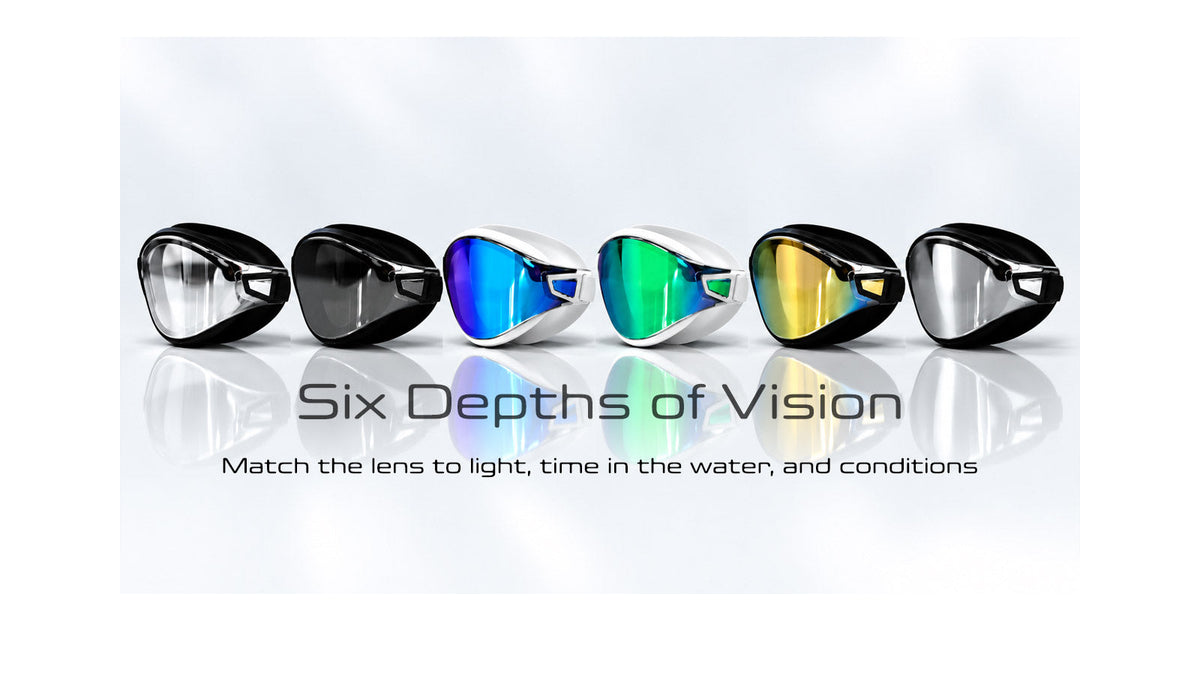
The AquaLuxe range uses one goggle body. The lens defines how it performs under different conditions.

- Clear → maximum visibility in low light and indoor conditions.
- Tint → reduces brightness without reflection for mixed light.
- Blue → reduces surface glare while keeping natural colour balance.
- Green → maintains consistent visibility across changing light.
- Gold → softens strong sunlight with warmer contrast.
- Silver → reduces intense glare during prolonged exposure.
Every lens has a defined role. None are interchangeable.
Understanding the difference
Some lenses may sound similar at first.
You don't use them the same way.
Blue vs Green
Both help manage outdoor glare.
- Blue suits stable light with a more neutral visual balance
- Green adapts better to changing light and mixed conditions over time
Green vs Gold
Both suit brighter outdoor conditions.
- Green handles changing light with balanced visibility
- Gold adds warmth and contrast in stronger, more consistent sunlight
Gold vs Silver
Both handle strong light.
- Gold suits typical sessions in strong sun
- Silver suits long exposure, where glare builds over time
A short session in or on the water and prolonged exposure across open conditions are not the same.
Why lens choice matters
Light changes how you see in the water.
- Surface reflection can flatten detail
- Strong sunlight can become harsh over time
- Changing conditions can disrupt visibility
You don't notice it immediately.
You notice it over time.
Longer sessions. Repeated exposure.
That's where the difference shows.
UV Protection
All lenses provide full UVA and UVB protection. This is a baseline requirement, not a feature tied to lens colour.
Visibility Over Time
Light is not static. Over time, the wrong lens forces your eyes to adjust constantly. This leads to squinting, tension, and reduced clarity.
The right lens reduces this load. It keeps your vision consistent throughout the session, rather than constantly correcting for glare, brightness, or contrast.
Why wear goggles at all
Not everyone does.
Some swimmers, surfers, and ocean users go without them.
But over time, a few things become consistent:
- Sessions get longer
- Light conditions vary more than expected
- Maintaining a clear vision becomes harder
Goggles don't change how you move through the water.
They help you:
- See clearly
- Stay comfortable
- Maintain consistency across sessions
Maintaining Lens Performance
Lens clarity depends on how you handle the goggles between sessions. Salt, moisture, and contact affect lens performance over time.
- Rinse after use to remove salt and residue
- Air dry naturally before storage
- Avoid contact with hard surfaces to protect lens coatings
The simple way to choose
Don't overthink it.
Match the lens to your conditions:
- Low light or indoor → Clear
- Mixed light without glare issues → Tint
- Surface glare → Blue
- Changing light → Green
- Strong sunlight → Gold
- Long exposure in intense glare → Silver
That's it.
When Conditions Change
Some swimmers move between environments, from indoor pools to outdoor sessions. In these cases, a single lens may need to cover a wider range of conditions.
Tint and Green lenses offer the most versatility across changing light. They don't replace a purpose-built lens, but they offer a balanced option when conditions vary.
Choosing the Right Lens
This isn't about adding options.
It's about choosing the lens that matches your time in the water, the light around you, and the conditions you move through.
The goggle stays the same.
The lens defines the experience.
Earlier in this series, read Why Your Swim Goggles Keep Fogging Up - What Actually Stops It.
Next in this series, read Mirror vs Clear Swim Goggles - When Each Actually Works.
Share:
Why Body Position Changes Speed in Bodysurfing
How Trim Controls Speed on a Wave