
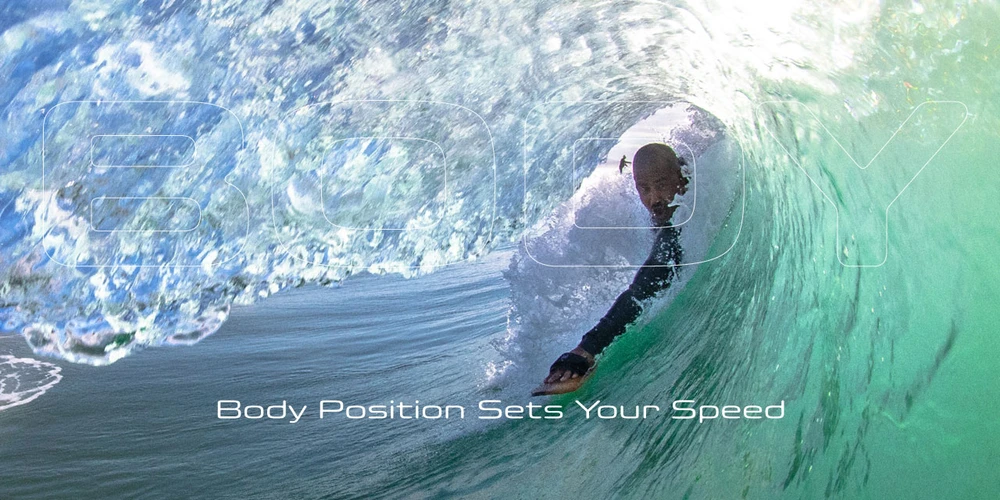
Why Body Position Changes Speed in Bodysurfing
Posted by POD Collective on 6th May 2026
One of the biggest things bodysurfers feel in the water, often without fully putting it into words, is how much body position changes speed.
Sometimes you feel light, clean and fast across the wave. Other times you feel heavy, flat and slow, even when the wave has enough energy to carry you. The difference is not always the wave itself. Often, the difference is how your body is meeting the water.
That matters because bodysurfing speed is not just about the handboard, the fins, or the wave. It is also about how much of your body is creating drag, how cleanly you are holding a line, and how efficiently you are working with the water rather than against it.
This is part of a larger system. Bodysurfing Speed – The Missing Link Most Riders Miss explains how that system works together.
The More Body in the Water, the More Drag You Create
The simplest way to understand body position is this: the more of your body you push through the water, the more resistance you create.
That resistance is drag.
When your body sits flatter and wider across the water, more surface area stays in contact with the wave. That can make you feel heavier and slower, because more of your body is pushing against the water rather than moving through it cleanly.
When your body position becomes cleaner and narrower, you reduce the amount of yourself that drags in the water. That makes it easier to glide, hold speed and stay connected to the energy of the wave.
There is another part of body position that matters: lift.
The faster you can raise more of your body out of the water, the less drag you create. When more of your weight is supported by the wave, rather than fully submerged, you move more efficiently and carry speed further across the face.
Lift is not a forced movement. It comes from how you position your body relative to the wave. By shifting your weight onto your leading side and maintaining balance through your arms and core, you allow the water to support you rather than resist you.
As more of your body rises, the wetted surface area reduces, drag drops, and speed increases.
Lift is one of the key reasons why two riders on the same wave can move so differently.
Why Riding More on Your Side Can Feel Faster
Where many bodysurfers start to feel the difference immediately.
If you plane more on the side of your body than flat across your stomach, you usually reduce the amount of body surface area pushing through the water. Less wetted area means less drag. Less drag makes it easier to hold speed.
That does not mean there is only one correct position for every wave or every rider. But it does explain why a cleaner side line can often feel faster and more efficient than a flatter, broader body position.
It is one of the clearest examples of how body position changes speed in bodysurfing.
Speed Is Not Just About Force - It Is About Resistance
Many people think speed is only about wave power. Wave energy matters, but resistance matters too.
You can be on a good wave, with enough push behind you, and still lose speed if your body is creating too much drag. You can also be in a less powerful section and carry better speed simply because your position in the water is cleaner and more efficient.
That is why body position matters so much. It changes not only how the wave pushes you, but how much of that energy you keep.
Body Position Also Changes Your Line
Speed is not just about going faster in a straight line. It is also about how well you hold a line across the wave.
A cleaner body position helps you settle into the face more naturally. It can make you feel more connected, more stable and more in control. A flatter or less efficient position can make you feel like you are pushing water, dropping out of the line, or losing hold at the wrong moment.
That is one reason two bodysurfers on the same wave can look completely different. One looks smooth and naturally connected. The other looks slightly out of sync with the water.
The difference often comes back to body position, timing and how each rider works with the wave.
Why the Same Rider Can Feel Different From Wave to Wave
Body position is not static. It changes constantly.
Small adjustments in rib pressure, shoulder angle, hip position and leg placement can all change how your body sits in the water. One wave may let you settle into a clean side line easily. Another may force you to flatter, widen, or later into the section.
Bodysurfing is so sensitive and so rewarding because small changes in body position can lead to very different outcomes.
Where the Handboard Fits In
A handboard still plays an important role. It refines the leading surface, improves stability, and helps you hold a cleaner line. It can also assist in generating lift, helping raise more of the body out of the water and reducing drag.
But it does not cancel out poor body position. If the rest of the body is creating too much drag, the handboard can only do so much. It works best when the rider gives it something clean to work with.
That is why the board should always be part of the bigger picture. It helps you hold and control speed, but body position still determines how much lift you create and how much speed you can unlock and carry.
In the end, the handboard is an aid. It supports what the body is already doing, but it does not replace it.
What This Means in the Water
If you want to improve your bodysurfing speed, don't just think about the board or the wave. Pay attention to how your body feels in the water.
- Are you too flat across the surface?
- Are you pushing too much of your stomach and chest through the water?
- Are you using your leading side to help lift and guide your position?
- Can you narrow your line and reduce drag?
- Can you feel when your body is in sync with the wave rather than working against it?
Those small observations often make a bigger difference than people realise.
The Real Takeaway
Body position changes speed because it changes drag, lift, line hold, and how efficiently you connect with the wave.
The more cleanly your body moves through the water, and the more effectively you lift out of it, the easier it is to hold speed. The more of your body you push against the water, the more energy you waste.
That is why body position is not a minor detail in bodysurfing. It is one of the main drivers of speed.
Take It Back to the Water
Bodysurfing speed does not come from one thing alone. It comes from how the full system works together.
Body position is one of the clearest parts of that system because it directly affects drag, lift, glide, and control.
Speed still comes from body + trim + control + surface.
And when body position improves, the whole system works better.