

Which is More Eco-Friendly: Polyurethane or Plastic?
Posted by POD Collective on 7th Jul 2024
Polyurethane is more environmentally responsible than most plastics - not because of a single claim, but because of how the material behaves across its full lifespan. This article examines why that is the case, what the data on ocean plastics reveals, and why longevity is the honest measure of sustainability in manufactured products.
For the specific application of polyurethane in bodysurfing handboard construction, read Truth About "Eco-Friendly" Bodysurfing Handboards.
What Polyurethane Actually Is
Polyurethane appears across a wide range of products because of its versatility. It can be formulated as a solid piece or in foam form, with precise control over rigidity, density, and flexibility. It stretches and returns to its original form under repeated load. It resists wear across extended use cycles. These properties make it useful across industries, from construction insulation to automotive interiors to ocean sports equipment.
Polyurethane accounts for only 2% or less of all waste detected in ocean surveys, whereas over 95% of plastics found in the oceans are thermoplastics. That single statistic establishes the material's environmental position more clearly than any marketing claim.
Polyurethane Versus Plastics - The Environmental Comparison
Both polyurethane and conventional plastics originate from fossil fuels. That is an honest starting point. The difference is in how each material behaves across its production, use, and end-of-life cycle.
Polyurethane materials generally last longer than their thermoplastic equivalents, reducing waste at the source. A product made from correctly formulated polyurethane that performs consistently across years of use generates less waste than a cheaper thermoplastic alternative that breaks down and requires replacement within one or two seasons.
There is also potential to utilise bio-based polyols in polyurethane production, thereby reducing the material's environmental impact and making it more sustainable than its fossil-derived plastic counterparts. Manufacturers are actively working to extend the end-of-life phase of polyurethane and to improve sustainability across the production cycle.
Polyurethanes are sustainable, affordable, and safe materials. Unlike many plastics, they help conserve natural resources by reducing the need for excessive energy use throughout their lifespans.
The Reason Polyurethane Is the More Responsible Choice
The advantage of polyurethane over synthetic plastics such as polystyrene and polyvinyl, and synthetic rubbers lies in three factors: longevity, recyclability, and ocean footprint.
Polyurethane does not require a specialist recycling facility. Its residues can be ground down and reprocessed into foam for boards, roofing, and insulation products. High-density panels replace wood, chipboard, and other materials. Polyurethane formulations can also be recycled back into their original form - polyol - demonstrating a sustainable material cycle that most thermoplastics cannot match.
How Polyurethane Is Recycled
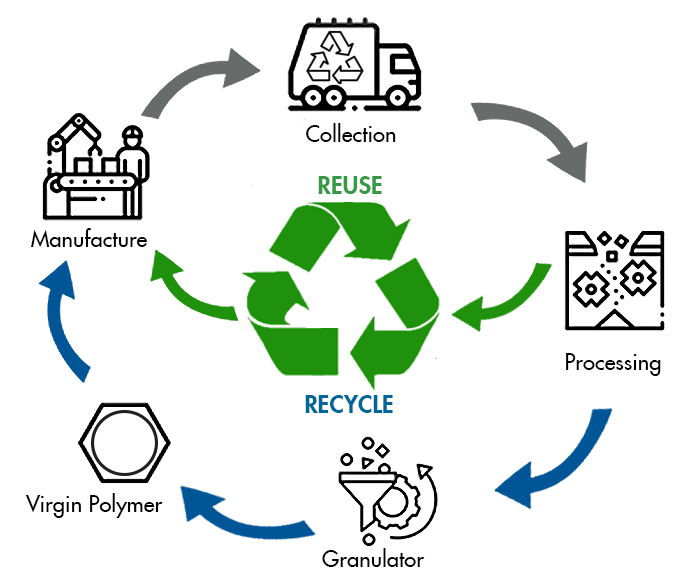
- Chemical reactions return polyurethane parts to their pre-polymer state.
- Recycled polyurethane reverts to its original form as polyol through chemical recycling
- Mechanical recycling grinds residues into reusable material for insulation, carpet underlay, and packaging
- Its long lifespan makes it more cost-effective across the full product lifecycle compared to short-life thermoplastic alternatives
How Plastics Affect the Environment
Plastic production has outpaced recycling infrastructure entirely. Manufacturers produce approximately 12 tonnes of plastic globally every second. Only 10% of it is recycled. The remaining 90% ends up in landfill, incineration, or the natural environment.
Most plastics are thermoplastic - they become malleable when heated, require injection moulding, and upon cooling become rigid single-use or short-life products. Bottles, grocery bags, and food containers are the most visible examples. Plastic bags block stormwater drains and sewer systems. Plastic debris fragments into microplastics that enter waterways and marine food chains.
Plastic production depends directly on fossil fuel extraction. Processing plastic requires ethane from fracking. Refining and production consume fossil fuels at every stage. Manufacturing a product whose useful lifespan lasts minutes demands a significant energy investment - a single-use water bottle, for example, requires six to seven times its volume in water just to produce.
In the United States alone, consumers dispose of over 2.5 million plastic bottles every hour - approximately 170 per person annually. Despite their convenience, single-use plastic bottles are among the most significant contributors to landfill waste globally.
Fracking damages the environment by injecting chemicals, large volumes of water, and high-pressure sand into underground rock formations to fracture them. It harms groundwater systems and creates methane air pollution. Fossil fuel production, livestock farming, and landfills together contribute approximately 30% of the current increase in global temperatures through methane emissions. Methane has a shorter atmospheric lifespan than carbon dioxide but a significantly higher capacity to absorb energy, making it a critical target for climate mitigation.
Further Reading
- Plastics and Climate Change - Geneva Environment Network
- Sachets - Small Packaging, Huge Problems - ABC News Australia
- Is Recycling Plastic Pointless? - CNA Insider
- Reimagining Plastic Waste as Energy Solutions - Nature
Ocean Plastic Recycling - Why It Is More Complex Than It Sounds
Recycling ocean plastics presents unique challenges that brands marketing products made from them rarely acknowledge. The vastness of the ocean, the prevalence of microplastics, and the high energy cost of collection and processing all contribute to a more complicated picture than the term "ocean recycled plastic" suggests.
Processing ocean plastics requires more energy-intensive sorting and processing than recycling a single plastic type. The sorting and cleaning processes involved diminish the overall energy efficiency of the recycled material. Transporting plastic waste to recycling facilities and then recycling it into raw materials for manufacturers adds additional energy costs, particularly over long distances.
Recycled ocean plastics also have significant limitations for end use. They are often heavy and brittle, with low impact strength, making them unsuitable for most consumer products that require consistent structural performance. That is, before accounting for the additional energy required to manufacture the product from degraded, mixed-composition source material.
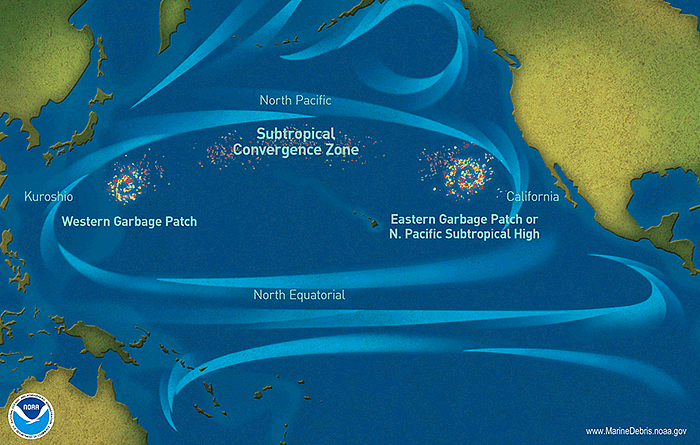
Image Credit: NOAA - National Oceanic and Atmospheric Administration
The largest concentration of ocean plastic debris is the Great Pacific Garbage Patch, located between California and Hawaii, spanning approximately 1.6 million km². To put that scale into perspective, France, Germany, and Spain combined cover approximately 1.6 million km². The patch harbours an estimated 80,000 tonnes of plastic debris in the North Pacific alone.
The Great Pacific Garbage Patch is one of at least five similar garbage patches around the globe. These figures account only for surface debris and do not include the plastics on the ocean floor.
Even on Henderson Island - one of the most remote islands in the world, in the South Pacific - researchers found 17.6 tonnes of plastic and an estimated 2,000 pieces of microplastics per square metre.
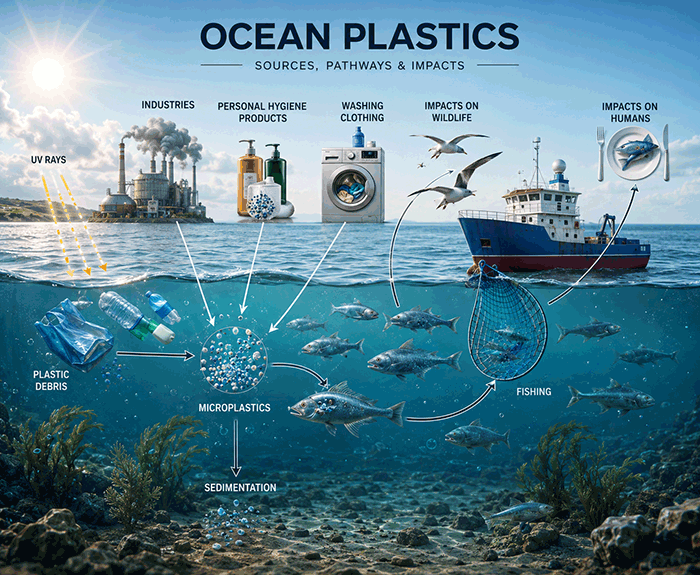
Ocean life ingests microplastics, causing internal physical damage to digestive systems. Those microplastics ultimately return to the human food chain. Microplastics returning to the human food chain through fish consumption is a documented and measurable consequence of plastic production and waste management choices made over the past seven decades.
The energy required to separate, clean, and process ocean plastics makes them a less viable sustainability solution than recycling single-stream plastics. There has to be a more energy-efficient solution to processing ocean plastic waste at scale. That solution does not yet exist at the level required to make ocean recycled plastic a genuinely responsible manufacturing choice for high-performance consumer products.
When "Recycled Ocean Plastic" Is a Marketing Claim
Some brands have marketed products as sustainable using the term recycled ocean plastics. Material science does not support this as a reliable claim for high-performance applications. Ocean plastic is a mixed-composition, UV-degraded, salt-contaminated material with unpredictable properties. In products that require specific flex, structural integrity, and consistent performance under load, the material's variability makes it unsuitable, and the energy required to process it to a usable state makes it difficult to justify as a sustainability argument.
Greenwashing is the practice of making claims about a product's environmental credentials that do not reflect the material facts. The term has entered mainstream vocabulary only recently, but the practice predates the language used to describe it. The most reliable test of a sustainability claim is the product's actual lifespan, performance, and end-of-life recyclability - not the marketing language used to describe its materials.
What Is the Least Sustainable Plastic to Recycle?
The least sustainable plastics to recycle depend on the available recycling infrastructure, processing costs, and market demand for the recycled material. PVC and polystyrene are among the most complex due to their chemical composition and the difficulty of separating them from other materials. Both can release harmful chemicals when melted down, making them less desirable than PET drink bottles, PP food storage containers, or HDPE recycling bins.
Recycling Codes - What They Actually Mean
The Society of Plastics Industry developed a coding system to give manufacturers and recyclers a uniform way to identify the resin type of plastic containers. There are seven codes. Many manufacturers and consumers misinterpret these codes as an indicator of recyclability or recycled content. They are not. They identify the resin type only.
Labels reading "Please Recycle", "Recycled Content", or "100% Recyclable" are frequently misleading. These labels often cause consumers to place non-recyclable packaging in recycling bins. Placing non-recyclable packaging in recycling bins contaminates recyclable material streams, reduces the quality and value of recovered material, and increases costs and rejection rates at recycling facilities.

1 PET - Polyethylene Terephthalate
- Microwave-proof food trays, drink bottles, containers, textiles, monofilament plastics, carpets, cling films, and industrial plastic wrap

2 HDPE - High-Density Polyethylene
- Bottles for beverages, detergent, and shampoo, bags, cereal box liners, extruded pipe, and wire and cable covering

3 PVC - Polyvinyl Chloride
- Packaging clamshells, shrink wrap, window and door profiles, pipes and fittings, power and data wiring, cables, cladding, roofing, rainwater systems, and flooring

4 LDPE - Low-Density Polyethylene
- Produce bags, dry cleaning bags, newspaper bags, garbage bags, squeeze bottles, container lids, shrink wrap, toys, coated milk cartons, and wire and cable coverings

5 PP - Polypropylene
- Medicine bottles, straws, bottle caps, jars, yoghurt containers, food packaging, and hot beverage cups

6 PS - Polystyrene
- CD cases, yoghurt containers, cups, plates, bowls, cutlery, hinged take-out containers, construction foam blocks, packing peanuts, and packaging foam

7 Other Resins
- Reusable water bottles, optical lenses, some citrus juice and sauce bottles, oven baking bags, and custom packaging. Includes materials that differ from the above six codes or from a combination of resins
Using Recycled Plastic Blends with Virgin Plastics
When blending recycled plastics with virgin plastics, such as raw polypropylene, the ideal recycled content varies depending on the required properties and the intended application.
Research on virgin and recycled polypropylene and high-density polyethylene blends found that recycled blends typically have lower hardness, density, and melting points than their virgin counterparts. For injection moulding or thermoforming, one study identified an optimal blending ratio of 78% post-consumer waste and 22% post-industrial waste. For high-quality consumer products, the recycled content ratio is typically less than 5%.
This data confirms that introducing high percentages of recycled or mixed-composition materials into a product that requires specific performance properties compromises the product's performance. The product becomes heavier, more brittle, and less consistent - regardless of the sustainability language used to describe it.
Inroads for Recycling Plastics
A blend of recycled plastics and road base material is gaining traction as a sustainable solution for managing plastic waste. In Australia, Reconophalt® is the first road surfacing material to incorporate high levels of recycled content from soft plastics, glass, and toner waste streams. For every one kilometre of two-lane road surfaced with Reconophalt, the following recycled materials are used on average:
- 200,000 recycled plastic bags
- 63,000 recycled glass bottles
- Toner from 4,500 used printer cartridges
- 250 tonnes of reclaimed asphalt road
Nature's Recyclers
Plastic-eating bacteria and enzymes represent a genuinely promising long-term solution to the global plastic waste problem. In March 2016, scientists in Japan discovered that PET bottles at a recycling plant were deteriorating due to the bacteria Ideonella sakaiensis.
Researchers at The University of Texas at Austin have since discovered enzyme variants that can break down plastics that typically take centuries to degrade, accomplishing this in days. If this research scales, it could significantly change the end-of-life picture for thermoplastics.
POD's Position - Performance First, Sustainability Always
POD's approach to material selection since 1988 has been grounded in function, longevity, and responsible manufacturing - not in the language used to describe materials at the point of sale.
The Original Classic Signature Shape POD Handboard is made entirely from 100% polypropylene with no additives other than organic colour pigments. The shape and configuration of that board mean it will outlast the consumer's lifespan, with durability so consistent that the owner can pass it to the next generation. That is a sustainability argument built on product lifespan, not material marketing.
All POD packaging avoids single-use plastics. Warehousing and distribution prioritise cardboard. POD reuses packaging materials wherever possible to minimise landfill waste.
Surfboard manufacturers have used polyurethane foam since the late 1950s. Building on over 35 years of research and responsible manufacturing practice, POD has developed a range of lightweight polyurethane bodysurfing handboards - the POD WOW 13" Handboard - formulated specifically for the mechanical demands of bodysurfing. The material science behind that formulation is documented in detail in Truth About "Eco-Friendly" Bodysurfing Handboards.
The Material You Choose Is the Position You Take
Polyurethane is not without environmental cost - no manufactured material is. But across longevity, recyclability, ocean footprint, and performance under real-world conditions, the material science supports polyurethane as the more responsible choice compared to thermoplastic alternatives and mixed-composition ocean plastics.
The WOW 13" Handboard is the practical proof of that position. A board formulated to the precise weight, density, and rigidity requirements of bodysurfing, built to last, and backed by a manufacturing philosophy that has not changed since 1988. The alternative that Shane was searching for when he first wrote this article has been found - in a material that the data supports and a product that the water confirms.
For the full development story, read POD Bodysurfing Handboards History - Successful 30 Years. To explore the full POD handboard range, visit POD Bodysurfing Handboards.