
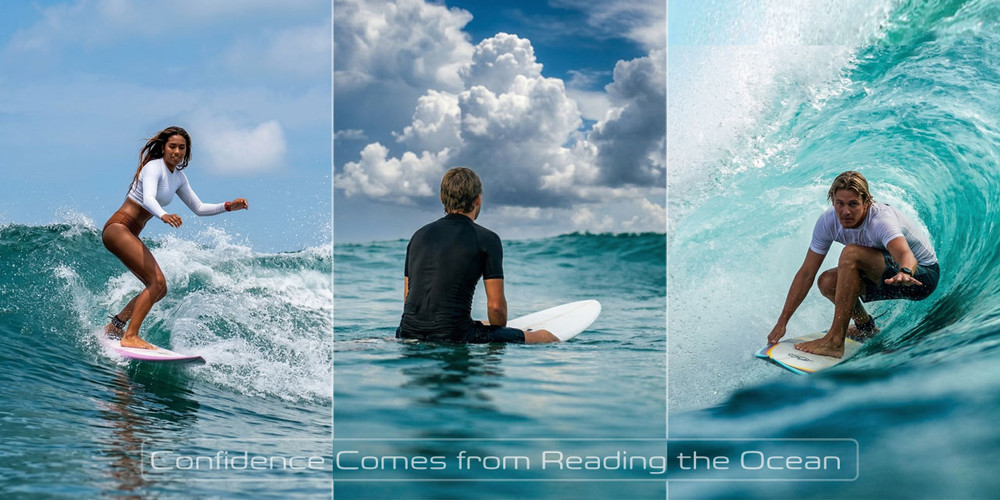
How to Surf – Building Real Confidence in the Water
Posted by Team Collective on 19th Mar 2026
A Practical Guide to Building Real Confidence in the Water
Surfing is not defined by standing up once; it is a continuous process of learning how the ocean moves, how your body responds, and how your equipment supports or limits your progression. Confidence in the water is not claimed. It is built, session by session, through deep understanding and real-world experience. This guide is written for those who want to approach surfing as a skill developed over time. Whether you are stepping into the water for the first time or returning after years away, the fundamentals matter more than trends or shortcuts. Progress lasts longer when it is rooted in core mechanical skills.
Surfing is not about controlling the ocean; it is about reading it and moving with it. You do not force waves to work. You match their timing, speed, and direction. Initially, nothing feels predictable, but eventually, patterns begin to appear. Real confidence comes from understanding what the ocean is doing before you even begin to paddle. You are looking for the "lineup," the point where the swell begins to peak and break, which is determined by the underwater topography and the tide's movement.
Understanding the Ocean Comes First
Before technique and before equipment, surfing begins with observation. Spending time watching the water reveals patterns that no instruction manual can teach. You begin to notice where waves break consistently, where they do not, and how currents move along the beach. Channels form where water flows back out to sea: these "rips" are essential tools for an experienced surfer to reach the backline with less effort, but they require respect and understanding from a beginner.
Experienced surfers are primarily good readers of the ocean. They choose conditions that suit their current ability rather than their ambition. Matching your skill level to the conditions builds confidence faster and removes unnecessary pressure from the session. If the "fetch" (the distance the wind has travelled over the water) has been long and uninterrupted, the swell will have more energy and organisation. Recognising this helps you decide if the conditions are within your comfort zone.
The Paddling Masterclass: Efficiency and Hydrodynamics
Paddling is where most sessions are won or lost. If your energy is spent before a set arrives, confidence fades quickly. The goal is efficiency: moving the most water with the least wasted effort. This involves understanding the displacement of your board. When your weight is centred correctly, the board sits flat on the water. If you are too far back, the tail drags and creates a "ploughing" effect; too far forward and the nose digs into the surface. Most surfers find their balance when the nose sits just a few centimetres above the surface, allowing the board to plane smoothly.
Effective paddling happens beneath the surface with a "deep-water" pull. Reaching forward comfortably and entering the water quietly prevents air from being trapped under your hand, which would otherwise reduce the resistance and power of your stroke. A slight lift through the chest improves visibility and reduces the "wetted surface area" of the board, which in turn reduces drag. When a wave approaches, your paddling must shift from a steady rhythm to a committed sprint. A short burst of speed helps match the velocity of the wave, and it is vital to continue paddling until you feel the board begin to "glide" independently of your effort.
The Surfer’s Eyes: Swell Period and Synoptic Charts
Confidence often begins on land, long before wax touches a board. Low-pressure systems are responsible for generating most swell. Synoptic charts show how these systems move, how strong they are, and how long they have been transferring energy across the ocean. Closely packed pressure lines, or isobars, indicate stronger winds and more powerful swell generation.
As swell travels, the "period": the time in seconds between each wave crest, becomes critical. Short-period swell (under 8 seconds) generated by nearby winds tends to be restless and uneven. Longer-period swell (10 to 16 seconds) from distant systems carries significantly more energy, moves faster, and interacts with coastlines more cleanly. Direction determines how that energy expresses itself; a south swell might bypass a north-facing beach entirely, leaving it flat despite what the swell height suggests. Learning to correlate these charts with your local beach turns uncertainty into intention.
The Second-Hand Board Trap: Checking Mechanical Integrity
Many newcomers or tourists begin their journey by purchasing a second-hand surfboard. While this is a cost-effective entry point, a board is only a bargain if it is mechanically sound. Beyond checking for "dings" or cracks in the fibreglass that allow water to reach the foam core and rot it, you must inspect the hardware. A surfboard is a system, and if the connection points fail, the board is useless.
Check the "fin boxes": the slots where the fins are inserted. If there is cracking around the box, the structural integrity is compromised. Ensure the stainless steel grub screws are not rounded out or rusted, as this makes it impossible to secure or change your fins. Similarly, inspect the "leash plug," the small plastic bar where your leg rope attaches. If this is loose or pulled, you risk losing your board in the surf, which is a significant safety hazard. A second-hand board often needs a fresh leash and a set of compatible fins to be truly seaworthy. Do not assume the gear it comes with is reliable; your safety depends on these small, often overlooked components.
The Mechanics of Underfoot Stability: Fin Setups
Fins influence confidence more than many surfers realise. They provide drive and hold, determining how secure a board feels underfoot. Single fins encourage smooth, deliberate movement and are ideal for learning the trim of a wave. Thrusters offer predictability and balance across most conditions. Twin fins trade stability for speed, which can feel "skatey" and unsettled for a beginner. When a board feels "nervous" or difficult to control, the issue is often a lack of stability in the fin setup rather than a lack of ability. At POD, we believe equipment should be a silent partner. Addressing mechanical issues lets you focus on the water.
Standing Up as a Result of Positioning
The pop-up often receives more attention than it deserves. In reality, it is a consequence of everything that happens beforehand. Strong take-offs come from correct positioning, matching the wave speed, and committing early. Practising on land builds familiarity, but timing in the water is what creates consistency. Stability almost always outperforms speed during the initial stages of a ride. Rushing the process leads to instability; stay low, maintain your centre of gravity, and let the board settle before looking down the line.
Surfing Is a Long Game
There is no finish line in surfing. The reward is the connection to the ocean and a process that never fully reveals itself. Take your time, build skills that last, and ensure your equipment, whether new or second-hand, is maintained to a high standard. When your gear is reliable, your mind is free to read the ocean and enjoy the movement. Respect the lineup, stay aware of your limits, and remember that the best surfer in the water is the one having the most fun while staying safe.