
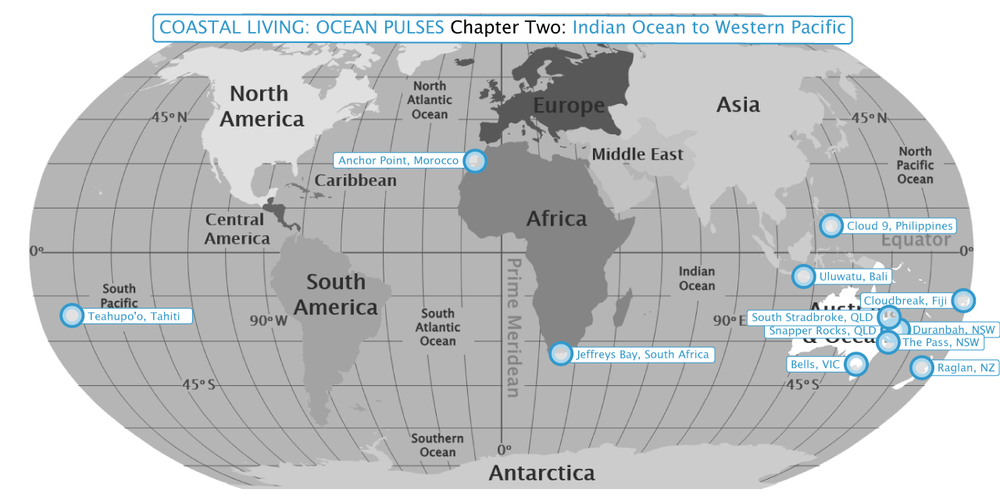
Coastal Living: Ocean Pulses | Indian Ocean – Western Pacific
Posted by Team Collective on 3rd Jan 2026
The Great Migration: Eastern Pulses and Ancient Energy
AFRICA: The Raw Frontier
Jeffrey’s Bay (J-Bay), South Africa: The World’s Best Right
- The Sections: J-Bay is composed of several sections, the most famous being Supertubes. When a large Southern Ocean swell (a long, rolling wave generated by distant storms) hits the reef, it creates a fast, hollow (barrel-shaped) and exceptionally long wall of water. Other sections, like Boneyards and Point, offer more manageable energy for longboarders and intermediate surfers.
- The Character: This is a high-speed wave. It demands "rail-to-rail" surfing (transitioning from one edge of the surfboard to the other while turning). It rewards those who can read the subtle changes in the reef. The water is crisp; you’ll often need a 3/2mm wetsuit. The scenery? Wild. And don’t be surprised to see pods of dolphins playing in the line-up (the area in the water where surfers wait for waves).
Skeleton Coast, Namibia: The Endless Barrel
- The Miracle Mile: This is a sand-bottomed left-hand point break (a wave that breaks over a point of land with a predictable direction) that, on its best days, can offer a tube ride (riding inside a hollow wave) lasting over a minute. It is a gruelling, high-consequence wave that requires elite fitness and a 4x4 vehicle to access.
- The Environment: A landscape of shipwrecks, seal colonies, and shifting sands. This is a place for dedicated shortboarders or bodyboarders. Only those who seek the ultimate barrel in one of the most isolated locations on the planet come here.
Taghazout, Morocco: The Gateway to the Sahara
- Anchor Point: The crown jewel of Taghazout. This point break produces long, drawing lines that peel over a mix of sand and rock. It is a culturally rich session, where the smell of woodsmoke and tagine wafts from the shore.
- The Multi-Sport Draw: Consistent winds along the coast make Morocco a premier destination for kitesurfing and windsurfing, particularly farther south in Dakhla. At the same time, the calmer bays near Agadir are perfect for SUP and beginner progression.
ASIA: The Tropical Laboratory
Uluwatu, Bali, Indonesia: The Temple of Consistency
- The Architecture of the Reef: Uluwatu is celebrated for its mechanical reef breaks (waves breaking over a consistent coral or rock formation). These waves detonate over a vast limestone and coral shelf. They create fast, hollow sections (barrel-shaped parts of the wave) that are the gold standard for high-performance riding. The reef is divided into several distinct sections: The Peak, Racetracks, and Outside Corner. This allows a variety of "characters" (wave types and riding experiences) to emerge depending on the tide and swell size.
- The Prime Season: To witness Uluwatu at its most majestic, visit between May and September. During this window, the Indian Ocean sends its most powerful pulses. The faces can reach over 10 feet. However, thanks to its unique position, Bali remains a year-round destination. Consistent energy arrives even during the "fringe" seasons.
- The Cliffside Culture: Uluwatu's experience is vertical. The "town" is built into the cliffs, with a labyrinth of staircases leading to warungs (local eateries) and shops that overlook the lineup. Between sessions, the 11th-century Uluwatu Temple serves as a stunning cultural anchor for the nightly Kecak fire dances at sunset.
- The Multi-Sport Draw: Beyond high-performance shortboarding, the deep-water channels around the Bukit are world-class for freediving. The water's clarity is incredible. It offers a unique perspective on the underwater "canyons" that funnel swells toward the shore.
Siargao, Philippines: The Cloud 9 Experience
- Cloud 9: This is the Philippines’ most famous wave, a thick, hollow (barrel-shaped) and incredibly photogenic right-hand barrel (a wave breaking in a way that creates a tunnel for surfers riding to the right). It breaks over a relatively shallow reef, making it a high-adrenaline arena for expert surfers and bodyboarders.
- Island Exploration: Siargao is a paradise for SUP (Stand-Up Paddleboarding). The island is surrounded by vast mangrove forests and turquoise lagoons. Sugba Lagoon is especially stunning. The water is as still as glass. This peacefulness contrasts perfectly with the energetic outer reefs.
The Maldives: The Atolls of the Endless Summer
- The Atoll Experience: Unlike the mainland, the Maldives is defined by luxury liveaboards (boats serving as floating hotels for surfers) and private island resorts. In the North Male Atolls, spots like Cokes (a fast, hollow right waves breaking to the right with a barrel shape) and Chickens (a long, peeling left waves breaking to the left with a continuous face) offer consistent, mechanical perfection.
- Exclusive Access: For the high-end traveller, resorts like Niyama Private Islands offer the rare "Vodi" break, a private wave exclusive to guests, allowing for a crowd-free experience that is almost impossible to find elsewhere in Asia.
- The Multi-Sport Crossover: This is the global capital for luxury snorkelling and catamaran sailing. Between swells, vibrant coral gardens offer an underwater safari. You might see manta rays and whale sharks. It's a perfect destination for those who value the "Blue Mind" lifestyle as much as the adrenaline.
The Mentawai Islands: The Laboratory of Perfection
- The Legend of the Barrel: Names like Lance’s Right (HT's) and Macaronis are etched into surf history. These are "laboratory waves" so consistent and perfectly shaped that they feel engineered.
- The Journey: Accessing the Mentawais is a badge of honour. You reach them by fast ferries or private charters. Here, the only schedule is the tide. This is the ultimate "Boat-Trip" destination. You wake up on the water, inches away from the peak.
- Island Soul: Beyond the reefs, the islands are home to one of the world's oldest indigenous cultures. The Siberut rainforest provides a dramatic, emerald backdrop to every session. It's a constant reminder that travellers are on the edge of the wild.
Sumba: The "Edge of Wildness"
- The Private Peak: To preserve the experience, the resort limits the number of surfers to just 15 per day. Picture a 300-meter-long journey with heavy barrels (hollow waves forming a tunnel), then sections of open faces (rideable, but not enclosed).
- The Waterman's Safari: Sumba is famous for its "Spa Safaris" and beach horseback riding, offering a rugged, "Stone Age" luxury unique in the Asian circuit.
OCEANIA: The Blue Water Cathedrals
Cloudbreak, Namotu and Tavarua Island: The Apex of Power
- The Heavyweight Champion: Cloudbreak is a left-hand reef break that can handle almost any size the Pacific throws at it. It ranges from 2-foot playful walls to 20-foot "freight train" barrels. These waves carry immense consequences. The reef is divided into three sections: The Point, Middle, and Shish Kebabs. On XXL swells, these can link up for a gruelling, 400-yard ride.
- The Prime Window: The optimal time to face Cloudbreak is between April and October. This is when the Southern Hemisphere winter sends its most consistent groundswells toward the Mamanuca Islands. The "shoulder seasons" offer smaller, glassy conditions. These are perfect for those looking to experience the reef without the life-or-death intensity.
- Travel and Access: Accessing the "outer reefs" requires a boat journey from the main island, Viti Levu. Or stay on the world-renowned islands of Tavarua or Namotu. Waking up to the sound of breaking waves, you have a fleet of boats ready to drop you on the peak at a moment's notice.
Restaurants: The Machine of Perfection
- The Character: It is a left-hand barrel that breaks over a shallow, live coral reef with the precision of a Swiss watch. While it is usually half the size of Cloudbreak, it is faster and more hollow, offering a "skatepark" feel for elite athletes.
- The View: For the land-based traveller, there is no better vantage point in the world than the Tavarua bar at sunset, watching the Pacific's energy wrap around the island's edge.
The Multi-Sport Crossover: Namotu and Beyond
- Wind and Kite: When the trade winds kick in, Namotu Lefts transforms into a world-class arena for kitesurfing and windsurfing.
- The Underworld: Between swells, the Great Astrolabe Reef near Kadavu Island offers some of the best diving and snorkelling on the planet. It is a world of soft corals, manta ray cleaning stations, and shark encounters in water so clear it feels like air.
Tahiti: The Liquid Cathedral of French Polynesia
Teahupo'o: The End of the Road (Tahiti Iti)
- The Sculpture of Water: Unlike any other wave, Teahupo'o doesn't just "break"; it folds. Because the reef shelf is a sudden, vertical wall rising from thousands of feet of depth, the wave creates a circular "vault" of water. On big days, the thickness of the lip is greater than its height, creating a turquoise cavern that is the ultimate test of human nerves.
- The "Tax" of the Reef: The reef here is a living, razor-sharp garden of fire coral. The safety considerations here, helmets and local guides, are not suggestions; they are prerequisites. This is an arena where the "drop-in" is a free-fall and the "barrel" is a cathedral.
- The Spectacle of the Channel: For the traveller, the experience is often found in the Pass. Sitting in a boat in the deep-water channel, you are mere meters away from the impact zone. You can hear the "whump" of the air being compressed inside the tube and feel the mist on your face. It is the most intimate view of the ocean's raw power on the planet.
The Inner Sanctum: Lagoons and Outriggers
- The Va’a Tradition: The outrigger canoe (Va’a) is the national sport and cultural icon. Gliding across the glass-like lagoons in a traditional canoe provides a connection to the ancient navigators who first crossed these oceans.
- Multi-Sport Depth: The sheltered lagoons of Moorea and Bora Bora are world-class for stand-up paddling (SUP) and freediving. Below the surface, you are immersed in a world of black-tip reef sharks, stingrays, and vibrant coral gardens. The water is so transparent that you feel suspended in space, an experience often described as "Blue Mindfulness."
The Mana of the Islands
- The Vibe: Life in the villages of the "Iti" (Small Tahiti) is slow and intentional. It’s about fresh poisson cru (raw fish with coconut milk), the scent of Tiaré flowers in the humid air, and a deep respect for the Mana, the life force that flows through the islands and the sea.
- The Timing: May to October brings the legendary swells, but the "summer" months (November to March) offer glassy, tropical days perfect for lagoon exploration and "fun-sized" waves at the river mouths like Papara.
New Zealand: The Rugged Emerald Isles
Raglan: The Infinite Left (North Island)
- The Geometry: Raglan is actually three waves in one. Indies, Whale Bay, and Manu Bay create a series of left-hand points. On rare, legendary days with a massive swell, these sections can link together for a ride exceeding 800 meters.
- The Character: It is a "rhythm" wave. It’s not about fighting the ocean; it’s about finding a line and holding it. It is arguably the best longboarding and high-performance SUP location in the Southern Hemisphere.
- Local Soul: The town itself is a "Blue Zone" of sustainability. It is a community of artists, organic farmers, and watermen who live by the tides. After a session, the local cafes and the sunset at the Manu Bay lookout are essential parts of the ritual.
Kaikoura: The Alpine Surf (South Island)
- The Right-Handers: Spots like Mangamaunu offer powerful, rocky right-handers that peel against a backdrop of snow. The water is cold and nutrient-rich, attracting an incredible density of marine life.
- The Multi-Sport Perspective: This is a global hub for encounters with ocean wildlife. Between sessions, travellers can kayak with fur seals or take boat tours to see the giant Sperm Whales that inhabit the canyon just offshore. It is a visceral reminder of the ocean's depth and mystery.
Piha and the Iron Sands (Auckland West Coast)
- The Challenge: The "Iron Sands" create a heavy, shifting beach break that demands respect. The currents are strong, and the peaks are punchy. It is the training ground for New Zealand’s top competitive talent.
- The Experience: The mist-heavy air and the roar of the Tasman Sea make Piha feel like the edge of the world, despite being only 45 minutes from Auckland.
The Seasonal Rhythm
- The Window: March to May is the magic time. The summer crowds have thinned, the water is at its warmest, and the autumn swells begin to march in with consistency.
- The Gear: Neoprene is a way of life here. A 3/2mm is standard in the North, but for the South Island, a 4/3mm with booties is essential for staying in the water long enough to enjoy the scenery.
AUSTRALIA: The Final Arena
QUEENSLAND: The Point Break Capital
Snapper Rocks: The "Superbank" (Gold Coast)
- The Longest Ride: Snapper offers a fast, hollow right-hand point break that, on a legendary day, can link up all the way to Kirra, a ride of nearly 2 kilometres. It is a gruelling, leg-burning journey through multiple barrel sections.
- The Cyclone Pulse: The optimal window is March to May. This is when a cyclone from the Coral Sea pushes massive energy onto the bank, creating 8 to 12-foot walls of water.
- Pro-Level Culture: This is the home of the Quiksilver Pro. The energy on the beach is electric, filled with surf schools, high-end cafes, and a community that lives and breathes competitive surfing. It is the definitive place to watch the sport's future in real time.
South Stradbroke Island: The Secluded A-Frame
- The Waves: Unlike the long points, Straddie is known for its punchy, hollow "A-frame" peaks. The waves here are fast and vertical, making it a favourite for high-performance bodyboarders and shortboarders.
- The Remote Vibe: Because it requires a boat to access, the crowds are significantly thinner. It offers a "secluded island" feel just minutes away from the city skyline.
- The Timing: April to September provides the cleanest conditions, with crisp offshore winds grooming the peaks into perfect triangles.
Noosa Heads: The Soulful Glide (Sunshine Coast)
- The Point System: Noosa features a series of stunning points, First Point, Little Cove, and Tea Tree Bay, nestled within a National Park. These waves are long, peeling, and much more mellow than the Gold Coast points.
- The Experience: Surfing here is a sensory journey. You walk through the eucalyptus forest, boards underarm, to find crystal-clear waves wrapping around the headland. It is a "Blue Zone" of relaxation and style, perfect for SUP surfers and families.
- The Festival: The Noosa Festival of Surfing celebrates the soul of the sport, attracting "gliders" from all over the world to these emerald waters.
NEW SOUTH WALES: The Pacific Highway Pulse
Duranbah (D-Bah): The Border Magnet
- The Waves: Known for its punchy, powerful "A-frame" beach breaks. It is a high-performance playground where you’ll see the world’s best training. The sandbars are shaped by the Tweed River breakwall, creating consistent lefts and rights ranging from 3 to 8 feet.
- The Vibe: It is vibrant, athletic, and often crowded. It’s the place to go if you want to test your aerial game or watch elite talent in a tight arena.
- Best Timing: March to May is prime time, as the water is still warm and the cyclone season delivers the most consistent groundswells.
The Pass, Byron Bay: The Soulful Right
- The Ride: On a good day, you can catch a wave at the point and ride it for 300 meters all the way to Clarkes Beach. It is the definitive longboarding wave, mellow, peeling, and exceptionally long.
- The Holistic Lifestyle: Byron is more than a surf spot; it’s a wellness retreat. Between sessions, you can hike to the Cape Byron Lighthouse for the first sunrise in Australia or spot pods of dolphins playing in the lineup.
- The season from May to September brings the cleanest southern swells and the glassiest morning sessions.
SYDNEY: Urban Power and Heritage
Maroubra: The "Bra" (Eastern Suburbs)
- The Body Culture: Maroubra has a legendary bodysurfing and bodyboarding scene. The "Dungeon" at the south end is a notorious heavy-water spot where the ocean’s weight is felt most.
- Patrol and Safety: Because the "Bra" can throw up wild conditions and strong rips, it is home to one of Australia’s most elite Surf Life Saving Clubs. The patrol here is world-class, ensuring the community remains safe even in heavy swells.
- The Atmosphere: It’s a place of community pride. The "Golden Age of the Bra" continues through a tight-knit local scene that respects the ocean's power.
The Sutherland Shire: Bate Bay and Beyond
- Cronulla: The National Surfing Reserve: Cronulla is a rare stretch of coastline that offers everything from gentle beach breaks at The Alley to the terrifying reef-slabs of Shark Island (a global destination for elite bodyboarders).
- Voodoo and Shark Island: These are "advanced-only" arenas. Voodoo is a world-class left-hand reef that holds massive south swells, while the "Island" is a shallow, technical barrel that breaks over a live reef.
- The Hidden Breaks: For the adventurous, the Royal National Park (the world's second-oldest) holds hidden gems like Garie and Era beaches, which feel miles from the city, tucked beneath towering cliffs and emerald bushland.
- Waterways and National Parks: The Shire is as much about the Port Hacking River and Gunnamatta Bay as it is the surf. It’s a place for kayaking, stand-up paddling in the mangroves, and exploring the "Bush-to-Beach" trails that define the local identity.
VICTORIA: The Heritage Coast
Bells Beach: The Natural Amphitheatre
- Legendary Waves: Bells is a powerful right-hand point break that breaks over a limestone reef. It is known for its "bumpy" and heavy faces which can handle massive swells up to 15 feet. It’s a wave that demands power, rail-to-rail surfing, and great fitness. The area is divided into two main peaks: Rincon (the faster, inside section) and The Bowl (the heavy, outer peak).
- The Rip Curl Pro: Every Easter, the world’s best talent converges here for the Rip Curl Pro Bells Beach, the longest-running professional surf competition in the world. Winning here and "Ringing the Bell" is considered one of the highest honours in the sport.
- The Prime Window: The best time to experience Bells is from March to May. During these months, the Southern Ocean is most active, grooming the swells into the powerful, well-formed walls that have made the spot world-famous.
- The Multi-Sport Draw: The Great Ocean Road is a masterpiece of coastal scenery. For the traveller, it offers world-class coastal trekking through the Surf Coast Walk and breathtaking views of the Twelve Apostles. Between sessions, the local town of Torquay offers an immersive look at the industry’s roots, as it is the birthplace of Rip Curl and Quiksilver.
Winki Pop: The High-Performance Neighbour
- The Wave: Winki Pop is a faster, more hollow, and more technical right-hand point break than its famous neighbour. It breaks over a shallow reef, offering high-speed sections that are perfect for modern, aerial, and "on-the-rail" surfing.
- The View: The walk between Bells and Winki along the cliff-top track is one of the most iconic coastal strolls in Australia, offering a "bird’s eye view" of the Southern Ocean’s raw energy.
- The Challenge: Because it is more consistent and "rippable" than Bells, the local talent level here is incredibly high. It is the place to watch Victoria’s best surfers push the limits of the sport.
Gunnamatta Beach: The Raw Power of the Mornington Peninsula
- The Atmosphere: This is a "wild" beach. With its towering sand dunes and shifting banks, Gunnamatta feels much more isolated than the Torquay side of the coast. The water is often a deep, churning turquoise, and the air is filled with thick sea mist.
- The Surf: It is a high-volume beach break that produces heavy, shifting peaks. It is a fantastic training ground for building paddle strength and ocean awareness. Because it picks up almost any swell, it is the "go-to" spot when the rest of the coast is small.
- The Multi-Sport Draw: The Mornington Peninsula is a premier destination for Hot Springs and Wellness. After a cold, salt-heavy session at "Gunna," the nearby Peninsula Hot Springs offer a geothermal soak that is the ultimate "après-surf" luxury.
SOUTH AUSTRALIA: The Desert Frontier
- Cactus Beach: A legendary "National Surfing Reserve" on the edge of the Nullarbor Plain. It offers three world-class breaks: "Castles," "Cactus," and "Caves." It is remote, rugged, and requires a "camp-and-surf" mentality.
- The Kangaroo Island Coast: For the adventurous, KI offers pristine, uncrowded beaches and incredible wildlife, from sea lions to koalas, providing a true "off-grid" ocean experience.
- The Limestone Coast: Towns like Robe offer beautiful, turquoise-water point breaks and a world-famous lobster industry perfect for a traveller's pit stop.
- Yorke Peninsula: Known as "Yorkes," this region is home to Pondalowie Bay, offering some of the most consistent and high-quality waves in the state, nestled within the rugged Innes National Park.
WESTERN AUSTRALIA: The Wild West
Margaret River: The Heavy-Water Heartland
- Main Break: A massive reef break that can hold waves up to 20 feet+. It is a peak of immense volume, attracting those who love the thrill of "big-wave" surfing.
- The Box: Just across the channel is The Box, a shallow, square, and terrifying right-hand barrel that is a favourite for elite bodyboarders.
- The Surf and Vine Lifestyle: What makes WA "Amazing" is the juxtaposition of world-class waves and world-class wineries. After a heavy morning session, you are minutes away from the finest Cabernet Sauvignons and Chardonnays in the world.
Perth: The City of Sunsets
Cottesloe and Trigg: The Perth Pulse
- Cottesloe Beach: The postcard of Perth. While the waves are often mellow and perfect for longboarding, the iconic pylon and "Indiana" tea house make it the ultimate spot for a sunset swim.
- Trigg Point: The city's high-performance hub. Breaking over a limestone reef, Trigg offers the most consistent waves in the Perth metro area, fostering a competitive and talented local community.
- The Sunset Ritual: In WA, the sun sets over the ocean. There is no better way to end a day than sitting on the grass at Cottesloe, watching the Indian Ocean turn to gold.
Gnaraloo: The Desert Left
- Tombstones: Gnaraloo’s crown jewel. This is a world-class, heavy left-hand barrel that peels over a shallow coral reef. It is a wave of high consequence, reserved for experienced surfers who aren't afraid of a "walk of shame" over the sharp reef.
- Off-Grid Living: There is no luxury here; it’s about "Station" living, camping under a canopy of stars and waking up to the sound of the Indian Ocean detonating on the reef.
Ningaloo Reef: The Aquatic Sanctuary
- The Multi-Sport Apex: One of the few places on Earth where the reef is so close to shore that you can swim to it. It is the global capital for swimming with Whale Sharks (March to August) and Humpback Whales.
- The Underworld: The snorkelling and diving here are peerless. The reef is a kaleidoscope of colour, home to over 500 species of fish. It is a "Blue Mind" sanctuary where the desert meets one of the world's most pristine marine parks.
Esperance: The Pristine Frontier
- The White Sands: Esperance is home to Lucky Bay, officially the whitest sand in the world. It is common to see kangaroos sunbathing on the beach against a backdrop of electric-blue water.
- Cyclops: For the "brag-worthy" factor, we must mention Cyclops. A terrifying, "monocular" slab reef accessible only by boat, it is considered one of the heaviest waves in existence. It is a true spectacle of ocean physics, where the wave face is thicker than it is tall, reserved for the absolute elite of the bodyboarding and tow-surfing world, offering a raw glimpse into the violent beauty of the Southern Ocean.
- Twilight Bay: For the traveller, Twilight Bay offers incredibly beautiful, safe swimming and fun, peeling waves in a setting that feels like a Mediterranean paradise at the edge of the world. It is the perfect place to wash off the desert dust before the long journey home.
Gear Considerations for These Conditions
Across the Indian Ocean and Western Pacific, conditions often reward preparation just as much as skill. This chapter moves through warm tropical reefs, high-glare lagoons, wind-shaped points, remote desert coastlines, and powerful cold-water setups, each asking something slightly different from your equipment. In places like these, the best gear choices are usually the simplest: items that help you see clearly, protect your body, and stay in the water longer with confidence.
For travellers crossing multiple climates and wave types, it makes sense to think in layers. Vision matters in bright water. Ear protection becomes more important where wind and repeated exposure are part of the routine. Fin choice should match the wave energy rather than the trend, and in the right conditions, simple bodysurfing setups can offer a clean, direct way to engage with the wave. Then there are the must-have extras, hydration, sunscreen, a first aid kit, and thermal planning, that often make the biggest difference over the course of a long trip.
Lens Clarity and High-Glare Water
From Bali, the Maldives, and Fiji to the clear lagoons of Tahiti and the white-sand coastlines of Western Australia, bright light and reflective water can quickly create glare and eye fatigue. In softer light or overcast conditions, clear lenses can help maintain natural vision, while mirrored or tinted lenses are often better suited to exposed tropical settings where the sun reflects hard off the water for hours at a time. When visibility stays comfortable, long swims, ocean sessions, and boat-based days all become easier to enjoy.
Ear Protection in Wind, Reef Zones and Repeated Exposure
Not every destination in this chapter is warm and gentle. Places like J-Bay, Raglan, Kaikoura, Bells, Gunnamatta, and the western edges of Australia all bring wind, chill, and repeated water movement that can wear you down over time. Even in warmer climates, regular reef sessions, strong currents, and long days in the ocean can make ear care worth taking seriously. Well-fitted ear protection is one of those small considerations that often feels minor until you spend enough time in the water to realise how valuable it is.
Fin Choice for Reef, Power and Session Length
Fast reef waves, open-ocean points, and long paddle-outs all place different demands on your lower body. In heavy or more technical water, drive, control, and secure fit matter far more than appearance. For longer sessions, travel days, or more forgiving waves, comfort and efficiency become just as important. A fin that matches the energy of the location, and the amount of time you plan to spend in the water, will always outperform one chosen without regard to conditions.
Handboards for Speed, Lift and Clean Wave Energy
In the right conditions, many of these coastlines also lend themselves to bodysurfing. Clean beach breaks, headland points, and even reef setups can offer long, flowing rides without a board.
A well-designed handboard adds lift and forward drive, helping you plane earlier and hold speed through flatter sections. Combined with the right fins, this creates a simple, efficient setup that works especially well in warm water, travel conditions, or sessions where you want less equipment and more connection to the wave.
As always, the conditions decide. Smaller to medium, clean pitching waves and open faces tend to suit this style best, while heavier, more critical waves still demand full control and protection.
Other Essentials Worth Packing
Some of the smartest travel items never make the hero shot. Reef-safe sunscreen, hydration, a hat or lightweight sun layer, and a compact first-aid kit make sense across this entire chapter, especially where coastlines are remote or boat access is involved. In colder regions, proper neoprene, booties, or extra thermal planning can be the difference between a short session and a memorable one. Good preparation is rarely glamorous, but it is often what keeps the journey enjoyable from one coastline to the next.