
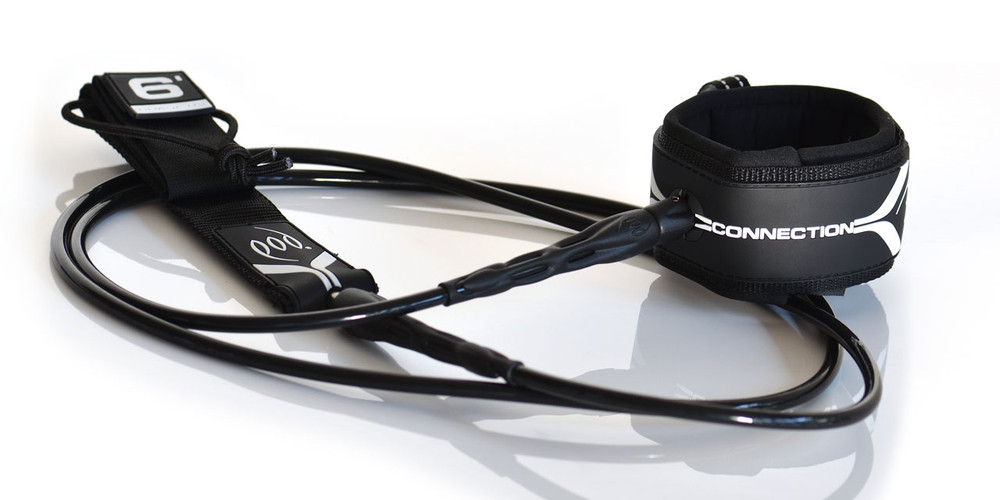
Surfboard Leash Size Guide - How to Choose and What to Avoid
Posted by POD Team on 31st Aug 2024
Choosing the right surfboard leash matters for every surfer, regardless of experience. A well-matched leg rope keeps your board within reach after a wipeout and reduces risk when paddling back through the break. The mistakes in leash selection are easy to make and just as easy to avoid once you know what to look for.
This guide covers common mistakes, leash sizing, and proper attachment.
Surfboard Leash History and Evolution
A surfboard leash is now considered essential equipment. But where did it come from, and how has it developed?
Early Beginnings
A leg rope was not always part of surfing. When surfers fell off, they swam back to their boards - time-consuming and exhausting until the leash arrived in the early 1970s.
The first surfboard leashes were basic. Surgical tubing or rope attached to the board with suction cups. They snapped regularly, causing boards to rebound dangerously toward the surfer.
1971 Innovation
Pat O'Neill, the son of surf accessories pioneer Jack O'Neill, came up with the idea of using urethane and invented the urethane leash known on surfboards today - a cord that was strong and stretchy. This allowed surfers to stay connected to their boards without the constant risk of the leash breaking under load.
The innovation sparked debate in the surf community. Some purists argued that using a leash was "cheating" and detracted from the skill of surfing. The leash's convenience and safety soon won over most surfers.
Improvements Over Time
In the 1980s, Peter Clarke, former owner of Full Bore, pioneered the first swivel connector by over-moulding it onto a urethane cord.
As years passed, leash design continued to improve. Manufacturers experimented with different materials and construction methods to build more durable, more comfortable equipment.
POD developed an advanced leash connection that prevents the swivel connector from over-spinning when the cord is stretched. The over-moulded POD connectors allow the 7mm cord to stretch up to six times its original length without twisting, maintaining full strength and flexibility throughout the entire range of motion.
Key improvements across the industry over time:
- Velcro straps: Early leashes had basic attachments. Padded non-slip neoprene cuffs with Velcro straps significantly improved security and comfort at the ankle.
- Swivels: Adding swivels to either end of the leash reduced tangling. Even a single swivel prevents the two parts from locking up - a common problem with early models.
- Materials and components: Modern leashes use high-quality urethane cord with well-designed end connectors that stretch in unison with the cord. This combination improves reliability and reduces the risk of snapping under stress.
The Modern Leash
Today's surfboard leashes are available in various lengths and thicknesses to suit different boards and wave conditions. Some features have quick-release mechanisms for added safety in big-wave situations.
The once-debated piece of equipment is now considered standard for surfing safety and enjoyment. Its evolution from surgical tubing to precision-engineered urethane cord reflects how much a simple idea can improve with consistent refinement.
What is a Surfboard Leash?
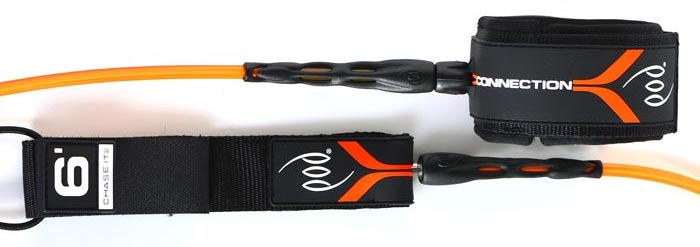
The leg rope connects at an ankle cuff - typically padded neoprene with webbing and a Velcro strap. The other end is the rail saver, which connects via a cord tied to a plug at the tail of the surfboard.
The two main functional components are the swivels and moulded connectors at each end of the urethane cord.
Benefits of Using a Surfboard Leash
The primary purpose of a leash is to keep your board within reach after a wipeout, rather than letting it wash to shore or onto the reef. Here are the key benefits:
Safety
- Prevents injury: A leash keeps your board from becoming a projectile in the surf, reducing risk to yourself and other surfers around you.
- Saves energy: Swimming after a runaway board in rough conditions quickly depletes energy. A leash keeps your board close and your energy where it belongs.
- Quick recovery: After a wipeout, a quick tug returns your board so you can remount and get back into position.
Performance
- Maintains position: Keeping your board close means you stay in the lineup rather than swimming to retrieve it after every wave.
- Consistent practice: Less time chasing your board means more time surfing and improving.
- Confidence in the water: Knowing your board stays with you allows you to commit to waves and manoeuvres without holding back.
Common Mistakes When Choosing a Leash
Leash selection looks straightforward, but a few consistent mistakes affect performance and safety. Here's what to watch for.
Choosing the Wrong Length
A leash that's too short restricts your movement. One that's too long creates unnecessary drag and can become a hazard in crowded breaks.
- Board size: Match leash length to board length. A 6-foot board pairs with a 6-foot leash.
- Wave conditions: Smaller waves can work with a shorter leash. Larger surf benefits from more length - it gives you more separation from the board on a wipeout.
- Stated length: This is consistently overlooked. A quality leash's stated length should reflect the urethane cord plus the end swivel connectors. The rail saver and tie cord should exceed the overall stated length. Some brands reduce the urethane cord length to cut costs, then count all components in the total, so the cord itself is shorter than advertised.
Ignoring Thickness
Leash thickness affects both durability and drag.
- 7-8mm leashes: More durable and better suited to larger, more powerful surf, where the cord takes more stress.
- 6mm competition leashes: Less drag, making them suited to small waves and high-performance surfing. They won't hold up as well in heavier conditions.
Match the thickness to your typical wave conditions rather than defaulting to the thinnest option available.
Overlooking the Rail Saver
The rail saver prevents the urethane cord from cutting into the rail of your board. It's a small component with a direct impact on board longevity.
- Construction: Look for a triple-wrap fold of Velcro and webbing. This keeps the leash cord securely against the rail, preventing it from moving or slipping.
- Length and width: The POD Rail Saver is 200mm long by 38mm wide - sized to distribute load across the rail rather than concentrating it at a single point.
- Quality: A poorly made rail saver comes loose under surf pressure, exposing the board rail to cord damage. It's worth checking before purchase.
Underestimating Material Quality
The material of a leash determines how long it lasts and how it performs under stress.
- Extruded urethane: Flexible, strong, and responsive to stretch and return. The correct choice for a reliable leash cord.
- Injection-moulded urethane: Less responsive to stretch. Not the same performance under repeated load.
- Velcro straps: Test the hook-and-loop by pulling it apart. Weak Velcro is immediately apparent and a reliable indicator of the leash's overall quality.
- Stitching and seams: Check these on the cuff and rail saver for any signs of poor construction before purchasing.
Neglecting the Swivel Mechanism
A poor swivel leads to tangling, which is both frustrating and dangerous in the water.
- Dual swivels: One at each end of the leash gives the best protection against tangling through the full range of movement.
- Single-piece vs two-piece swivels: Two-piece swivels can seize under saltwater exposure and corrosion. Single-piece swivel shafts rotate within a plastic housing, maintaining smooth rotation over time.
- End connectors: Well-designed connectors stretch in unison with the urethane cord. This prevents stress concentration at the connection points - the most common location for leash failure.
Ignoring Cuff Comfort and Fit
An ankle cuff that fits poorly will cause discomfort long before the session ends.
- Comfort: A padded, non-slip neoprene cuff evenly distributes pressure around the ankle and stays in place without irritating the skin.
- Velcro closure: The hook and loop closure needs to hold firmly under the stress of a wipeout. Cheap Velcro releases under load - exactly when you need it most.
Choosing the Right POD Leg Rope
Selecting a leash starts with understanding how and where you surf.
Wave Size and Surfing Style
- Small to moderate waves: A 7mm urethane cord leash matched to your board length handles most everyday conditions reliably.
- Larger surf: An 8-9mm cord provides the extra strength needed when the leash takes more force on a wipeout.
- Performance surfing: A thinner leash reduces drag and suits quick, precise surfing in smaller conditions.
- Longboarding: A standard or thicker leash provides a more reliable hold for the longer board and the different riding style.
Leash Length - The Matching Rule
Match leash length to board length. A 7-foot board pairs with a 7-foot leash. A longer leash provides greater separation between you and the board in larger surf, reducing the risk of impact. A shorter leash reduces drag in smaller conditions.
Getting the length right is the single most important sizing decision. Everything else follows from there.
POD Leg Ropes - Sized for Every Board
POD leg ropes are available in four lengths to match your board and conditions:
- POD 5ft Leg Rope - high performance shortboard surfing in smaller surf
- POD 6ft Leg Rope - the all-rounder for everyday shortboard conditions
- POD 7ft Leg Rope - mid-length and power surf applications
- POD 8ft Leg Rope - longboard and bigger wave conditions
Material and Component Quality
- Urethane cord: High-quality extruded urethane with connectors that stretch in unison with the cord. Strength and flexibility work together rather than against each other.
- Velcro straps: Strong hook and loop that holds under load. Test it before purchasing.
- Brand reliability: Choose brands that back their leash construction with real water testing, not just specification sheets.
How to Tie a Surfboard Leash Cord
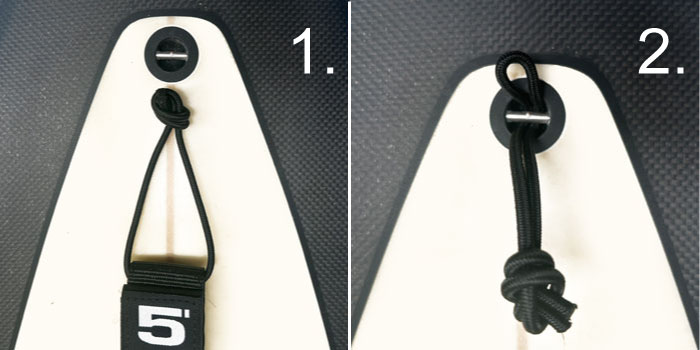
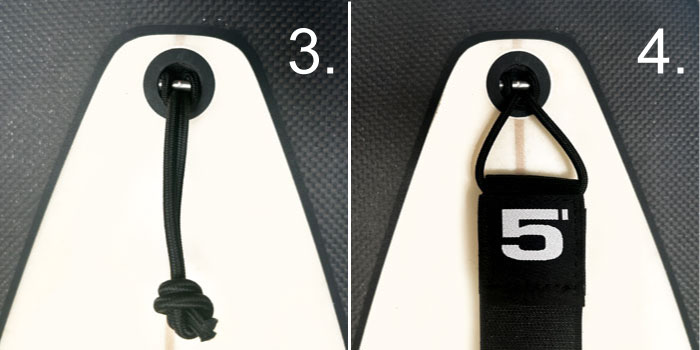
Attaching the leash cord correctly to the surfboard plug ensures a secure connection that won't fail in the surf.
Attaching the Leash Cord to the Surfboard Plug
- Remove the leash cord from the rail saver.
- Thread the cord through the surfboard plug on your board.
- Loop the cord under the stainless steel rod and pull it tight.
- Attach the cord back to the Velcro and webbing rail saver, ensuring it sits snug and won't work loose under load.
Daily Care and Storage
- Rinse after every session: Fresh water removes salt and sand from the cord, cuff, and swivels. Salt build-up accelerates corrosion in the swivel mechanism and degrades the Velcro closure over time.
- Check for wear regularly: Fraying webbing or fin cuts along the urethane cord are clear signs the leash needs to be replaced before it fails in the water.
- Store correctly: Keep the leash out of direct heat and sunlight. UV exposure and heat degrade the urethane cord faster than saltwater alone.
Right Leash. Conditions. Your Choice.
Length, thickness, rail saver quality, swivel construction, and cuff fit all contribute to how a leash performs and how long it lasts. Getting any one of these wrong affects the session - getting them all right means the leash disappears from your attention entirely.
Match the leash to your board and your conditions. Check the components before you buy. A well-chosen leash is one you stop thinking about the moment you paddle out.