
Bodysurfing Speed - The Missing Link Most Riders Miss
Posted by POD Collective on 20th Apr 2026
For years, I wrote about handboard shape, bottom contour, concave, control, stability and how certain configurations improved speed on a wave. That was not wrong. It came from decades of testing in real surf, with and without a board, and from shaping handboards that many riders later described as making them feel more connected to their bodies than anything else they had used.
What I had not yet fully said is this: the board does not create speed on its own.
That is the missing link.
Long before I had access to papers on planing surfaces, trim or how you position your body on the wave, pressure distribution or hydrodynamic loading, I was in the ocean testing what felt right, what held a line, what stalled, what tracked, what splashed back, and what moved in better unison with the hand, arm and body. What I felt through the hand, and how that translated through the board. Years later, when people pointed me toward physics, I realised something important. Much of what I had learned in the water had a sound mechanical explanation.
That matters because bodysurfing is not just about the board. It never was.
It is about how the body, hand, arm, trim and surface work together in motion.
Body position is one of the clearest parts of this system. To explore it further, see Why Body Position Changes Speed in Bodysurfing.
The Earlier Truth Still Stands
Let's be clear. A good handboard still matters. Shape matters. Concave matters. Rail release matters. Hand position matters. A well-designed board can help you hold a cleaner line, reduce wasted drag, improve control and carry speed more efficiently across the wave face.
That is why I have spent so many years refining shape and configuration.
But that is only part of the story.
The deeper truth is that no board, no matter how well shaped, can perform in isolation. Without the hand, the arm, the body and the rider's ability to connect with the wave, it is not bodysurfing. It is just an object moving through water.
Ever Felt Fast - Then Suddenly Stall?
Most bodysurfers have felt it.
You take off clean. For a second, everything feels light, fast and connected. Then the speed disappears. The board feels flat. The nose wants to push down, the line breaks. You slide sideways, your legs crossing over each other, lose hold, or fall off the wave's energy source.
Most people blame the board.
Most brands sell the board as the answer.
But the board is only part of the answer.
The Missing Link
The missing link in bodysurfing speed is your connection to the wave.
That connection is not random. It is a system. A moving relationship between your body, your trim, your control and the surface you are presenting to the water.
Speed comes from that system: body, trim, control and surface.
That single idea changes everything, because it explains why two riders can use the same board and get very different results.
One rider looks smooth, dominant and naturally connected to the wave.
The other looks slower, less settled, less comfortable on the wave, and more reactive. The board has not changed. The difference is how the rider drives it.
Why the Same Board Can Perform Differently
I have seen this in the water for years. Two bodysurfers can ride the same board, in the same surf, and one of them will clearly have the upper hand. They look more in command, more connected, more dominant on the wave.
That difference does not come down to marketing. It comes down to how the rider loads, trims and presents the body to the wave.
It is no different to surfing. Two surfers can ride the same size board, yet one will make that board come alive while the other struggles to unlock the same speed, hold and flow.
The same applies in bodysurfing.
Body Length Changes the Equation
I used to bodysurf with a friend who was over 185 cm tall, while I am around 173 cm. I used to call him the human Mini Malibu. It was not a joke without meaning. His extended reach, longer arm line and greater body length changed the physics of how he connected with the wave.
He could often engage the wave earlier than I could. His longer leading line through hand, arm and body gave him an advantage in certain take-offs and sections, especially on longer rolling waves, just like a longboard compared to a shorter surfboard. He effectively had more usable planing length in motion.
That is not theory for theory's sake. That is what happens in the ocean.
Body length, reach, mass distribution and timing all influence how early you engage, how cleanly you trim and how much speed you can hold once the wave begins to run.
Where Anatomy and Mechanics Matter
You don't need to reduce this to a simple comparison between men and women. The better way to understand it is through body mechanics.
Different riders apply force differently.
- Some carry more of the load through the chest and shoulders.
- Some drive more effectively through hip position and leg bend.
- Some naturally hold a cleaner leading arm line.
- Some have better sensitivity in trim and pitch correction.
- Some connect with the wave earlier and more naturally.
These differences affect how the rider loads the board, how the body sits in the water and how the rider controls speed, hold and release.
So yes, anatomy matters. But anatomy matters because it changes mechanics, not because one group is universally better than another.
What Actually Creates Bodysurfing Speed
If you want to understand bodysurfing speed properly, you need to stop looking at the board as the sole source of performance and start looking at the full system.
1. Body
The wave is not just carrying your body. It is part of the hydrodynamic system, which is how your body works with the water. Your torso, shoulders, hips, and legs all influence the wetted area, drag, lift distribution, and stability.
2. Trim
Trim is one of the biggest keys to speed. With or without a board, head position, chest height, rib pressure, hip angle and leg bend all change how the body meets the water. Small changes in trim can mean the difference between a clean glide and a sudden stall.
3. Control
The leading arm and hand are not passive; they act as control surfaces. They guide the angle, manage pressure, and help the rider make constant micro-adjustments as the wave changes shape beneath them.
4. Surface
The handboard refines the leading surface. It can make that interface more stable, more repeatable and more efficient. But it still depends on the rider to load it correctly and work in unison with the rest of the body.
That is why speed comes from body + trim + control + surface.
The Human Hydrofoil
Years ago, after bodysurfing Bondi Beach, a friend introduced me to a pilot and engineer. I had already shaped and tested what felt right in the water, refining handboard designs through instinct, repetition and real conditions.
That day, for the first time, someone explained why it worked.
He sketched it out. Lift, drag, angle, surface. What I had learned through feeling in the ocean had a mechanical explanation. The body was not separate from the board. It was part of the system.
That moment stayed with me.
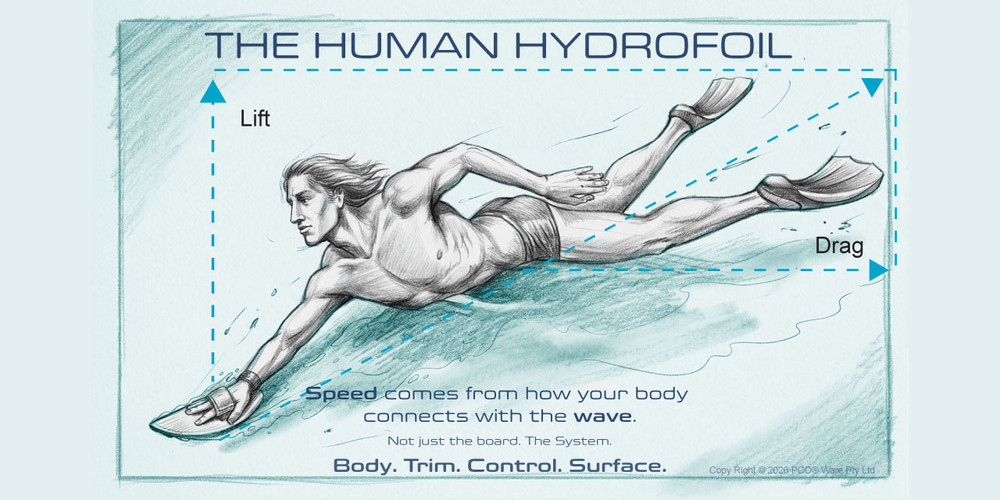
What we are really doing in bodysurfing is closer to a human hydrofoil. The body, the leading arm, the hand and the board all work together to create lift, manage drag and control direction across the wave.
Speed does not come from the board alone. It comes from how the body connects, trims and moves with the water.
Original field sketch illustrating lift, drag, and body position, a moment where real-world experience met mechanical understanding.
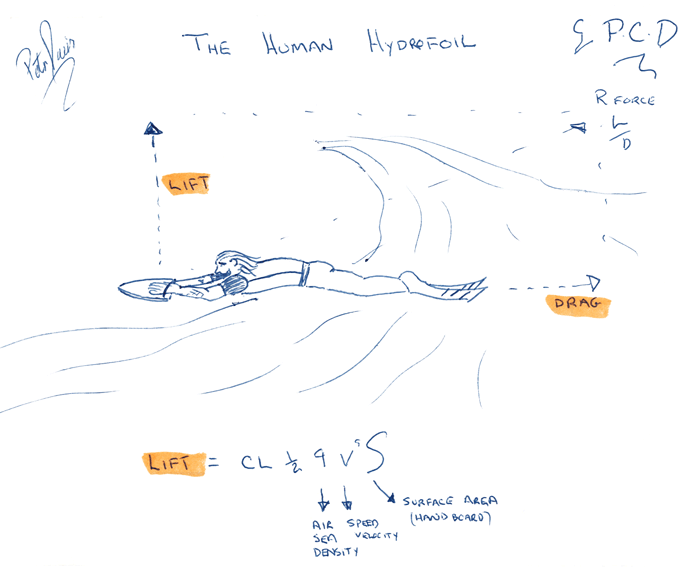
Lift, drag and body position working together. The body is not separate from the board, it is part of the system.
It confirms why two riders on the same board can look completely different. One is working with the wave, reducing drag and holding a clean line. The other is out of sync with it.
The difference is not the board.
The difference is how the rider drives it.
The Board Alone Does Not Create Speed - It Helps You Hold and Control It
This is where many explanations go wrong.
A handboard does not magically create speed out of nowhere. What it can do is help stabilise the leading surface, improve pressure management, reduce wasted drag and make a good line easier to hold and repeat.
That is a very important role. But it is not the whole story.
When the system is aligned, the board feels alive. It tracks. It holds. It settles. It feels like it belongs there.
When the system is misaligned, even a good board can feel flat, awkward or overworked.
Why Some Riders Feel Naturally Connected to the Ocean
Over the years, one thing became obvious to me. Some people naturally connect with the ocean at a different level. They instinctively find better timing, cleaner trim and more useful body position, with or without a board.
That instinct matters.
The board can sharpen it. It can reward it. It can amplify it.
But it cannot replace it.
That is why bodysurfing remains such a pure form of wave riding. The equipment can help, but the rider still has to feel the wave, read the energy and move with it.
How This Changes the Way We Think About Handboards
This shift in thinking changes how we view handboards, or handplanes, and how they perform in the water. It strengthens the role they play.
Once you understand that the board is part of a larger system, better design becomes even more important. The aim is no longer to make a board that looks functional in isolation. The aim is to shape a board that works in unison with the hand, arm, body, and wave.
That has always been the deeper goal behind POD handboard design.
Not just a board with lift, control and speed on paper.
A board that feels connected to the rider in motion.
The POD Connection
Across the broader POD system, the thinking has always been bigger than any one piece of equipment.
POD is built around the human-ocean connection, with performance systems engineered for feet, hands, eyes, the body, and the board. That logic only makes sense when you understand that wave performance is not isolated. It works as one integrated system.
Swim fins, handboards, goggles and other equipment each play a role, but none of them replaces the body. They support it. They refine it. They help the rider work more efficiently with the ocean rather than against it. It's an aid to assist you.
The Difference Is How You Drive It
If you have ever wondered why one rider looks effortless on a wave while another struggles on the same equipment, this is why.
The difference is rarely just the board.
The difference is how the rider drives it.
The rider who understands body position, trim, control and surface will almost always unlock more speed than the rider who sees the board as the whole answer.
That is the missing link most riders miss.
What the Water Taught Me First
For years, I shaped and tested handboards by feel, by feedback, by failure, by adjustment and by time in the ocean. Later, the physics gave language to much of what the water had already taught me.
That does not make the lived experience less valuable. It makes it more valuable.
Because the best equipment does not come from theory alone, it comes from understanding how real bodies move through real water on real waves.
And that is the point.
Bodysurfing speed does not come solely from the board.
It comes from how your body connects with the wave.
Speed comes from body + trim + control + surface.
That is the missing link.
Continue reading: