
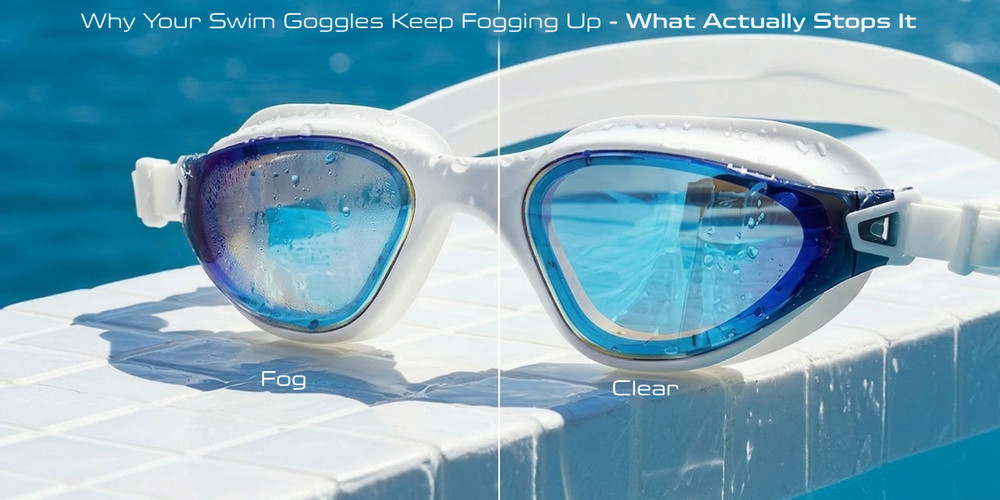
Why Your Swim Goggles Keep Fogging Up - What Actually Stops It
Posted by POD Collective on 29th Mar 2026
Maintaining clear vision in the water is essential for performance, spatial awareness, and confidence. When goggles fog, the interruption to your rhythm is immediate; you lift your head more often, drift off your line, and lose the connection to your environment. To manage fogging effectively, you must look beyond temporary fixes and understand the lens's physics and the environment in which it operates.
Fogging is a predictable result of temperature differentials. When warm, moist air from your face meets the lens's cooler surface, it reaches the dew point. This causes moisture to condense into thousands of microscopic droplets that scatter light, creating the haze you see. Every solution comes back to managing two variables: the temperature difference between your skin and the water, and the amount of moisture trapped inside the seal.
The Physics Rule: Fogging is driven by the interaction between your body heat and the water temperature. Managing this thermal exchange is the only way to maintain consistent clarity.
The Role of Hydrophilic Coatings
Most high-quality goggles are manufactured with a hydrophilic coating. The term hydrophilic literally means water-loving. Unlike a standard surface where water beads into droplets, a hydrophilic surface attracts water, forcing it to spread out into a flat, transparent film. As long as this layer remains intact, you see through the moisture rather than the fog.
At POD, we follow the Mechanical Truth principle: we do not use shortcuts or tiered quality levels for our optical coatings. Whether you are training in a pool or swimming in the ocean, the hydrophilic layer is built to a single universal standard for performance and longevity.
Why Most Goggles Fog Faster Than Expected
Even premium goggles can fail if the delicate hydrophilic layer is compromised. Common actions that inadvertently reduce clarity include:
- Internal Friction: Rubbing or wiping the inside of the lens, even with a soft cloth, micro-scratches the coating and strips away its water-loving properties.
- Thermal Shock: Rinsing your goggles with hot water can cause the coating and the silicone seal to expand and degrade prematurely.
- Trapped Humidity: Fitting your goggles while your face is dripping wet traps a high-humidity microclimate inside the lens, instantly overwhelming the anti-fog layer.
How to Manage Fogging with Discipline
You cannot change the laws of physics, but you can manage them with a consistent routine:
1. The Cool Dip Method
Before putting your goggles on, dip them briefly in the water you are about to swim in. This helps equalise the lens temperature with the water temperature, reducing the thermal shock that leads to condensation.
2. Maintain a Dry Seal
Try to keep the skin around your eyes relatively dry when first fitting your goggles. A dry seal prevents excess moisture from being trapped inside the air pocket before you start your first lap.
3. Use Fresh Water Rinses
After every swim, especially in chlorine or saltwater, rinse your goggles gently with cool, fresh water. Salt crystals and pool chemicals are abrasive; removing them protects the integrity of the factory coating.
Pool vs. Ocean: Changing Conditions
Your environment dictates how fogging behaves. In indoor pools, high ambient humidity can make condensation feel more persistent. In the ocean, you contend with shifting water temperatures and the abrasive nature of salt. In open water, clarity is not just about comfort; it is a safety requirement for sighting and navigation. Our gear is designed based on experience in these demanding Australian conditions since 1988, ensuring reliability where it matters most.
When it is Time to Replace Your Gear
Eventually, every coating reaches its limit. If fogging occurs within the first 50 metres regardless of how well you maintain the lenses, or if the optics appear dull after rinsing, the hydrophilic layer has likely worn away. At this stage, you are no longer fighting physics; you are fighting worn-out materials. Replacing your gear ensures you stay focused on your stroke rather than your equipment.
Not just seeing the water, but staying connected to it.