
Mirror vs Clear Swim Goggles - When Each Actually Works
Posted by POD Collective on 3rd Jun 2026
Most people choose swim goggles based on how they look. The lens colour, the frame, the mirror finish. What matters more is whether the lens matches the light you are swimming in.
The wrong lens does not fail immediately. It works against you gradually. Squinting, tension, and reduced clarity over time. The right lens removes that load and keeps your vision consistent throughout the session.
The primary objective of any swim lens is to manage how much light reaches the eye.
Clear lenses allow the maximum amount of light to reach the eye.
Tinted and mirror lenses reduce light, but in different ways. Tint controls brightness without reflection. Mirror coatings reflect high-intensity light away from the eye.
Not all light-reducing lenses behave the same. Each suits different conditions in the water.
Understanding this distinction allows you to maintain total clarity regardless of whether you are in a dimly lit indoor pool or facing the high-glare environment of an ocean swim. POD does not tier its optics. Every lens option in the AquaLuxe range is manufactured to the same standard for clarity and protection.
The Functional Difference Between Clear and Mirror Lenses
Clear and mirror lenses manage environmental light through two distinct mechanical processes. Clear lenses provide a natural, unfiltered view of the water. They are the benchmark for low-light or controlled indoor environments where visibility must remain bright and consistent. They do not filter light. They simply protect the eyes while maintaining maximum transparency.
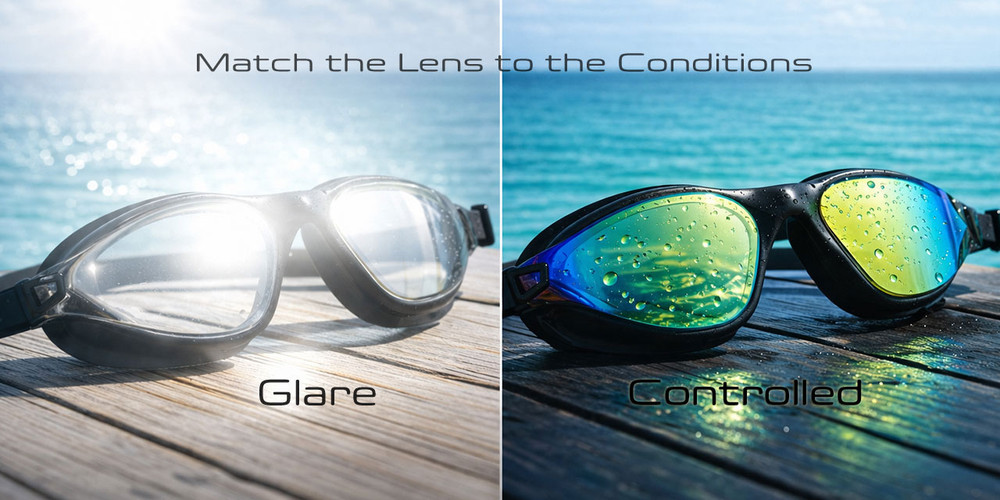
Mirror lenses use a thin metallic coating applied to the outer surface of the lens. This layer reflects high-intensity light away from the eyes before it can pass through the lens. This reduction in brightness helps mitigate harsh reflections in outdoor settings. The core difference is a choice between light transmission and light reflection.
Use clear lenses to enhance vision in low light. Use mirror lenses to reduce glare in bright conditions. If you are squinting, the lens is not reducing enough light. If you are struggling to see the bottom, it is reducing too much.
How Lens Choice Affects Eye Fatigue
Lenses do more than alter brightness. They change how your brain perceives detail. When you swim in bright sunlight with clear lenses, the ciliary muscles in your eyes must constantly work to manage glare. This leads to eye strain and a loss of focus over longer sessions. Mirror and tinted lenses allow these muscles to remain relaxed, which is important during open-water swimming, where you must frequently sight landmarks against a bright horizon. Reducing this physiological strain allows you to remain relaxed and connected to your stroke.
Understanding Tint and Mirror Colours
The colour of a tinted or mirror lens changes how glare, contrast, and brightness are managed in the water. Different lenses behave differently under different light conditions, which is why lens choice should match the environment rather than appearance alone.
- Clear lenses - allow maximum light transmission. They perform best in low-light, indoor, or night swimming where visibility needs to stay bright and natural
- Tinted lenses - reduce overall brightness without a reflective coating. They suit mixed-light conditions where the water is bright but glare is not extreme
- Blue mirror lenses - reduce surface glare while keeping a natural colour balance. They work well in bright outdoor pools, open water, and conditions where reflected light affects visibility
- Green mirror lenses - help maintain balanced visibility as light conditions change. Suited to overcast sessions, shifting cloud cover, and open-water environments where light and surface texture vary throughout the swim
- Gold mirror lenses - soften strong sunlight while improving warmth and contrast. They help with sighting in open water, especially when glare, reflection, and changing colours make distance markers harder to read
- Silver mirror lenses - provide the strongest glare reduction for prolonged exposure in highly reflective conditions. Suited to harsh sunlight, midday outdoor swimming, and long sessions where eye fatigue becomes a factor
Matching the Lens to the Conditions
A lens is not just a colour choice. It is a filter that changes how your eyes manage light in the water.
Clear vision also depends on maintaining the internal anti-fog surface, which works together with the external lens coating to help manage visibility throughout the session.
No single lens suits every condition. Clear lenses keep vision bright in low light, tinted lenses reduce brightness without reflection, and mirror lenses help manage glare when surface light becomes harder to control.
The right lens is the one that matches your time in the water, the light around you, and the conditions you move through.
When Clear Goggles Work Best
Clear lenses perform best when the ambient light is limited or highly controlled. They are the right choice for indoor pools, early morning training sessions before sunrise, and late afternoon swims. Because they offer no colour distortion, they provide the sharpest possible view of the pool floor and lane markings. In these environments, using a mirror lens is counterproductive as it artificially dims your surroundings and can compromise your safety and spatial awareness.
When Mirror Goggles Work Best
Mirror lenses suit high-glare, reflective environments. This includes outdoor pools where the sun reflects off the tiles and open water swimming where light bounces off the surface of the chop. By reflecting light away, mirror lenses let you see through surface sparkle and maintain a clear view of what is ahead. In the Australian sun, a mirror lens is not optional. It is a tool for both comfort and protection, which one POD has understood through ocean testing.
The Environment - Pool vs Ocean
The environment dictates your requirements. In a pool, lighting is consistent, and surface glare is minimal, making clear or light-tinted lenses the standard. In the ocean, conditions are dynamic. You are dealing with changing light levels, wind-induced surface texture, and direct sunlight. In open water, managing glare is as important as maintaining a seal. It helps you navigate safely and stay connected to the water's movement.
Unified Performance in Every Lens
POD AquaLuxe goggles are built around a single balanced goggle body with multiple lens configurations for different lighting environments. The fit, seal, and overall construction remain consistent across the range, allowing the lens to match conditions without altering the goggle's feel.
Whether you are swimming indoors, training at sunrise, managing surface glare in open water, or spending long periods under harsh Australian sunlight, each lens performs under specific conditions while maintaining the same reliable fit and visibility.
To maintain long-term optical clarity and protect the integrity of the lens coating, always rinse goggles with fresh water after swimming and avoid wiping the inside of the lens while wet.
Match the Lens to the Light
- AquaLuxe Clear Lens Swim Goggles - low light, indoor pools, and maximum visibility
- AquaLuxe Tinted Lens Swim Goggles - mixed light and moderate brightness reduction
- AquaLuxe Blue Mirror Swim Goggles - surface glare and bright outdoor swimming
- AquaLuxe Green Mirror Swim Goggles - changing light and balanced visibility
- AquaLuxe Gold Mirror Swim Goggles - strong sunlight and enhanced contrast
- AquaLuxe Silver Mirror Swim Goggles - intense glare and prolonged outdoor exposure