

Bicep vs Wrist Bodyboard Leash - Which One Stays Out of Your Way
Posted by POD Collective on 17th Aug 2024
Bodyboard Leashes - Bicep or Wrist, Which Works Best for You?
A bodyboard leash - sometimes called a boogie board leash - is one of the most important pieces of equipment you carry into the surf. It keeps your board within reach after every wipeout, so you spend more time riding and less time swimming after your board.
The choice between a bicep and wrist leash comes down to riding style, wave conditions, and personal comfort. This article covers both options clearly so you can choose the right setup for your bodyboarding.
If you already know what you need, browse the POD Bodyboard Leashes and Plugs range directly.
What Is a Bodyboard Leash?
A bodyboard leash - also known as a boogie board leash - connects you to your board so you do not lose it in the surf. Whether you are a beginner or an experienced rider, the right leash keeps your session safer and more efficient.
Why a Leash Matters in the Water
A bodyboard leash keeps your board connected to your body during wipeouts. Without one, a wave can carry your board away from you, leaving you separated from your flotation in moving water. A leash also saves energy across longer sessions - you spend less time chasing your board and more time riding waves. For beginners, it removes one of the most common frustrations of learning in the surf.
- Safety - without a leash, a wipeout can send your board into the current, leaving you to swim after it in conditions that may be working against you. A leash keeps the board close and reduces that risk
- Convenience - you get back on the board faster after a wipeout. Less time retrieving means more time on waves
- Confidence - knowing your board stays with you lets you commit to waves and manoeuvres without holding back
Types of Leashes
- Bicep leash - fits around the upper arm above the elbow. Offers more freedom of movement during paddling. Preferred by many experienced riders in larger surf
- Wrist leash - attaches to the wrist. Easier to put on and take off. A practical choice for beginners and those who prefer a straightforward setup
- Coiled leash - the cord coils like a spiral, staying compact until stretched. Reduces drag in the water
- Straight leash - a non-coiled cord that provides predictable movement. Less likely to tangle but may create more drag depending on length
Bicep Leashes
Bicep leashes are popular among riders who want reduced drag and more freedom of movement through the paddle stroke.
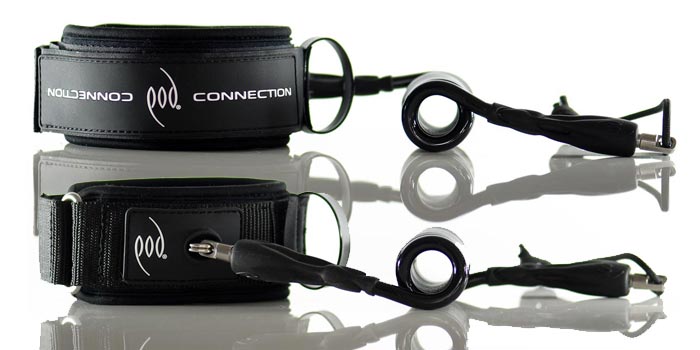
Design and Features
A bicep leash sits around the upper arm just above the elbow. A padded neoprene non-slip cuff provides a snug, comfortable fit. The cuff connects via leash connectors to a coiled or straight urethane cord tethered to the board.
- Padded cuff - non-slip neoprene padding keeps the cuff in place and reduces discomfort during extended sessions
- Adjustable strap - velcro and webbing straps allow the fit to be adjusted for different arm sizes
- Durable materials - handles repeated saltwater exposure without degrading
- Swivels - prevent tangling during use
- Leash connectors - reduce cord stretch and lower the risk of the urethane cord snapping at the connection points
Advantages of Bicep Leashes
- Increased mobility - the leash sits higher on the arm and stays clear of the paddle stroke, giving more freedom of movement through each stroke cycle
- Reduced drag - positioned above the elbow, the leash sits closer to the body and creates less resistance through the water
- Comfort over long sessions - the padded cuff distributes pressure across a wider surface area, avoiding the concentrated tightness that can develop at the wrist
- Better for performance riding - for riders performing tricks and advanced manoeuvres, the bicep leash stays out of the way and allows more controlled movement
Disadvantages of Bicep Leashes
- Fit sensitivity - a cuff that is too tight can restrict circulation in the upper arm, leading to numbness or discomfort during longer sessions
- Not for every body type - riders with larger or more muscular arms may find the positioning and tightness uncomfortable depending on the cuff design
- Adjustment period - beginners switching from a wrist leash may need time to get used to the feel and positioning of a bicep leash
Wrist Leashes
Wrist leashes are a reliable choice - particularly for riders who want a simple setup or are newer to bodyboarding.

Design and Features
Wrist leashes attach around the wrist, securing the board to your arm with a padded cuff and adjustable strap.
- Padded neoprene cuff - reduces chafing and provides a comfortable fit across a range of wrist sizes
- Adjustable strap - velcro straps allow quick adjustment for a snug, secure fit
- Coiled or straight leash - available in both cord types to suit different preferences
- Moulded connectors - better quality wrist leashes use moulded ends rather than tied ends, which are more likely to loosen over time
- Swivel mechanism - reduces tangling during use
Advantages of Wrist Leashes
- Ease of use - quick to put on and take off. Practical for beginners and experienced riders alike
- Quick release - many wrist leashes include a quick-release loop for fast detachment when needed
- Comfort at the wrist - the wrist is less pressure-sensitive than the upper arm for many riders. A well-fitted neoprene cuff sits comfortably without cutting off circulation
- Versatility - works across a wide range of conditions and skill levels. A practical option for riders who want a reliable connection without adjusting their setup
Disadvantages of Wrist Leashes
- Increased drag - a leash attached at the wrist sits lower on the arm, creating more resistance during the paddle stroke
- Paddle interference - the leash can interfere with the stroke cycle, particularly in larger surf where precise paddling matters
- Tangling - despite swivel mechanisms, wrist leashes can still tangle in more turbulent water
Choosing Between a Bicep and Wrist Leash
Your wave environment and riding style are the two most useful filters for this decision. Both leashes work - the question is which one works better for how and where you surf.
Personal Preferences and Riding Style
- Comfort and fit - some riders find the bicep position more comfortable because it distributes pressure across the upper arm. Others prefer the simplicity and familiar feel of a wrist leash
- Performance riding - if you are working on tricks and advanced manoeuvres, a bicep leash keeps the cord out of your way during movement
- Newer riders - a wrist leash is easier to manage and adjust, which makes it a practical starting point
Wave Conditions and Environments
- Small to medium waves - wrist leashes are reliable in these conditions. Drag is less of a factor and the setup is straightforward
- Larger or more powerful surf - a bicep leash offers better mobility and is less likely to tangle in turbulent water, both of which are useful when conditions demand more from you
- Crowded breaks - a bicep leash sits closer to the body, reducing the chance of the cord catching on other surfers or obstacles in busy conditions
Practical Tips
- Try both - if you have access to both leash types, testing them in the water gives you a more reliable feel than any guide can
- Talk to other bodyboarders - riders who surf similar conditions will have direct experience with what works in those waves
- Check fit carefully - a leash that fits correctly is more comfortable and causes less distraction in the water. Check the cuff sizing and adjustability before committing.
How to Fit a Bodyboard Leash Plug
Attaching a leash to your bodyboard correctly keeps it secure and prevents damage to the board. Follow these steps carefully.
Find the Right Spot for the Plug
Most standard boards come with a pre-installed plug, usually located 15 to 20 cm down from the nose. If your board does not have one, consult a bodyboard specialist to pre-drill and install the plug correctly.
Before drilling, check your stringer position. Bodyboards can have single, double, or triple stringer configurations. The diagram below shows the three stringer types and the recommended plug position for each, highlighted in green.
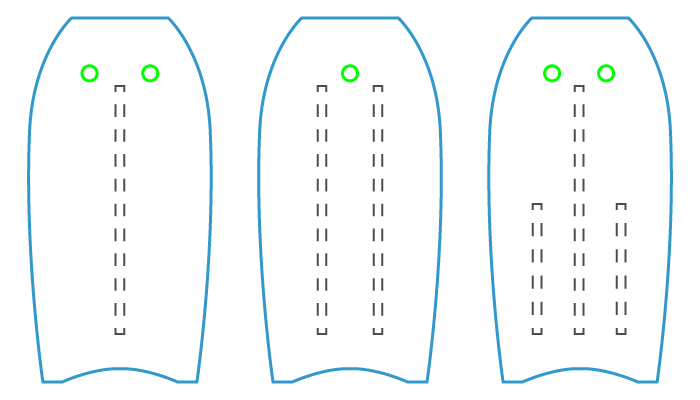
The position of the plug - left or right side - should reflect which arm you wear your leash on.
- Measure and mark: measure 15 to 20 cm down from the nose, then mark the centre point. This is your installation spot
- Avoid the stringer - keep the plug at least 10 to 15 cm away from the stringer. Drilling into the stringer can damage the board's internal structure
Install the Leash Plug
If your board already has a plug, skip this step.
- Drill the hole - use a drill bit smaller than the plug bolt. Work slowly to avoid damaging the board
- Insert the plug - push both halves of the plug into the hole from each side of the board. Align them carefully then press them firmly together
- Secure the plug - tighten the screw to hold the plug in place. Do not over-tighten as this can crack or compress the board material around the plug
Attach the Leash Cord to the Plug
The attachment process is the same for both bicep and wrist leashes.
- Thread the cord - feed the leash cord through the plug until the loop sits tight against the plug
- Secure the loop - pass the leash cuff through the loop at the end of the cord then pull it tight. If the cord is too short, untie the knot, rethread, and retie
- Check tightness - give the cord several firm tugs to confirm the connection is solid before entering the water
Test Your Setup
- Inspect the plug - confirm it is seated firmly with no visible damage or movement
- Tug the leash - apply force to the cord to confirm the attachment holds under load
- Check the cuff - the cuff should sit snugly around your wrist or bicep without restricting circulation
What Are Bodyboard Leashes Made Of?
Understanding leash materials helps you assess quality and choose the right leash for your conditions.
Cord Material
- Urethane - most bodyboard leashes use polyurethane cord. Strong, flexible, and resistant to the stress of repeated wave impact and saltwater exposure
- Coiled urethane - better quality leashes use coiled urethane cord. The coil stays compact until stretched, reducing drag and tangling while keeping the board within range
Cuff and Padding
- Neoprene - a non-slip neoprene cuff is flexible, comfortable against the skin, and provides enough cushioning to prevent chafing over extended sessions
- Velcro webbing straps - allow quick, secure fastening and adjustment across different arm or wrist sizes
Swivels and Connectors
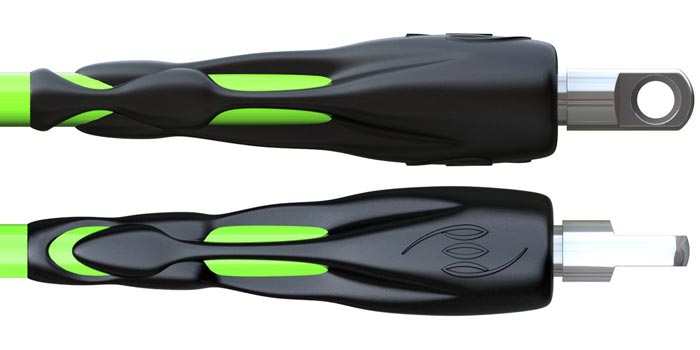
Leash connectors reduce cord stretch and lower the risk of the urethane cord snapping at the connection points.
- Swivels - two designs are common. Two-piece swivels can seize under saltwater exposure and corrosion, causing the cord to tangle. Single-piece swivel shafts rotate within a plastic housing, maintaining smooth rotation over time
Single swivel shaft and plastic barrel housing

Two-piece swivel

POD Connectors - over-moulded stainless steel single-piece swivels that allow the cord to stretch to its full potential without compromising strength or rotation. Constructed to perform reliably across repeated saltwater exposure.
Swivel materials
- 316 marine grade stainless steel - resistant to rust and corrosion in saltwater. Provides smooth, consistent rotation
- High-strength injection moulded PU plastics - used for the connector housing. Keeps weight low while maintaining the structural integrity needed under load
Plugs and Attachments
- Hard resin plastic - bodyboard leash plugs use durable resin that handles the pressure and stress of regular surfing without cracking
- Nylon cord - attachment points use nylon cord for flexibility and wear resistance, keeping the leash firmly connected to the board over time
Overall Construction
The materials used across a leash - cord, cuff, swivels, connectors, and plug - all contribute to how it performs and how long it lasts. A well-constructed leash handles the demands of regular surfing without requiring constant replacement or adjustment.
To understand how leash cord materials behave under load and why construction quality matters, read Why Surfboard Leashes Fail Under Load and Snap and POD Connection - Why Organic Fusion Stops Leash-Twist Tangle.
Bicep or Wrist. Both Work. Pick Your Position.
Bicep leashes give you more mobility and less drag - the right choice for performance riding and larger surf. Wrist leashes are straightforward, easy to use, and reliable across most conditions - a practical option for beginners and riders who prefer a simple setup.
Consider the waves you surf most often and how you ride them. In bigger surf, the bicep leash earns its position. In smaller waves, crowded breaks, or between the flags, a wrist leash does the job cleanly.
Try both if you can. The leash that disappears from your awareness in the water is the one that fits.